Ɛhia
1
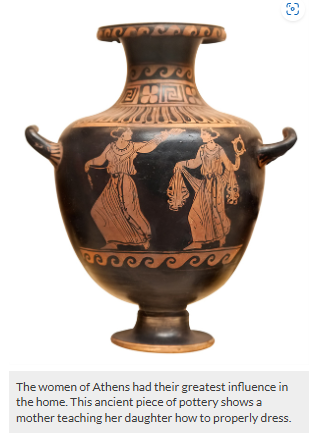
What is being illustrated (shown) on the pottery?
What is being illustrated (shown) on the pottery?
C4.6-8.1
H3.6-8.2
Drag the items below to the correct category. Don't be afraid to go back and reread whatever section you need to.
Might work in the Agora
Could remarry
Might be trained as artisans
Could purchase their freedom
Ran the household and taught rich children
Could own the most property
Might revolt
Had the most rights
Might work 10 hours a day in a dangerous mine
Never went out alone
Managed the household with separate rooms for spinning and weaving
Could be priestesses
Were called helots
Slaves with the most rights
Were forced to do the worst jobs
Were ready to fight
Athenian Slaves
Athenian Women
Spartan Slaves
Spartan Women
Women: Athenian women could not inherit or own much property. They could not vote or attend the Assembly.
A few women held jobs, and some sold goods in the market. A few very important women were priestesses. However, most Athenian women had their greatest influence in the home. They spent their days managing the household and raising their children—the two roles that their society believed women should have. An Athenian wife had separate rooms at home to complete her responsibilities, which included spinning, weaving, and supervising people who were enslaved. She never went out alone. An Athenian mother taught her sons until they were about 6 or 7 and ready for school. She educated her daughters until they were 15 and ready to be married.
What is being illustrated (shown) on the pottery?
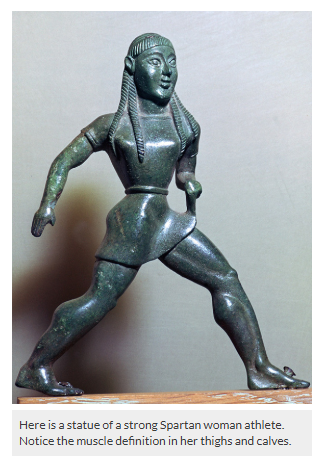
What does this statue demonstrate?
Match the facts below with the correct city-state. Some facts may be true for both city-states, so you may need to check both.
Athens | Sparta | |
|---|---|---|
Women ready to fight | ||
Slaves treated harshly | ||
Women could not go out alone | ||
Women did not dress nicely | ||
Declared war on their slaves | ||
Women who could become priestesses | ||
Slaves called helots | ||
Slaves taught children | ||
Women allowed to talk to husband's friends |
Only men were considered citizens in Athens. Citizenship was not possible for women and people who were enslaved, so they had far fewer rights than free men did.
Women: Athenian women could not inherit or own much property. They could not vote or attend the Assembly.
A few women held jobs, and some sold goods in the market. A few very important women were priestesses. However, most Athenian women had their greatest influence in the home. They spent their days managing the household and raising their children—the two roles that their society believed women should have. An Athenian wife had separate rooms at home to complete her responsibilities, which included spinning, weaving, and supervising people who were enslaved. She never went out alone. An Athenian mother taught her sons until they were about 6 or 7 and ready for school. She educated her daughters until they were 15 and ready to be married.
Which statement below is most true about women in ancient Athens?
According to these paragraphs, who were the most important women?
Click on the word that is a synonym for "impact" Then, click on the synonym for "upbringing." Finally, click on the word that is a synonym for "overseeing." (You need to click on 3)
A few women held jobs, and some sold goods in the
What six statements are true about Athenian women?
In Athens, women were allowed to vote and participate in the Assembly.
Most Athenian women had their main influence within the home and family.
Athenian mothers educated their daughters until they were 15 years old.
Women and Enslaved People in Athens (Part 2)
Enslaved People Many people were enslaved in ancient Athens. Most Athenians who weren't poor enslaved at least one person. Some people were born into slavery, while others were forced into it as captives of war. This was true in many societies in the ancient world.
People enslaved in Athens performed a wide variety of jobs, including tasks that required a great deal of skill. Some ran households and taught Athenian children. A number of enslaved Athenians were trained as artisans. Others worked on farms, in factories, or for the city as clerks.
Some people were enslaved to work in the silver mines, where they might work ten hours a day, in cramped tunnels 300 feet below the surface. They had little air to breathe and were often harshly punished if they stopped to rest. Without machinery to make work easier, people in ancient times resorted to enslaved labor for the worst jobs.
What is the main purpose of this section of text? (These three paragraphs)
Which three statements are true about Athens and slavery?
What six statements below was true of the slaves in Athens?
Click on the word that is a synonym for "forced into labor." Then, click on the synonym for "prisoners." Finally, click on the word that is a synonym for "communities." (You need to click on 3)
Some enslaved people in Athens were trained to be artisans.
Individuals forced into slavery were always born into it in ancient Athens.
In Sparta, women had more rights than other Greek women. Although Spartans who were enslaved had little freedom, they had some rights that Athenians who were enslaved did not.
Women: Spartan women lived the same simple life as Spartan men. They wore plain clothing with little decoration and did not wear jewelry or use cosmetics or perfume. Like Spartan men, women were expected to remain strong and healthy—and ready to fight when needed. A wife was expected to protect her husband's property in times of war. She also had to guard it against invaders and revolts by people who were enslaved.
Spartan women were free to speak with their husbands' friends or express political opinions. Other Greeks even said they ruled over their men. Women could also own and control their own property. They could even marry again, should their first husband be away at war for too long a time.
Which sentence best describes ancient Spartan women?
How were ancient Spartan women different from most women in ancient Athens?
What six statements below were true of Spartan women?
Click on the word that is a synonym for "ordinary." Then, click on the synonym for "beauty products." Finally, click on the word that is a synonym for "attackers." (You need to click on 3)
Spartan women lived the same simple
Spartan women were expected to be strong and healthy like Spartan men.
Enslaved people in Sparta had no rights compared to those in Athens.
Spartan women could manage their own property and express their opinions.
Women and Enslaved People in Sparta (Part 2)
Enslaved People: Spartans who were enslaved, the helots, were people the Spartans had conquered. There were many more helots than citizens in Sparta. The Spartans treated the helots harshly, fearful that the helots would revolt.
Occasionally, the Spartan government declared war on the helots so that any people it thought might rebel could be legally killed. In fact, the Spartan government once asked the helots to choose their best fighters, saying that these people would be set free as thanks for fighting for Sparta. The helots selected 2,000 men. Immediately, the Spartans killed every one of them to eliminate the possibility of any future helot leaders.
Despite this harsh treatment, helots did retain some rights. They could marry whomever and whenever they wanted. They could pass their names on to their children. They could sell any leftover crops after giving their owner his share. Helots who saved enough money could even purchase their freedom.
Click on the word that is a synonym for "sometimes." Then, click on the synonym for "announce." Finally, click on the word that is a synonym for "instantly." (You need to click on 3)
Why did the Spartans kill 2000 helots?
What four statements below are true about helots?
All of these below are rights Sparta's helots had, EXCEPT...
Helots were treated kindly by the Spartans out of fear of a revolt.
The Spartan government once legally allowed the killing of helots to prevent rebellion.
Helots could save money and potentially buy their own freedom.
Athenian women had more rights than Spartan women.
What answer below best shows what Spartan women and Athenian women had in common?
What four answers below are most likely true after reading these two passages.