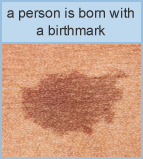
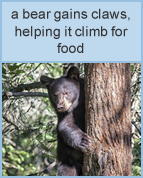
What would happen if organisms of a certain species were not able to reproduce? That species would not be able to exist for more than one generation. Reproduction allows species to exist from one generation to the next by passing on genetic information.
All organisms must reproduce, but not all organisms reproduce the same way. Some organisms reproduce through asexual reproduction. Asexual reproduction is when one organism produces offspring that are identical to itself. There is only one parent in asexual reproduction, so an offspring receives all of its genes from one parent. Some advantages of asexual reproduction are it is efficient and often reproduction is quick. Disadvantages include no variation and no adaptability over generations.
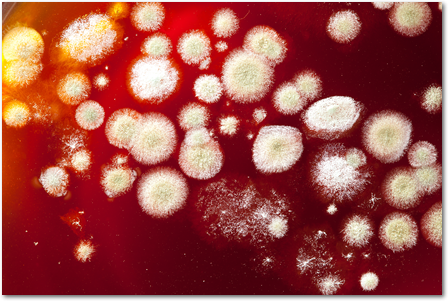
Mold can reproduce asexually through the use of spores.
Asexual reproduction is common among unicellular organisms. However, most multicellular organisms reproduce sexually. Sexual reproduction is when two parents each contribute a sex cell to a new offspring. Sexual reproduction involves meiosis. Offspring that are produced through sexual reproduction are not genetically identical to either of their parents because they receive half of their genes from each parent.
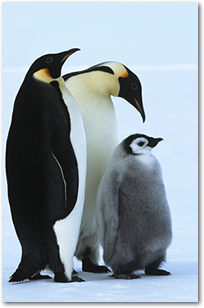
Emperor penguins, like most birds, reproduce sexually.
Required
1 point
1
Question 1
1.
If certain plants reproduce asexual, how will their DNA compare with their offspring?
Required
1 point
1
Question 2
2.
What are some benefits of asexual reproduced crops? (choose 2)
Required
1 point
1
Question 3
3.
Like humans, mangoes have inherited and acquired traits. Choose the correct word for each trait.
sweetness: __________
shelf life: __________
worm hole: __________
size: __________
bruise: __________
Required
1 point
1
Question 4
4.
Choose either sexual, asexual, or both to answer these statements.
2 parents: __________
1 parent: __________
Production of offspring: __________
Clone: __________
Inherited Traits: __________
DNA Diversity: __________
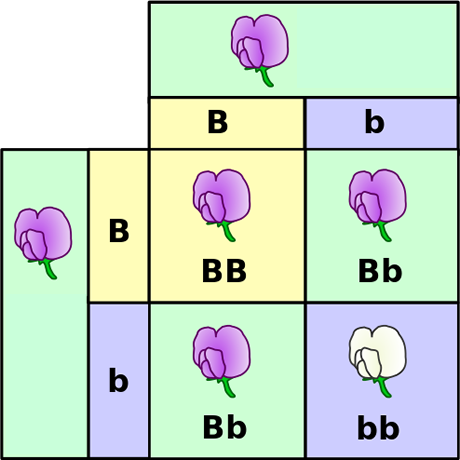
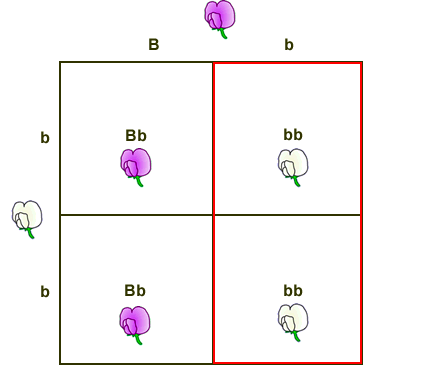
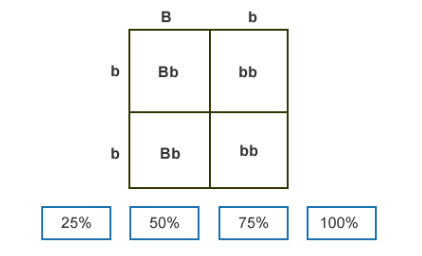
A Punnett square is a chart that shows the likelihood of all of the possible allele combinations that result from a genetic cross. Punnett Squares help show the probability that an offspring will receive a particular combination of alleles. Probability is the likelihood that particular outcomes will occur.
This Punnett square is used to predict the probability of a pea plant producing purple or white flowers.
The top purple flower has allele combination Bb and represents the male genotype. The side purple flower has allele combination Bb and represents the female genotype. Each box in the middle represents a possible allele combination when the two parents are paired. The offspring received one allele from each parent.
The steps of creating Punnett squares:
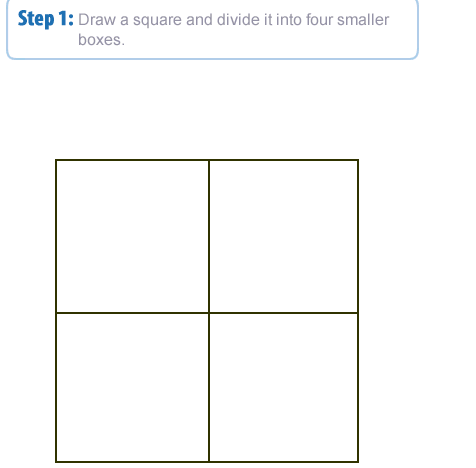
Draw a square and then divide it into four squares.
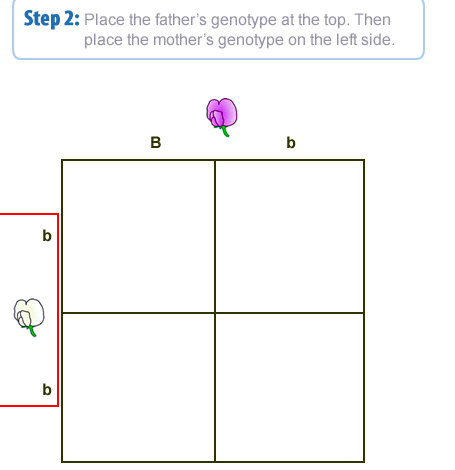
Place the male parent's genotype at the top of the Punnett square with one letter above each box. Place the female parent's genotype on the left side of the square, placing one letter in front of each box.
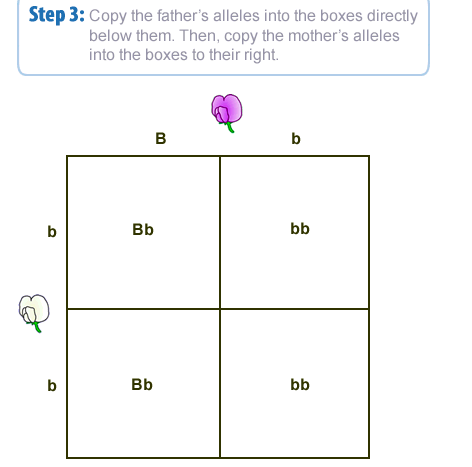
Copy the male parent's alleles into the boxes directly below them. Then, copy the female parent's alleles into the boxes to their right.
The Punnett square shows the probability of offspring these to parents could have. The genotypes would be 50% Bb and 50% bb. The phenotype would be 50% purple and 50% white.
Required
1 point
1
Question 5
5.
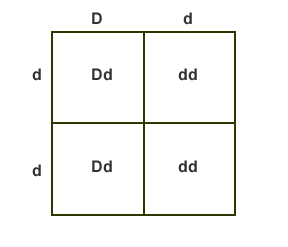
The Punnett square below shows the potential allele combinations for an offspring if one parent has dimples (D), the dominant trait, and the other parent does not (d). Select the genotype below that shows the no-dimples combination of alleles.
Required
1 point
1
Question 6
6.
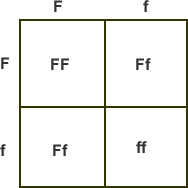
The Punnett Square below shows the potential allele combinations for an offspring whose parents have freckles. Freckles are a dominant trait (F). No freckles are recessive (f). What is the probability that the offspring will have freckles?
Required
1 point
1
Question 7
7.
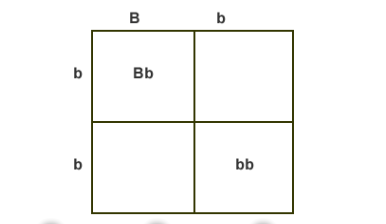
Jack’s genotype for eye color is Bb, meaning that he has brown eyes. Jill’s genotype for eye color is bb, meaning she has blue eyes. Fill in the Punnett square below to see the potential allele combinations for their offspring’s eye color.
Other Answer Choices:
bb
BB
Bb
Required
1 point
1
Question 8
8.
What is the probability of Jack and Jill’s offspring having blue eyes?
Required
1 point
1
Question 9
9.
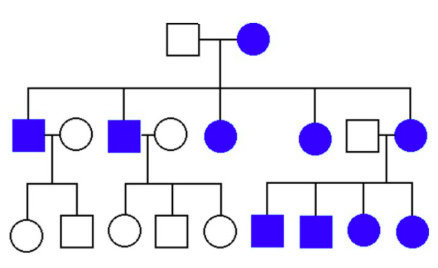
Bobo bugs are either black (B) or brown (b). This is a bobo bug pedigree that shows whether an individual is black (dominant) or brown (recessive).
Identify the genotype of each bug below.
I:1 __________
I:2 __________
II:4 __________
III:3 __________
Natural selection is the process where an organism with helpful traits is likely to have more offspring than an organism without helpful traits.
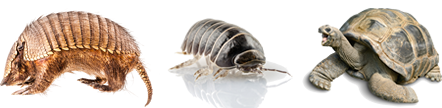
Armadillos, pill bugs, and tortoises all developed shells to keep them safe. For all three organisms, the hard shells are a useful trait that helps keep them alive. They developed the shells through the process of natural selection.
Required
1 point
1
Question 10
10.
Which organism is more likely to have more offspring?
Required
1 point
1
Question 11
11.
According to Darwin’s theory of Natural Selection, the presence of a particular trait in a population will increase if…
Adaptations cannot happen without variation among a population of organisms. Variation is the difference in traits among members of the same species.
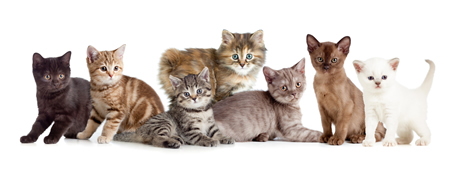
All of these kittens have different traits even though they are all of the same species. This difference in traits is called variation.
Variations happen in a population because of mutations. A mutation is a change in an organism's genes. When an organism's genes change, its traits can change as well. Mutations can happen before birth or during an organism's life.
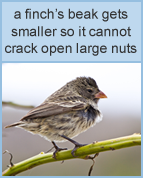
Finch beaks come in many sizes and shapes. Mutations to the genes controlling beak size and shape caused these differences.
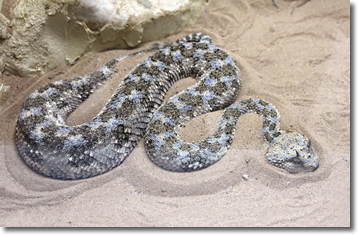
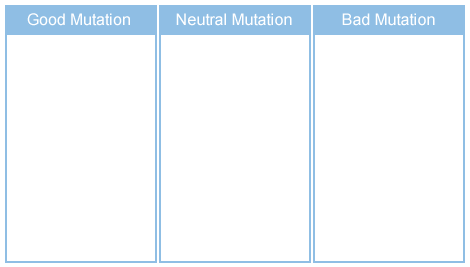
Mutations can be good, bad, or neutral. Good mutations help an organism survive in its environment and can lead to adaptation.
This viper's poisonous venom is an adaptation that came from a good mutation.
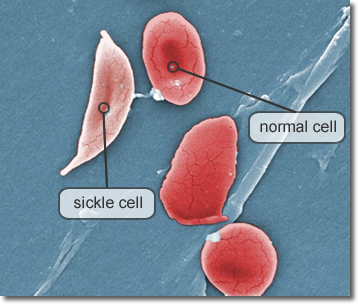
Bad mutations can cause an organism to have a shorter life.
Sickle cell disease changes the shape of red blood cells and can lead to medical problems.
Required
1 point
1
Question 12
12.
Categorize each of these traits as being caused by good, bad, or neutral mutations.
Other Answer Choices:
Required
1 point
1
Question 13
13.
Is it possible for a cricket to develop a trait that never has existed in that species before?
When different species evolve from a common ancestor, we call it common
descent. Paleontologists have found evidence of common descent in the fossil
record. This evidence has helped scientists develop the theory of evolution.
Fossils are important for estimating when and how species change over time. We
can use fossils to compare the anatomy of different groups of animals to
determine how they are related, when they lived, and when they became extinct.
Comparative embryology is the study of similar patterns among embryos. Some
of these similarities are only present in the embryo form and not in their adult
form. For example, all animals that have a backbone have gill slits and tails at
some point in their embryonic development. As the animal grows, these
characteristics disappear in animals that live on land, but are still present in the
animals that live in or around water. Organisms that share traits are more closely
related. These similarities in embryonic development show how some animals
may share a common ancestor.
Required
1 point
1
Question 14
14.
Some snakes have vestigial legs, tiny hind leg bones buried in muscles toward their tail ends. What would this indicate?
Required
1 point
1
Question 15
15.
The further back in time we look, the more different the organisms will be compared to organisms today.
Required
1 point
1
Question 16
16.
What is true about embroys?
Required
1 point
1
Question 17
17.
What order do these wings go in from ancient to modern? __________
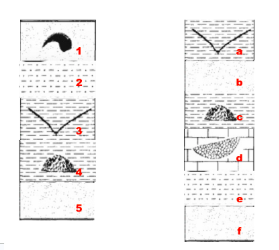
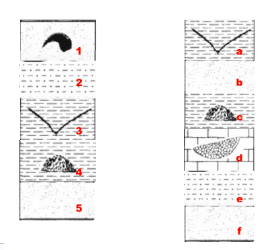
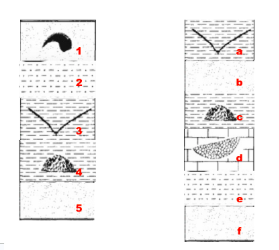
A geologic column is a series of layers of different types of rock, placed by the settling of sediments over millions of years, when the rock was a sea bed. If that rock is now on dry land, it can be seen and studied by humans. These layers are often colorful and dramatically different to each other, and each of the layers represents the kinds of sediments that were most common in that era. Rocks take millions of years to form, and so by looking at the layers of rock and measuring their age, we can figure out what was happening in that area of the earth all those years ago. These layers can go back as far as billions of years in some cases, and provide valuable information about the earth's history.
Required
1 point
1
Question 18
18.
3 and a are the same layer.
Required
1 point
1
Question 19
19.
a is the youngest layer.
Required
1 point
1
Question 20
20.
Put the fossils in order from oldest to youngest. (if they are the same layer, put the number first)