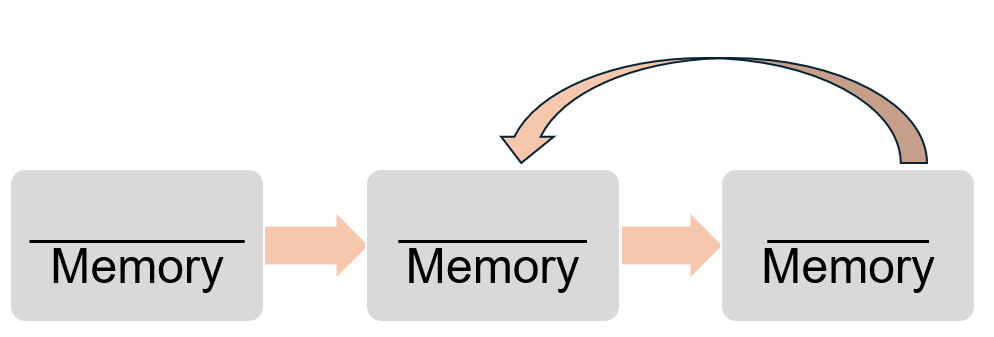
Drag and drop the correct terms into their place in this diagram about memory.
Mmuae Afoforo a Wobɛpaw:
Short-term
Retrieval
Long-term
Encoding
Attention
Sensory
Remember... these are open notes but NOT open neighbor, phone, or internet. Use this opportunity to mark your notes things that you had to look up because you didn't remember them--these are the things you might need to study!
Which of the following is POSITIVE REINFORCEMENT? Mark All that apply
Which of the following is NEGATIVE REINFORCEMENT? Mark all that apply
Match the reinforcement/punishment to its example
| Draggable item | arrow_right_alt | Corresponding Item |
|---|---|---|
Positive Punishment | arrow_right_alt | A child throws a fit in a store because they want a toy. The parent gets the child the toy to get them to behave |
Negative Punishment | arrow_right_alt | The radio in your car will not turn on until you buckle your seat belt. So, you buckle your seat belt, now you can get your tunes on |
Negative Reinforcement | arrow_right_alt | You cussed in practice, the rule is you have 25 push-ups now... Every time you swear its 25 push-ups |
Positive Reinforcement | arrow_right_alt | You came home late (past curfew) your parents take away your car for a week |
The process by which a stimulus increases the chances of a preceding behavior occurring again is called
Ivan Pavlov's experiments with dogs yielded information about
A conditioned response occurs
The process by which a stimulus increases the chances of a preceding behavior occurring again is called
The process of getting information into memory is called
Which type of memory has an essentially unlimited capacity?
The process of retrieval refers to
Every day as she walks to school, Susana passes a mural painted on the side of a building. However, when asked, she says she does not remember ever seeing it. Which of the following is the best explanation for this occurrence?
While your Mom is lecturing you about cleaning your room, you lose concentration. Then, suddenly you hear the significant words, “no car keys.” When she asks, “Are you listening to me?” you are able to repeat the last few things she said before mentioning car keys. Which of the following best explains this phenomenon?
“The magical number seven, plus or minus two” refers to the storage capacity of ________ memory.
A mnemonic device is a
Conscious memory of factual information is called ________ memory.
The increase in synaptic firing potential that contributes to memory formation is known as
What is learning primarily based on?
What is a primary concept of the behavioral approach?
What is the main concept of social learning theory?
Sally goes to a cultural event with her friend Kajal. She is unsure about how to behave in this setting, so she watches Kajal and copies her interactions and mannerisms. In this instance, Sally learned how to behave through what type of learning?
Drag and drop the correct terms into their place in this diagram about memory.
Match the memory technique to the correct description.
| Draggable item | arrow_right_alt | Corresponding Item |
|---|---|---|
Spacing Review | arrow_right_alt | breaking information into smaller parts to make it easier to remember |
Acronym | arrow_right_alt | intentionally making connections between new and old information while reviewing to create deeper encoding |
Elaborate Rehearsal | arrow_right_alt | repeating the information over and over to keep it in short-term memory longer (like repeating a phone number until you dial it) |
Visualization | arrow_right_alt | Using the first letter of a list of items to create one word to help keep information in short-term memory |
Chunking | arrow_right_alt | creating mental images of things in a list or steps in a procedure to help encode information into long-term |
Maintenance Rehearsal | arrow_right_alt | Reviewing material in shorter but more frequent bursts (like 10 minutes each night) in order to improve long-term memory |
Which of the following best describes the DIFFERENCE between classical and operant conditioning?
According to the levels of processing theory, which of the following will result in a memory with the strongest recall? (i.e. the strongest, most easily remembered)