MAP: English II EOC - Session 1(2022)

Last updated 9 months ago
33 questions

Hovering Above Seattle

by Marcia Amidon Lusted

1 Reaching 605 feet above the skyline of Seattle, Washington, the Space Needle looks like a flying saucer from a science fiction movie. In reality, the structure is one of the most iconic and familiar landmarks in the Pacific Northwest.

2 The Space Needle was the tallest structure west of the Mississippi River when it was completed in 1962. It was built for the Century 21 Exposition, which was also known as the Seattle World’s Fair. The fair’s motto was “Living in the Space Age.” In 1957, the startling news that the Soviet Union had launched the first satellite to orbit Earth had begun a race to put a man on the moon. The United States was determined to be the first to succeed.

3 The Space Needle became a key symbol of the fair’s motto and the nation’s commitment to space exploration. Even the colors of the paint chosen to cover it have space themes: The framing metal legs were painted “astronaut white,” the slender interior tower was painted “orbital olive,” the ring that extends at the top was painted “re-entry red,” while other elements to the dome-shaped top were painted “galaxy gold.”

4 The Space Needle’s final design combined the ideas of two men. Seattle businessman Edward E. Carlson sketched a building that looked like a giant balloon tethered to the ground, and architect John Graham came up with the concept to build something that looked like a flying saucer. A second architect, Victor Steinbrueck, contributed the hourglass shape of the tower.

5 The private investors who backed the project had only a year to build the tower before the fair opened. Workers labored around the clock to make sure it would be finished. After a small lot within the fair’s grounds was acquired, construction began in April 1961. The hole for the massive foundation measured 30 feet deep and 120 feet across. It took a fleet of 467 cement trucks an entire day to fill it. Steel rods reinforced the foundation. More than 70 bolts, each measuring 30 feet long, attached the tower structure to the base. The Space Needle grew at a rate of 120 feet per month, until it was finished in April 1962.

6 Workers installed the last elevator car the day before the fair opened. During the fair, nearly 20,000 people a day took the thrilling elevator ride to the top five floors, which were contained in the dome-shaped portion. Posters for the fair also showed a beam of light from the top of the structure shining directly into space, but the actual light was not added until 1999.

7 Completed at a cost of $4.5 million (about $21 million today), the Space Needle was ahead of its time. It is designed to withstand wind speeds of 200 miles per hour and major earthquakes. It withstood a 6.9 Richter scale earthquake in 2001, which was strong enough to make water splash out of the toilets in the tower! It is also equipped with 25 metal rods to protect against lightning strikes.

8 The city of Seattle designated the Space Needle a historic landmark in 1999. With its observation deck at 520 feet and the rotating SkyCity restaurant at 500 feet and no tall skyscrapers nearby, it is one of the best places to view the city. The restaurant makes one complete rotation every 47 minutes, offering 360-degree views of Seattle, including majestic Mount Rainier and the city’s waterfront. Because the dome section is so well balanced, it requires only a 1.5-horsepower motor (a slight upgrade from the original one-horsepower motor). It may not be exactly like hovering above Seattle in a flying saucer . . . but it’s pretty close.
1

Which piece of evidence best advances the author’s purpose of revealing the United States’ goal of progress?

1

Select the appropriate boxes to match the textual evidence from the passages to the main ideas in the passages. Match each piece of textual evidence to one main idea.

Innovation
Expansion
Overcoming Obstacles
states were created west of St Louis
St Louis had no money to construct the arch
The Space Needle looks like a flying saucer
1

What do the two passages reveal about twentieth-century innovation in the United States?

1

What are the main reasons the author of each passage emphasized dates? Select all that apply.

Dark Side of Antri

by Sewell Peaslee Wright

Commander John Hanson relates an interplanetary adventure illustrating the splendid Service spirit of the [crew] of the Special Patrol.

1 “I believe Mr. Croy is right,” I decided. “The messenger of these people must be returned to his own kind; the sooner the better. He has given me a mental map of his country; I believe that it will be possible for me to locate the principal city, in which his ruler lives. We will take him there.”

2 I hesitated for just an instant.

3 “We are gambling with the fate of a world, a fine and happy people. Let us throw the dice quickly, for the strain of waiting will not help us. Is that as you would wish it?”

4 “It is, sir!” came the grave chorus.

5 I hastened to my quarters and brought the Ertak’s log down to the minute, explaining in detail the course of action we had decided upon, and the reasons for it. I knew, as did all the Ertak’s officers who had saluted so crisply, and so coolly gone about the business of carrying out my orders, that we would return from our trip to the dark side of Antri triumphant or—not at all.

6 It was perhaps a quarter of an hour when word came from the navigating room that the messenger was aboard, and we were ready to depart.

7 Bori Tulber had furnished me with large scale maps of the daylight portion of Antri. From the information conveyed to me by the messenger of the people of darkness—the Chiesee they called themselves, as nearly as I could get the sound—I rapidly sketched in the map of the other side of Antri, locating their principal city with a small black circle.

8 Realising that the location of the city we sought was only approximate, we did not bother to work out exact bearings. We set the Ertak on her course at a height of only a few thousand feet, and set out at low atmospheric speed, anxiously watching for the dim line of shadow that marked the twilight zone, and the beginning of what promised to be the last mission of the Ertak and every man she carried within her smooth, gleaming body.

9 “Twilight zone in view, sir,” reported Croy at length.

10 “Thank you, Mr. Croy. Have all the exterior lights and searchlights turned on. Speed and course as at present, for the time being.”

11 I picked up the twilight zone without difficulty in the television disc, and at full power examined the terrain.

12 The rich crops that fairly burst from the earth of the sunlit portion of Antri were not to be observed here. The Antrians made no effort to till this ground, and I doubt that it would have been profitable to do so, even had they wished to come so close to the darkness they hated.

13 The ground seemed dank, and great dark slugs moved heavily upon its greasy surface. Here and there strange pale growths grew in patches—twisted, spotted growths that seemed somehow unhealthy and poisonous.

14 I searched the country ahead, pressing further and further into the line of darkness that was swiftly approaching. As the light of the sun faded, our monstrous searchlights cut into the gloom ahead, their great beams slashing the shadows.

15 In the dark country I had expected to find little if any vegetable growth. Instead, I found that it was a veritable jungle through which even our searchlight rays could not pass.

16 How tall the growths of this jungle might be, I could not tell, yet I had the feeling that they were tall indeed. They were not trees, these pale, weedy arms that reached towards the dark sky. They were soft and pulpy, and without leaves; just long naked sickly arms that divided and subdivided and ended in little smooth stumps like amputated limbs.

17 That there was some kind of activity within the shelter of this weird jungle, was evident enough, for I could catch glimpses, now and then of moving things. But what they might be, even the searching eye of the television disc could not determine.

18 One of our searchlight beams, waving through the darkness like the curious antenna of some monstrous insect, came to rest upon a spot far ahead. I followed the beam with the disc, and bent closer, to make sure my eyes did not deceive me.

19 I was looking at a vast cleared place in the pulpy jungle—a cleared space in the center of which there was a city.

20 A city built of black, sweating stone, each house exactly like every other house: tall, thin slices of stone, without windows, chimneys or ornamentation of any kind. The only break in the walls was the slit-like door of each house. Instead of being arranged along streets crossing each other at right angles, these houses were built in concentric circles broken only by four narrow streets then ran from the open space in the center of the city to the four points of the compass. Around the entire city was an exceedingly high wall built of and buttressed with the black, sweating stone of which the houses were constructed.
1

What can be inferred from paragraph 8 of the passage?

1

Which of the following best expresses the meaning of the phrase throw the dice as used in paragraph 3?

1
Read the text in the boxes and then read the summary of the passage below. Select the text box that best completes the summary to the empty box.

The crew of the Ertak decides to return the messenger to his people. They set out in search of the city, __________. The ship’s searchlights first reveal a weird jungle and finally a strange city built in concentric circles.
1

Which set of words and phrases best reveals the overall tone of the passage?

1

What does the author’s use of first-person narration reveal about the main character, John Hanson?

You Asked: How Does 3-D Printing Work?

by John Patrick Pullen

1 It’s not every day that 3-D printing will make people’s mouths water. But that was the case at the 2015 International CES [Consumer Electronics Show], when XYZPrinting unveiled a device that can output icing and dough-based goodies like cookies.

2 This sweet development is the latest in a long, gradual history of innovation for 3-D printing, which goes back to 1983, when engineer-turned-entrepreneur Chuck Hull invented it in his spare time. Back then, Hull’s day job was curing rugged coatings onto tables using UV lights. But he postulated that focusing that light like a laser would allow the liquid resin with which he was working to form shapes. That was the basis for stereolithography (SLA), the advent of 3-D printing, and eventually the basis for his company, 3D Systems.

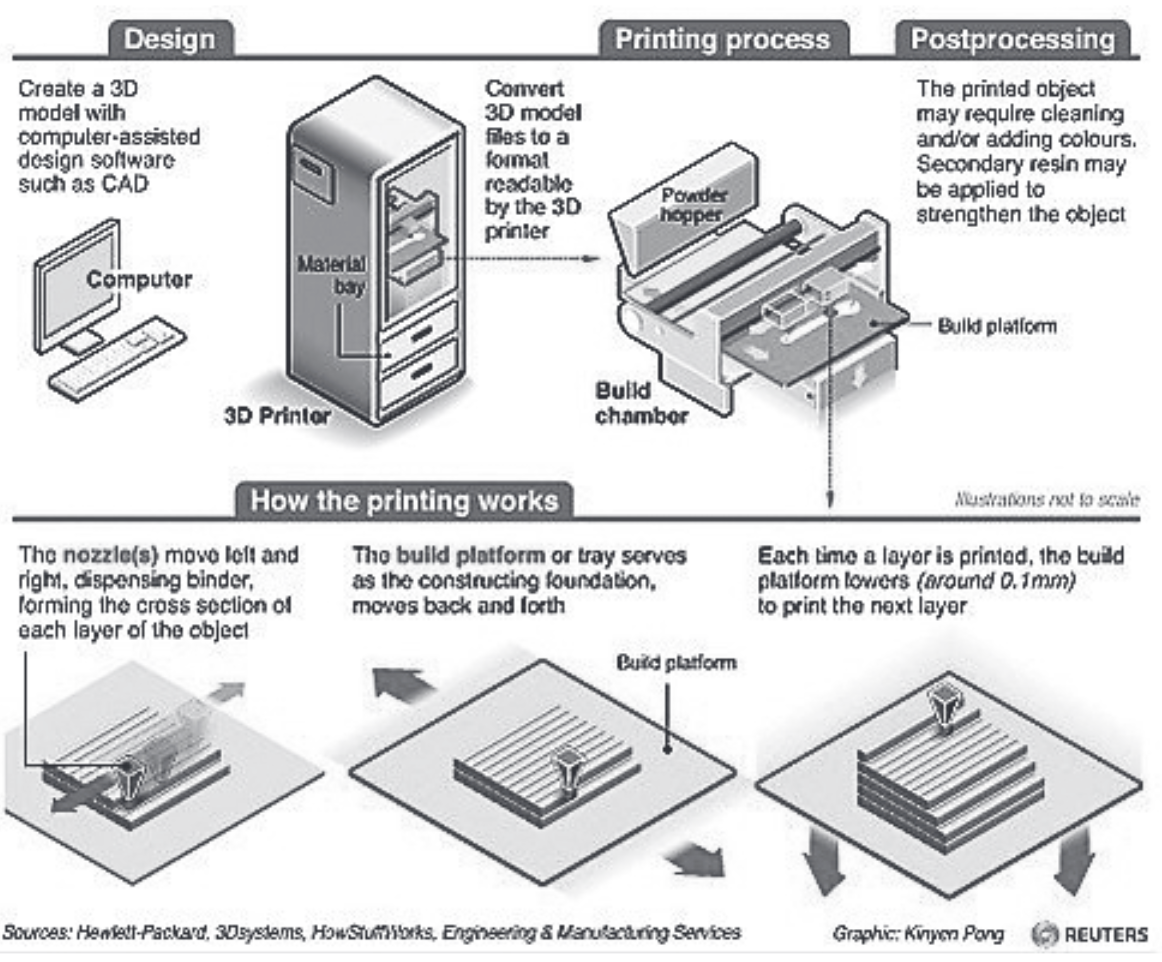
3 Today, 3-D printing essentially lets computer users take digital fles and turn them into physical projects. If that sounds like paper or 2-D printing, that’s because they’re very similar. In 2-D printing, a fle is created and sent to a printer, and a page is output. 3-D printing’s workfow is almost exactly the same: a fle is created and submitted to a device, the product is output, and it may require some fnishing touches when done.

4 SLA is the earliest form of 3-D printing, and it’s very high quality. Originally used for what product developers call rapid prototyping, SLA was designed to give designers the ability to touch, feel, and compare the goods they were making. A slow-moving technology, it can take hours or days to print using SLA machines, which shines a laser into a pool of liquid, building the form layer-by-layer as a base support gradually moves the shape that’s being made. Despite this painstaking process, SLA’s quality is so good that you might never know your object was 3-D printed. SLA is used primarily only in commercial printing.

5 Another kind of 3-D printing is Selective Laser Sintering (SLS). “Selective Laser Sintering is a powder and laser type technology, but boy doesn’t that sound similar to toner and laser technology that’s used in a photocopy?” says John Hauer, founder of 3DLT, a company that prints 3-D products for retailers. And in essence SLS is very similar to a laser printer, only instead of scoring the toner onto a piece of paper, this three-dimensional technology shines its laser onto a bed of powder, turning it into hardened material. Also primarily a commercial technology, SLS can be used in many ways, allowing people to produce products in everything from nylon-based plastics to metals, including stainless steel, silver, gold, and titanium.

6 The third major kind of 3-D printing, Fuse Deposition Modeling (FDM), is the one that’s making the most waves with consumers right now. “That is what people envision as kind of like weed whacker string, where a plastic is inserted into a hot end and then melted, layer by layer, to achieve the product,” says Hauer. And to continue the paper printing analogy, FDM is also very similar to inkjet printing, where ink is extruded through a print head onto a page.

7 While this technology is getting better all the time, it still, literally, has some rough edges. But Hauer says some people like that. “You can feel the ridges— you can scrape your thumb along it and it’ll actually make a sound,” he says. “Because people are so interested in 3-D printing, the ability to touch and feel a 3-D printed product and tactilely know it’s different than a mass produced product has actually been advantageous. It’s helped them better understand the technology.”

8 And of course, food is something that everyone understands, which is why the edible printing technology made such big headlines at CES. Our future holds chocolate flowers, elaborate cake toppers, crazy confectionaries and other exciting edibles, says Hauer. "It has the opportunity to be a big thing," he says. "We've even seen 3-D printed cheese, 3-D printed peanut butter and some of those things."

9 But the real question is, will 3-D printed doughnuts taste as good as the real thing?

--
English II - Session IPage 13 Copyright © 2022 by the Missouri Department of Elementary and Secondary Education. All rights reserved.Go On
1

Which phrases contribute to the light-hearted, sometimes humorous tone of the passage? Select all that apply.

1

Which word best expresses the meaning of postulated as it is used in paragraph 2?

1

The writer references popular foods in the introductory and concluding paragraphs to emphasize that

1

Study the graphic explaining the 3-D printing process. Match each quotation from the passage to the process step from the graphic that it describes.

Design
Printing Process
Postprocessing
a file is created (par. 3)
the product is output, and it may require some finishing touches when done (par 3)
three-dimensional technology shines its laser onto a bed of powder

The Secret of the Sea

by Henry Wadsworth Longfellow
Ah! what pleasant visions haunt me
As I gaze upon the sea!
All the old romantic legends,
All my dreams, come back to me.

5 Sails of silk and ropes of sandal,
Such as gleam in ancient lore;
And the singing of the sailors,
And the answer from the shore!

Most of all, the Spanish ballad
10 Haunts me oft, and tarries long,
Of the noble Count Arnaldos1
And the sailor’s mystic song.

Like the long waves on a sea-beach,
Where the sand as silver shines,
15 With a soft, monotonous cadence,
Flow its unrhymed lyric lines;—

Telling how the Count Arnaldos,
With his hawk upon his hand,
Saw a fair and stately galley,
Steering onward to the land;—

20 How he heard the ancient helmsman
Chant a song so wild and clear,
That the sailing sea-bird slowly
Poised upon the mast to hear,

25 Till his soul was full of longing,
And he cried, with impulse strong,—
“Helmsman! for the love of heaven, Teach me, too, that wondrous song!”
“Wouldst thou,”—so the helmsman answered,
30 “Learn the secret of the sea?
Only those who brave its dangers
Comprehend its mystery!”
In each sail that skims the horizon,
In each landward-blowing breeze,

35 I behold that stately galley,
Hear those mournful melodies;
Till my soul is full of longing
For the secret of the sea,
And the heart of the great ocean

40 Sends a thrilling pulse through me.

---
*Count Arnaldos: Character in a 16th Century Spanish ballad who wanders near the sea to learn its secret
1

Which is the best definition of the phrase monotonous cadence in line 15?

1

Which of these phrases provides the best context clue to the meaning of tarries in line 10?

1

The author’s use of sensory language within the poem helps the reader

1

Which lines contribute to the romantic and legendary tone of the poem? Select all that apply.

Connecting the Country: The Interstate Highway System

by Eric Arnesen

1 Before Dwight D. Eisenhower became president of the United States in 1953, he had been a career military man. Shortly after the end of World War I (1914–1918), then-Lieutenant Colonel Eisenhower participated in a War Department project. It involved a convoy of army vehicles driving from the East Coast (Washington, D.C.) to the West Coast (San Francisco). Sounds easy, right? Well, at that time, there were few highways. Most roads that existed were unpaved. The War Department hoped to make a point: There was a desperate need for better, safer, and faster highways in America.

2 The convoy, consisting of 81 vehicles and 282 members of the military, departed on July 7, 1919. It covered 3,251 miles in 62 days—a “world’s record,” one military officer stated, for “total continuous distance traveled.” Half the trip took place on dirt roads, however, and more than 500 miles of those roads proved to be almost impassable for the military’s heavy vehicles. Soldiers had to help push or pull the vehicles when they got caught in mud. Eisenhower remembered the experience long after it was over. When he later observed the two-lane autobahn1 in Germany during World War II (1939–1945), he saw the “wisdom of broader ribbons across the land.”

3 Some groups lobbied on behalf of greater road construction, and federal officials drafted reports: Toll Roads and Free Roads (1939) and Interregional Highways (1944) in particular made the case for a national highway system. Congress even passed a Federal-Aid Highway Act in 1944, but it didn’t provide any money to fund construction. Then, as the fghting in World War II ended, soldiers returned from overseas, got married, and started families. Many Americans moved out of the cities into the suburbs. The number of cars on America’s roads skyrocketed. Traffic congestion grew, and safety issues soared.

4 By the time Eisenhower took office as president in 1953, much had changed since his 1919 transcontinental trip. One thing hadn’t changed, however: There still was no national highway system.

5 The Eisenhower Administration threw its weight behind new legislation designed to address the issue. In 1956, Congress passed a new Federal-Aid Highway Act. It designated $25 billion for the construction of 40,000 miles of interstate highway over a period of 12 years. In reality, the project took 35 years, cost about $114 billion, and created more than 47,000 miles of highway.

6 While Eisenhower considered the highway system important for the American public and certainly wanted better and safer roads, more than those issues motivated him. The president believed that highway construction could be “an important economic tool” in the hands of the government. It could be used to boost employment in hard times. Highway construction and maintenance meant jobs for tens of thousands of people. Employed people felt good about spending their wages, so good jobs would boost the U.S. economy. A highway system also allowed for the transportation of goods and people.

7 Eisenhower included national defense in his argument for better roads, too. During the Cold War2 (1947–1991), the potential for a catastrophic nuclear war loomed large in Americans’ imagination. Fears of nuclear bombs dropping on U.S. cities forced the federal government to consider how it could safely evacuate an estimated 70 million people. The government believed that well-built and well-designed highways should be part of the solution.

8 As Eisenhower noted in his memoirs, “Our roads ought to be avenues of escape for persons living in big cities threatened by aerial attack or natural disaster, but I knew that if such a crisis occurred, our. . .highways, too small for the food of traffic of an entire city’s people going one way, would turn into traps of death and destruction.” Even though excellent roads would hardly address the large-scale disaster of a nuclear war, the political climate during the Cold War added weight to the civil defense arguments in support of the highway bill.

9 In the end, the Interstate Highway System created a partnership of sorts between the federal government and the state governments. The federal government raised and provided the majority of the funds to the states. The states built and maintained the portions of the highway within their boundaries.

10 The Interstate Highway System was credited—or blamed—for many things. It linked the nation’s urban and suburban areas to one another. It made regional and cross-country travel much easier and safer for drivers. It strengthened the country’s “car culture,” encouraged economic growth, and prompted the growth of hotels, restaurants, gas stations, and other businesses. At the same time, critics believe that the new highway system and the gasoline consumption it encouraged contributed to air pollution, urban sprawl, and the destruction of low-income neighborhoods to make way for new superhighways.

11 Americans can agree on one thing about the Dwight D. Eisenhower National System of Interstate and Defense Highways: The monumental government program profoundly changed the way Americans live. It is considered the “greatest public works project in history.”


---
1The autobahn refers to high-speed expressways built in Germany.

2The Cold War was a period of intense diplomatic and political tension between the United States and the Soviet Union and their respective allies, when the fear of nuclear war hung over the world.

---
English II - Session IPage 23 Copyright © 2022 by the Missouri Department of Elementary and Secondary Education. All rights reserved.Go On
1

Which idea from the passage best supports the inference that the Cold War was an important factor in the construction of the U.S. Interstate Highway System?

1

In paragraph 10, the author lists the reasons some people criticized the Interstate Highway System. Based on these reasons, the reader can infer that the system’s critics probably were

1

Read the sentence from paragraph 1.
“There was a desperate need for better, safer, and faster highways in America.”
Which details best emphasize this idea of desperate need? Select all that apply.

1

What idea does paragraph 10 contribute to the passage as a whole?

A Voyage to the Moon

by Edgar Allan Poe

Esteemed physicist and astronomer Hans Pfaal of Rotterdam takes his frst fight in a balloon he powers with his own invention, a gas much less dense than hydrogen. He theorizes his balloon should ascend to a place balloonists never before attained—the moon. An initial mishap defates his sense of arrogance.

1 It was the frst of April. The night was dark; there was not a star to be seen; and a drizzling rain, falling at intervals, made me very uncomfortable. But my chief anxiety was concerning the balloon, which, in spite of the varnish with which it was defended, began to grow rather heavy with the moisture. I therefore set my assistants to working, and in about four hours and a half I found the balloon sufficiently infated. I attached the car and put all my implements in it—a telescope, a barometer, a thermometer, an electrometer, a compass, a magnetic needle, a seconds watch, a bell, and other things. I had further procured a globe of glass, exhausted of air and carefully closed with a stopper, not forgetting a special apparatus for condensing air, a copious supply of water, and a large quantity of provisions, such as pemmican,1 in which much nutriment is contained in comparatively little bulk. I also secured a cat in the car.

2 It was now nearly daybreak, and I thought it high time to take my departure. I immediately cut the single cord which held me to the earth, and was pleased to fnd that I shot upward with inconceivable rapidity, carrying with all ease one hundred and seventy-fve pounds of leaden ballast and able to have carried as much more.

3 Scarcely, however, had I attained the height of ffty yards, when roaring and rumbling up after me in the most tumultuous and terrible manner, came so dense a hurricane of fre and gravel and burning wood and blazing metal that my very heart sunk within me and I fell down in the car, trembling with terror. Some of my chemical materials had exploded immediately beneath me almost at the moment of my leaving earth. The balloon at frst collapsed, thenfuriously expanded, then whirled round and round with sickening velocity, and fnally, reeling and staggering, hurled me over the rim of the car; and in the moment of my fall I lost consciousness.

4 I had no knowledge of what had saved me. When I partially recovered the sense of existence, I found the day breaking, the balloon at prodigious height over a wilderness of ocean, and not a trace of land to be discovered far and wide within the limits of the vast horizon. My sensations, however, upon thus recovering, were by no means so replete with agony as might have been anticipated. Indeed, there was much of madness in the calm survey which I began to take of my situation. I drew up to my eyes each of my hands, one after the other, and wondered what occurrence could have given rise to the swelling of the veins and the horrible blackness of the fnger nails. I afterward carefully examined my head, shaking it repeatedly and feeling it with minute attention, until I succeeded in satisfying myself that it was not, as I had more than half suspected, larger than the balloon. It now occurred to me that I suffered great uneasiness in the joint of my left ankle, and a dim consciousness of my situation began to glimmer through my mind. I began to understand that my foot had caught in a rope and that I was hanging downward outside the car. But strange to say! I was neither astonished nor horror-stricken. If I felt any emotion at all, it was a sort of chuckling satisfaction at the cleverness I was about to display in getting myself out of this dilemma.

5 With great caution and deliberation, I put my hands behind my back and unfastened the large iron buckle which belonged to the waistband of my pantaloons.2 This buckle had three teeth, which, being somewhat rusty, turned with great difficulty on their axis. I brought them, however, after some trouble, at right angles to the body of the buckle and was glad to fnd them remain frm in that position. Holding with my teeth the instrument thus obtained, I proceeded to untie the knot of my cravat;3 it was at length accomplished. To one end of the cravat I then made fast the buckle, and the other end I tied, for greater security, tightly around my wrist. Drawing now my body upward, with a prodigious exertion of muscular force, I succeeded, at the very frst trial, in throwing the buckle over the car, and entangling it, as I had anticipated, in the circular rim of the wicker-work.

6 My body was now inclined toward the side of the car at an angle of about forty-fve degrees; but it must not be understood that I was therefore only forty-fve degrees below the perpendicular. So far from it, I still lay nearly level with the plane of the horizon, for the change of position which I had acquired had forced the bottom of the car considerably outward from my position, which was accordingly one of the most extreme peril. It should be remembered, however, that when I fell from the car, if I had fallen with my face turned toward the balloon, instead of turned outwardly from it as it actually was—or if, in the second place, the cord by which I was suspended had chanced to hang over the upper edge instead of through a crevice near the bottom of the car— in either of these cases, I should have been unable to accomplish even as much as I had now accomplished. I had therefore every reason to be grateful, although, in point of fact, I was still too stupid to be anything at all, and hung for perhaps a quarter of an hour in that extraordinary manner, without making the slightest farther exertion, and in a singularly tranquil state of idiotic enjoyment.

7 This feeling, however, did not fail to die rapidly away, and thereunto succeeded horror and dismay, and a sense of utter helplessness and ruin.
2

The passage develops the themes of pride, arrogance, and control, as well as the human vulnerability to chance. Match each detail from the passage to the theme it best supports.

Pride, Arrogance, and Self Control
Human Vulnerability to Chance
“I . . . was pleased to fnd that I shot upward with inconceivable rapidity. . . .” (paragraph 2)
“Some of my chemical materials had exploded immediately beneath me. . . .” (paragraph 3)
"The balloon at first collapsed, then furiously expanded . . . hurled me over the rim of the car. . . ." (paragraph 3)
"If I felt any emotion at all, it was a sort of chuckling satisfaction. . . ." (paragraph 4)
". . . my position, which was accordingly one of the most extreme peril." (paragraph 6)
". . . I should have been unable to accomplish even as much as I had now accomplished." (paragraph 6)
1

As Dr. Pfaal regains consciousness, he examines his body, determines what saved him from death, and devises a plan to get back into the balloon. What does this indicate about Dr. Pfaal?

1

Which of these best describes the impact the introduction has on the reader?

1

Read the excerpt from paragraph 5.
“With great caution and deliberation, I put my hands behind my back and unfastened the large iron buckle. . . .”
Which of these best expresses the meaning of deliberation as it is used in the excerpt?

2

A student is writing a research paper on whether or not zoos are effective in the ethical treatment of animals. Which pieces of information should be included in the paper? Select all that apply.

1

A student is writing an informative essay about cryptozoology. Read the paragraph from the essay and answer the question that follows.
Cryptozoologists are open-minded but skeptical about their findings.
Advancements in technology have allowed them to confirm many biological discoveries while debunking others.
The broadening field of biological science has also made use of DNA research to differentiate between documented sightings and the factual existence of cryptids.
After doing more research, the student wants to add the following sentence to the paragraph:
“To be a cryptozoologist, you have to have your feet firmly planted in biological data while embracing the belief that the fantastical can be a real thing in nature.”
Where would the sentence best be added to provide specific support?

1

Makayla is a tenth-grade student interested in designing her schedule and college plans around a career path that would provide employment quickly after college graduation. She has started using the Internet to research “getting a job after graduation.” Her teacher suggests asking a question as a search strategy in order to conduct a more relevant search. What is the most effective research question to meet Makayla’s needs?

1

Select the box that matches each research topic with its most appropriate audience.

High School Students
Classroom teachers
Parents of High School Students
Salary Scale
Top Social Media Apps
School support opportunties
Extracurricular club meeting dates
Eduardo, a sophomore, has written a letter to the school board requesting they purchase new uniforms for the high school band.

Dear Board of Education:

I am writing to request your assistance in purchasing new band uniforms for the high school. I am a drum major and this letter represents the feelings of the high school band.
We have had the current uniforms for over ten years, and they are beginning to show wear. It’s not fair that the cheerleaders get new uniforms every year. Part of our performance is based on how our uniforms look on the field. Did you know that our score in competitions is partially based on [ ]? If we had new band uniforms, we would definitely have a chance to score better and bring home more awards.

I am grateful for your consideration of our request.
Sincerely,
Eduardo
1

Select the word or phrase that maintains a style and tone appropriate for his audience

"Did you know that our score in competitions is partially based on ?"

1

Eduardo has rewritten his letter to the school board to make his word choice more suitable for his audience. He has asked you to reread his letter before he sends it. Which sentence should be omitted to strengthen the organization and fluency of his writing?

1

A student has written an essay about cryptozoology. Read the draft of a paragraph from the essay.

It deals in relict hominoids, surviving species of an otherwise extinct group, and mythical creatures. Cryptozoologists spend their lives investigating claims of fantastical sightings and making remarkable discoveries.

Which of these would be the best introductory sentence for the paragraph?

1

Read the paragraph and select the best transition word to connect the ideas in the paragraph.

Maya was nervous upon waking up. Today was her sixteenth birthday, and her older brother had promised to take her to get her driver's license. As she rolled out of bed, she yelled his name. __________, he didn’t answer. “Great,” thought Maya, “he’s not here. How will I ever get to the license bureau?”