4/2 BM: Checking account Statement & Reconcile Bank Statements
star
star
star
star
star
Last updated 11 months ago
22 Nsɛmmisa
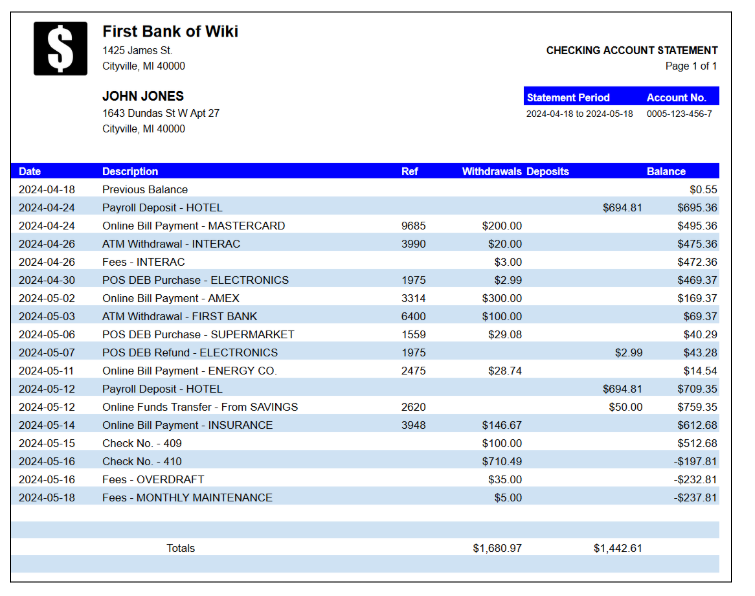
How frequently does John typically receive account statements from his bank?
Daily
Weekly
Monthly
Annually
How much did John Jones have in his account on the first day of the statement period?
-$72.47
$0.55
$694.81
$1,442.61
John has two ATM transactions but only one of them has a fee (Interac). Why?
Interac is an out-of-network ATM and First Bank charges customers if they use out-of-network ATMs.
First Bank charges customers for using their ATMs.
Banks charge fees if you take out less than $100 at an ATM machine.
The first ATM transaction is free but all additional ATM transactions have a fee.
Most employers will pay their employees by directly depositing their paycheck into their checking account. According to his checking account statement, John was paid ________________ every __________ .
$200.00, 3 weeks
$694.81, 2 weeks
$300.00, 1 month
$100.00, 2 weeks
What is the impact of the Online Funds Transfer - From Savings that appears on John's statement?
John's Savings account balance declined by $50 and his Checking account balance increased by $50
John's Savings account balance increased by $50 and his Checking account balance declined by $50
John's Savings account balance had no change and his Checking account balance declined by $50
John's Savings account balance increased by $50 and his Checking account balance had no change
Which statement is true regarding Check No. - 409?
This check likely came from John’s employer.
This check was written by John and paid to another person or business.
This check caused John to overdraw his checking account.
This check added $100 to John’s account.
Which transaction caused John to overdraw his account?
The Online Bill Payment for $146.67
Check No. 409 for $100
Check No. 410 for $710.49
The Overdraft Fee of $35
What was the result of John overdrawing his checking account?
John’s payment was greater than the balance he had available in his account so the bank will deposit $237.81 into John’s account so he can pay his bills.
John’s payment was greater than the balance he had available in his account so he was charged a $35 fee.
John’s payment was greater than the balance he had available in his account so he was charged a $5 monthly maintenance fee.
John’s payment was greater than the balance he had available in his account so the bank will transfer $35 from a linked account.
Which fees was John charged on his checking account during this statement period?
Online Transfer Fee, Overdraft Fee, Per Check Fee
Per Check Fee, ATM Fee, Overdraft Fee, Maintenance Fee
Online Transfer Fee, ATM Fee, Maintenance Fee
ATM Fee, Overdraft Fee, Maintenance Fee
What is the mathematical formula that you would use to describe the financial activity on a bank statement?
Ending Balance = Previous Balance + Deposits + Withdrawals
Ending Balance = Previous Balance - Deposits + Withdrawals
Ending Balance = Previous Balance + Deposits - Withdrawals
Ending Balance = Previous Balance - Deposits - Withdrawals
Part II: What Did You Learn?
Use what you learned from analyzing the checking account statement to answer this question.
Why is it important to review your checking account statement?
FINE PRINT: Checking Account Agreement
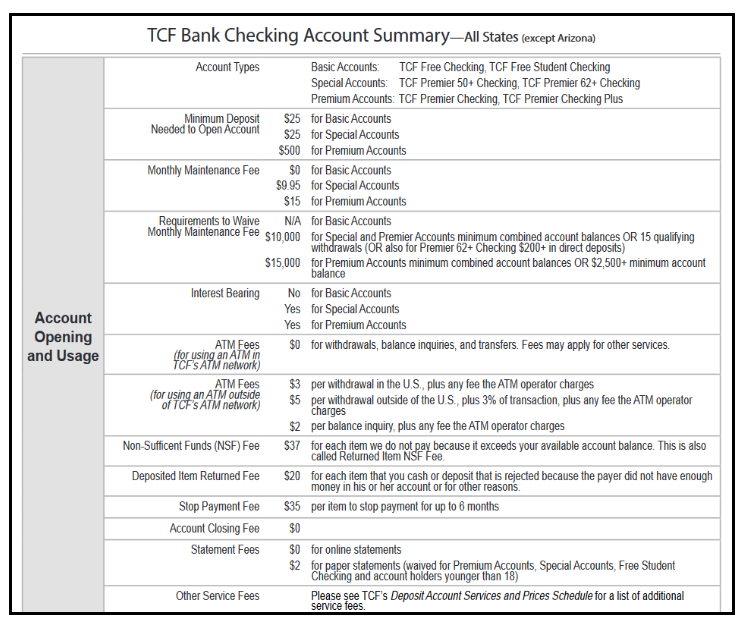
In this activity, you will explore a checking account agreement in more detail to understand its various components. Then, you will answer questions using the sample checking account agreement below.
A Student Checking account would be classified as what type of account according to the Agreement?
Basic
Special
Premium
Premier
Which of the following is TRUE about a TCF Free Student Checking Account?
The minimum deposit to open the account is $25.
The monthly maintenance fee is $15 per month.
The account earns interest, which makes this a good savings account too.
There is a $3 withdrawal fee for using an ATM in the TCF ATM Network.
Assuming you have a TCF Free Student Checking Account, which fee would end up costing you extra money?
Out-of-network ATM Fee
Monthly maintenance fee
Paper statements fee
Account closing fee
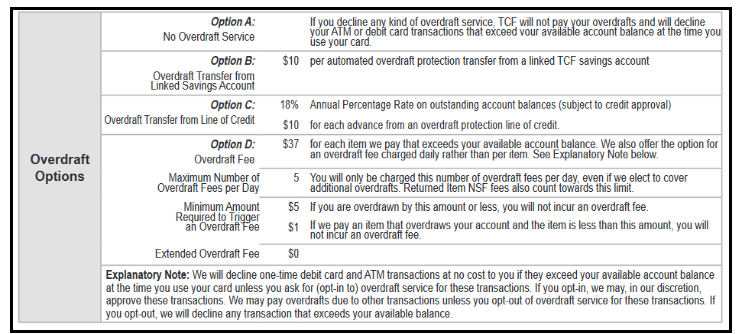
You choose Option A for Overdraft Options. What would happen if you had $30 in your checking account and you tried to take out $45 at the grocery store using your debit card?
Your transaction would be denied, you’d have to return the groceries, and you would be charged an overdraft fee
Your transaction would be denied, you’d have to return the groceries, and you would NOT be charged an overdraft fee.
Your transaction would be processed so you can purchase the groceries, but you would NOT be charged an overdraft fee.
Your transaction would be processed, but you’d have to return the groceries, and you would be charged an overdraft fee.
You choose Option B for Overdraft Options. Assume that you have $30 in your checking account and $50 in your savings account. What would happen if you tried to take out $45 at the grocery store using your debit card?
Your transaction would be denied and you would have to return the groceries if you didn’t have the cash to pay for it.
Your transaction would be approved since the bank would transfer money from your savings to your checking account, and you’d be charged a $10 fee.
Your transaction would be approved since the bank would transfer money from your savings to your checking account, and you’d be charged a $37 fee.
Your transaction would be approved and the entire $45 bill would be charged to your savings account, not your checking account.
You choose Option D for Overdraft Options. What would happen if you had $10 in your checking account and completed the following debit card transactions on the same day:
$45 for groceries
$20 for movie tickets
$15 for popcorn and soda
You would be able to purchase the groceries, but would not be able to buy the movie tickets and popcorn and soda.
You would be able to purchase everything, and you would be charged one overdraft fee of $37.
You would be able to purchase everything, and you would be charged three overdraft fees totaling $111.
You would be able to purchase everything, and you would owe the bank $70 and be charged three overdraft fees totaling $111.
Assuming you have a TCF Free Student Checking Account, how many maximum overdraft fees can you incur in one day?
1
2
5
8
Which of these TCF checking account fees is the MOST expensive?
Stop Payment Fee
Deposited Item Return Fee
Paper Statements Fee
Overdraft Fee (Option D)
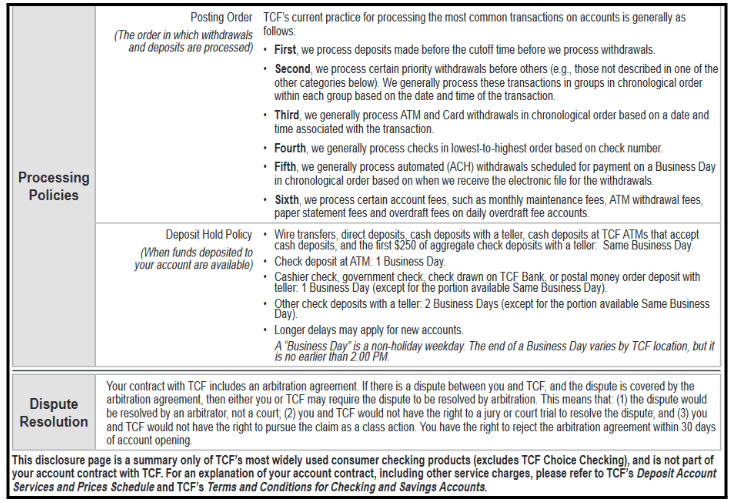
You have the following transactions post to your account on the same day: your paycheck deposit, a check you wrote for your rent, and a debit transaction for groceries. Which would be processed FIRST?
Your paycheck deposit
The check you wrote for rent
The debit transaction for groceries
It depends which day of the week it is
You deposit your birthday check for $50 at the TCF ATM. When will you have access to the money?
Immediately
Same day
One business day
One week later
Part II: What Did You Learn?
Use what you learned from analyzing the checking account agreement to answer this question.
What advice would you offer to someone who is considering opening a checking account?