In 'Cowboy from Head to Toe,' the author explains why cowboys wore certain clothing. Read the features in the chart and the details in the Answer Bank. Write the correct detail about the purpose of the clothing in the box next to the feature it best describes. Write one detail in each box. Some details will not be used.
Informative/Explanatory Writing Prompt
Clothing plays an important role in people’s daily lives at work, at school, in the outdoors, and at other places. Consider how certain articles of clothing are best for certain places and situations.
Writer’s Checklist
My essay has an effective beginning, middle, and end.
My essay flows smoothly from one idea to another.
My essay contains a strong controlling idea that stays on topic.
My essay includes specific and relevant details, reasons, and/or examples.
My essay uses precise and vivid language.
My essay contains sentences that are clear and varied in structure.
My essay includes correct grammar, usage, punctuation, capitalization, and spelling.
My essay uses material from the source(s).
Write an informative/explanatory essay for your teacher that explains how different types of clothing can help people’s daily lives. Be sure to use details and examples from both passages to support your ideas.
I came home from school one afternoon, full of excitement and a touch of nervousness. Our teacher, Mrs. Hughes, had announced that our fourth-grade class’s upcoming play would be The Wizard of Oz. I’ve read the book and watched the movie several times. It’s one of my favorite stories. In the past, I’ve been too shy to try out for school plays. However, the idea of portraying the Cowardly Lion made me think I would like to be a part of the cast. I love the lion more than any other character.
When I arrived at school the next day, I signed up for tryouts and brought home a short script to memorize. The script called for my character to jump out of hiding and roar at Dorothy. My older brother, Michael, overheard me practicing and laughed.
“Annie, you sound more like a timid little kitten than a fierce lion,” he said. He let out a big roar that made me laugh too. We practiced being lions until Mom called us to dinner.
More than anything, I wanted to do a good job and get the part. I thought about how much fun it would be to wear the lion costume. It had a big mane made from yarn and a long, tufted tail. For the next few days, I came home and practiced my lines until I no longer needed the script.
On the day of my audition, I felt confident until I watched my classmates’ auditions. Then, when I stood up in front of the class, my shyness came back and I stumbled on my lines. I was dissatisfied with my performance. Unfortunately, the part I wanted went to another student, and I was asked to take the role of Auntie Em.
I was so disappointed that I came home in tears. Instead of getting to wear the lion costume, I was given a plain dress and a gray wig.
Mom found me crying in my room and asked what was wrong.
“I wanted to be the Cowardly Lion, and now I have to wear this old dress,” I told her. “I want to quit the play.”
“Honey, sometimes we have to do things we don’t think we will like,” Mom said. “Even though
you didn’t get the part you wanted, go out there and be the best Auntie Em you can possibly be.”
I decided to take Mom’s advice. I asked Michael if he would help me rehearse again.
“I’ll feed the dog every day for a week if you’ll go over my lines with me,” I told him.
“That sounds like a fair trade,” my brother said.
We rehearsed my part every day after school until the night of the play. When I entered the
auditorium, I was still nervous, but I remembered what my mother told me about doing my best. It was fun being backstage and watching the other kids perform. By my final scene, I wasn’t scared anymore. This time I remembered my lines. My voice rang clear and strong. I could be heard throughout the packed auditorium. When all of us in the cast came out to take a bow, people cheered.
Afterward, Mom and Michael came backstage to congratulate me. Mrs. Hughes walked over and said, “Annie, you were a great Auntie Em. I know it wasn’t the part you wanted, but you really made the best of it.”
Even better than what my teacher said was the big hug I got from my mom.
“I’m so proud of you!” she told me.
Michael smiled at me, pulled at my silly wig, and said, “Good job, Sis.”
I can’t wait to try out for next year’s play!
Circle the sentence from the passage that best tells how the Dutch donuts differed from today’s donuts.
Circle the sentence from the passage that explains why Fox suggests Lion and Bear should have a contest.
A student made a plan for a research report. Read the plan and the directions that follow.
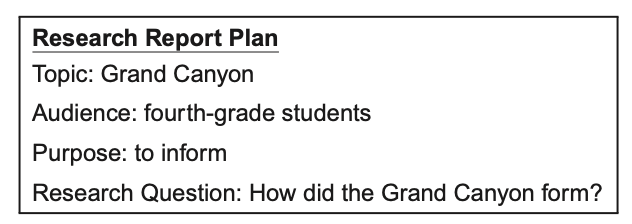
Which sources would most likely have information for the report? Choose two answers.
A student is taking notes for a research report about teeth. The student found a diagram of a tooth and took notes.
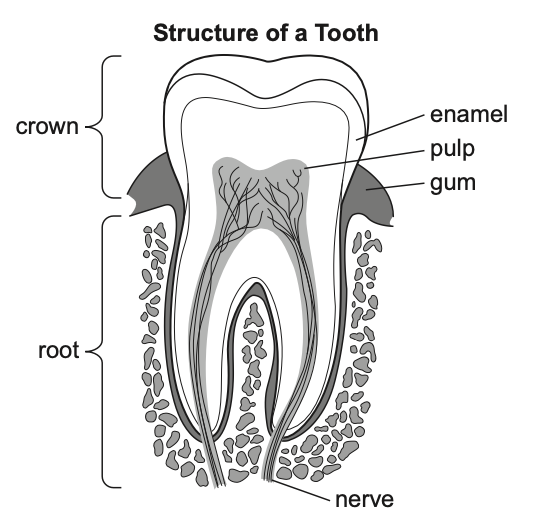
Which note is supported by the diagram?
A student is taking notes for a research report about sunflowers. The student has found a
diagram that illustrates the life cycle of a sunflower.
Read the descriptions. Write the letters A–F in the boxes to match each description with the
correct picture.
A. The plant grows many leaves.
B. Plants begin as seeds.
C. Seeds from the flower fall to ground.
D. The seed begins to grow.
E. The seed pushes its way through soil.
F. The fully grown plant produces a flower.
A student is writing a research report about ways some organizations are helping cheetahs to survive. Which research question would provide the most useful information?
A student is writing a report about the parts of mountain bikes. Read the paragraph headings from a source. Which paragraphs most likely have information for the report?
*Choose two answers.*
Read the sentences. Select the word that correctly completes the last sentence. Barry was disappointed. He wanted to play baseball, but all his friends were busy. Because he did not want to waste the beautiful summer day, decided to go swimming instead.
A student is writing a science report for her teacher. Read the paragraph from the student’s report.
Where is the hottest place on Earth? The answer is not so simple. The hottest places can change from year to year. The temperature at Death Valley, California, was a roasting 134 degrees Fahrenheit on July 10, 1913. That’s too hot for me! Scientists can use satellites to measure temperatures in hard-to-reach places. In 2005, a satellite over the Lut Desert in Iran recorded the unbelievable temperature of 159.3 degrees! Some of the other hottest places are in Australia and China.
Which sentence is the least appropriate for the audience and purpose of the paragraph?
Read the sentence.
Monday is Labor Day so students will not be in school.
Where should a comma be placed to correct the sentence?
Read a student's paragraph about orangutans:
_________ These giant apes live in trees most of the time, and they can move from branch to branch easily. They swing through the trees using their long arms, long fingers, and toes. Some male orangutans have an arm span of about 7.5 feet. Their hands and feet are like human hands and feet because they have an opposable thumb and a big toe for grasping objects.
What is the best topic sentence for the paragraph?
Listen to the Presentation.
The Sea's Prize
Listen to the presentation
How You Learn
Complete the table based on actions mentioned in the presentation. Each action has an effect. Write each effect beside the action that produces it.
by Kathleen Nyquist
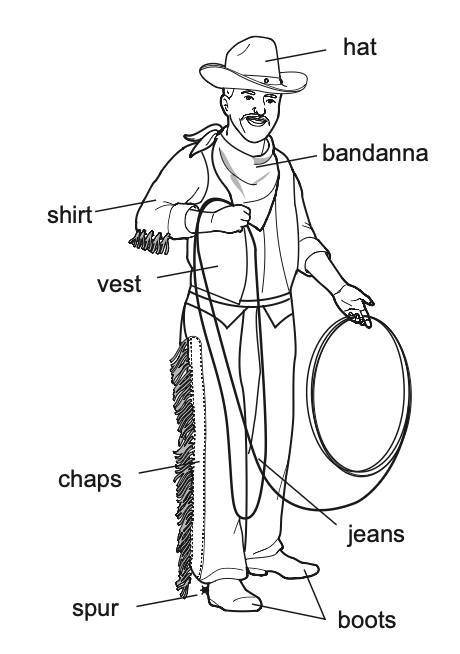
Many people today wear western clothes because they like the style. Cowboys and cowgirls
choose clothes for their usefulness.
In the late 1800s, many cowboys lived outdoors. They carried all of their supplies on a horse. They needed useful, durable clothes for life in the wilderness.
A cowboy used his hat, or “Stetson,” for many things. (John B. Stetson invented the felt cowboy hat.) A cowboy’s hat kept rain from his neck and sun from his face. Oats for horses could be put inside. Hats could hold water for drinking or putting out fires. A cowboy could wave his hat as a signal.
People could tell by a cowboy’s hat where he came from. Men from rainy areas wore hats with a deep crease in the crown. The crease let water drain off easily. In windy areas cowboys wore hats with a low crown. They were less likely to get blown off by the wind. Cowboys from sunny places needed hats with wide brims for shade.
Bandannas came in handy, too. Since most shirts were collarless, cowboys used bandannas to help protect their necks from sunburn. They often wore bandannas over their mouths to avoid eating dust kicked up by cattle. If someone broke an arm, the bandanna became a sling until a doctor came. Bandannas were also used as ties when cowboys wanted to dress up.
Cowboys often wore wool shirts. Wool absorbed a cowboy’s sweat on a hot day. It kept him warm on a cold night. Some cowboys wore shirts made from the skins of deer. Like the fancy western clothes of today, buckskin shirts often had fringe on them.
Fringe was first used by Native Americans. Cowboys learned that rainwater slipped off the thin strips. This kept clothes from getting soaked. Cowboys could also cut off the long leather fringe to fix fences or whatever needed tying.
Cowboys often wore vests over their shirts. Vests kept out cold winds, and cowboys could move easily in them. Also, vests had pockets. (Most shirts didn’t.) Cowboys needed vest pockets to carry matches, gold nuggets, and notebooks for recording cattle brands.
Shirts were tucked into heavy-duty pants, such as Levi’s jeans. (These were invented by Levi
Strauss in the mid-1800s.) A cowboy could ride many rough trails before his jeans wore out.
Mexican cowboys, called vaqueros, gave American cowboys the idea of wearing chaps. These
large pieces of leather protected legs from thorns, wire fences, and kicking cattle.
Of course, a cowboy wouldn’t be complete without boots. These were useful, too. The pointed toes made it easy for a cowboy to slip his feet into stirrups. The raised heels kept his feet from slipping out. When roping cattle on foot, a cowboy dug his big bootheels into the dirt to keep from falling. Spiked wheels, called spurs, were usually filed until blunt, then attached to bootheels. They were used to give signals to the horse.
Cowboys and cowgirls today wear many of the same types of clothes as cowboys of the late
1800s. Fashions change, but useful work clothes never go out of style.
Read the sentence from 'Cowboy from Head to Toe.'
Wool absorbed a cowboy’s sweat on a hot day.
What is the meaning of absorbed?
Based on the information in 'Warm Your Toes with a Hat,' why do you lose a large amount of heat through your head?
How are the ideas in 'Cowboy from Head to Toe' and 'Warm Your Toes with a Hat' related? Choose two answers.
Which detail from the passage best supports the idea that The Wizard of Oz is one of Annie’s favorite stories?
Which sentences from the passage explain what may have caused Annie to get a role different from the one she had wanted? Choose two answers.
Complete the chart using the details from the passage in the Answer Bank. Write each detail under the description of Annie that the detail supports. One box in the chart will be blank.
Which sentences show how Annie is helped to feel differently about her role in the school play?
Circle two sentences.
Ask someone what his or her favorite treat is. The answer might be donuts! These yummy fried cakes are enjoyed all over the world. Where did donuts come from? How did they get that hole in the middle? The answers may surprise you.
People have been eating fried dough for thousands of years. Scientists have found fossils of fried cakes with holes in ancient sites. No one knows what they tasted like, but it is likely that ancient people enjoyed them. We still enjoy donuts today.
In the 1840s, many Dutch people moved to the United States. They brought a favorite snack. Its name was “olykoeks.” That Dutch word meant “oily cakes.” This treat got its name because the dough was fried in oil. Olykoeks were a lot like donuts. However, they were missing one important thing. These cakes had no holes.
Later in the 1800s, a woman named Elizabeth Gregory made an interesting type of fried dough cake. She filled the middle with spices and bits of fruit. Sometimes she used nuts. Mrs. Gregory called her treats “dough nuts” because they had nuts in the middle.
Elizabeth Gregory’s son, Hanson Gregory, was a ship captain. He always took plenty of his
mother’s treats on long sea trips. One day, Captain Gregory punched the filling out of the middle of the dough nut. No one knows for sure why he did this. Maybe he did not like nuts. Or maybe a storm led to the creation of the donut hole.
An old story says that Captain Gregory was trying to steer his ship through a bad storm. He had to keep both hands on the wheel. However, the captain was hungry, and he wanted his favorite snack, his mother’s dough nut cake. However, he could not hold food and steer at the same time. The captain had a great idea. He jammed one of his mother’s cakes onto the spoke of the wheel. The wooden spoke poked out the hole. Captain Gregory liked the cake better without the filling in the middle. The donut as we know it was born.
No one knows whether the story about Captain Gregory is true. However, it is true that donuts became a popular snack about 100 years ago.
During World War I, American soldiers were sent to France. Some American women volunteered to help the soldiers overseas. One way they did this was to make them a treat from home—donuts. The soldiers loved these tasty snacks. When the soldiers came back to the United States, they wanted even more of those yummy donuts. It did not take long before donuts became popular across the United States.
People loved donuts, but making donuts by hand took time. In 1920, baker Adolph Levitt knew he needed a way to make donuts faster to meet his customers’ demands. He invented the first donut machine. His customers were happy. Finally, they could get their donuts without waiting in a long line!
Donuts were a popular treat at the 1933 World’s Fair in Chicago. People lined up to watch
machines create them. Donuts were called “the hit food of the Century of Progress.” That is a
pretty fancy name for a fried treat!
Donuts even have their own day. National Donut Day is celebrated on the first Friday in June every year. This day began in Chicago in 1938 to honor the women who had served donuts to American soldiers.
The donut has had a long and interesting history. The story started with fried cakes and a hungry ship captain. Today this snack is one of the most popular treats in the world.
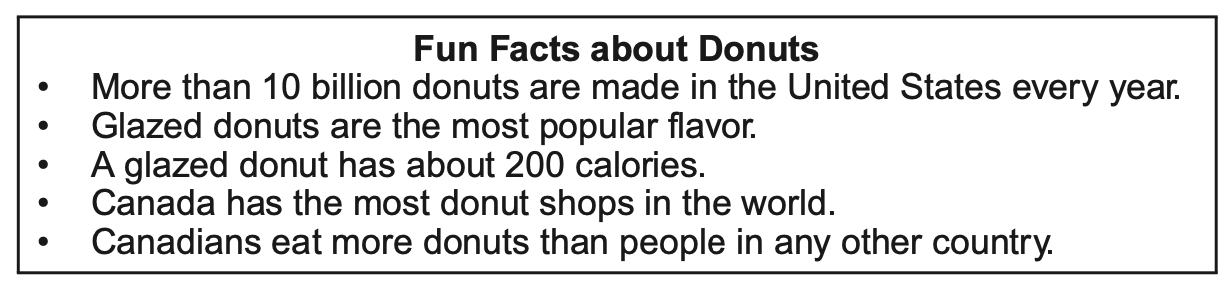
Which idea does the text box 'Fun Facts about Donuts' support?
Read the sentences from the passage.
In 1920, baker Adolph Levitt knew he needed a way to make donuts faster to meet his customers’ demands. He invented the first donut machine. His customers were happy. Finally, they could get their donuts without waiting in a long line!
Which words mean the same as 'customers'? Choose two answers.
Part A
After reading the passage, which conclusion is best supported?
Part B: Which sentence from the passage best supports the answer to Part A?
One lazy sunny afternoon, Fox was napping under a shady bush until she was startled by the
sound of booming voices drifting through the forest. With a curious yawn, Fox wandered in the direction the voices were coming from.
Fox discovered Lion and Bear standing under an ancient tree. A broken beehive with gleaming honey seeping from its cracks lay between them.
“What is happening?” Fox asked Lion and Bear as she licked her lips.
“Lion wants my honey,” Bear bellowed. “I shook the tree and knocked the beehive from its
branches. The honey belongs to me!”
“But I chased the angry bees away with my speed,” shouted Lion. “The honey belongs to me!”
Fox felt her stomach rumble as she eyed the delicious prize, but clearly, Lion and Bear would not share. The two powerful animals ruled the forest and were never challenged by other creatures.
Carefully, Fox listened as Lion and Bear continued to argue. Suddenly, a lively glimmer sparked in her eyes.
“You should have a contest to settle your disagreement,” Fox declared. “The animal that climbs the highest in the tree will win the honey.”
“That’s easier said than done,” Bear grumbled as he peered upward at the trees.
“I’m sure Lion is strong enough to climb to the top,” Fox mentioned slyly.
“Lion cannot defeat me,” Bear retorted. “I’m as mighty as a mountain.” Puffing out his chest, he marched over to the tree to get ready.
Lion also hesitated. He had noticed Fox gazing at the honey and felt a glimmer of worry.
“I don’t like contests,” Lion declared.
“Are you afraid that Bear will race by you?” Fox asked.
“Bear will never pass me,” Lion declared, lashing out at the suggestion. “I’m a bolt of lightning!” Then he dashed toward Bear.
In a flurry of legs and claws, Lion and Bear gripped the tree’s trunk. As swiftly as the wind, they ascended. Branches trembled and shook, and bright green leaves fluttered down behind them like butterflies.
As Bear and Lion climbed, Fox briefly glanced at the honey. Her mouth began to water, but she patiently watched the contest. Bear was lagging behind, so Fox proclaimed, “Lion’s strength is carrying him to victory.”
Instantly, Fox’s words prodded Bear like a stout stick. With a fresh burst of energy, Bear
strengthened his efforts.
“Amazing!” Fox praised Bear as she sniffed the honey just once. The inviting scent tempted her, but she turned her attention to the contest again. Lion was slowing his pace, so Fox called out, “Bear’s speed is superior.”
Roaring, Lion grabbed the branches above Bear and regained the lead.
Finally, Lion and Bear reached the treetop. Exhausted, they peered down at Fox, who was
devouring every last drop of honey. Lion and Bear wondered how they could have been so foolish to trust Fox.
After the honey was gone, Fox sang a song to Lion and Bear:
Strength is a mighty gift.
You can shake a towering tree.
And when you are quite swift,
the buzzing bees are left behind.
But if talent leads to pride
and endless boasts of skill,
then wisdom soon gets pushed aside
and careful judgment disappears.
Because you could not share
your glory or your prize,
I have earned my tasty fare,
a banquet feast for humble Fox.
Read the sentences from the passage.
Instantly, Fox’s words prodded Bear like a stout stick. With a fresh burst of energy, Bear strengthened his efforts.
What is the meaning of the phrase “prodded Bear like a stout stick”?
Part A: Which conclusion is supported by details in the passage?
Part B: Which evidence from the passage supports the answer to Part A?
Lion and Bear have similar character traits. Choose the character trait each pair of details supports. Write the trait in the box beside its supporting details. Only two words in the Answer Bank will be used.
What is a theme of the passage?
Which reason most likely explains why the merchant, the farmer, and the artist are excited when they see what they believe is a ship?
When the artist shouts “Is something wrong?” to the men as they pass her by, they answer her without words. Which question would best help listeners understand the men’s answer to the artist?
How are the characters similar? Choose two answers.
Which question would best start a discussion about the speaker’s purpose for the presentation?
What is the value of practice in the learning process?
Why do scientists compare the brain to a muscle? (Choose two answers.)
Which sentence describes what the presentation is mostly about?