Tyler would rather be fishing. The river would be dancing on a breezy day like this, the sun
sparkling on its surface. Instead, he was helping his best friend, Ellie, and her mom remove boxes from an old house Ellie’s mom was trying to sell.
“I saved this for you,” said Ellie, handing Tyler a book. “It’s my way of thanking you.”
The next day, Tyler had time to examine the book. It had a cover made of brown leather that
wrapped around the pages and was tied closed with a rawhide cord. Curious, Tyler figured out how to open it. The pages were smudged and yellowed, but he could read the words.
My name is Jimmy Sandberg. It’s June 7, 1870, and today I’m 11 years old. Pa gave
me this journal to collect my thoughts.
Tyler admired a realistic drawing of a boy and a man standing by a river.
Pa is leaving again. Pa’s a steamboat pilot, and the Liberty is glorious to behold. Still, it’s hard to say goodbye. New Orleans is a fair distance. I expect he won’t be back for three weeks.
A drawing showed an elegant steamboat and a man in uniform standing beside the boat’s wheel.
The next few pages were filled with drawings of fish. Flipping through, Tyler noticed more pictures than words—fish, snails, shells, and frogs.
My line was in the water, but I got nary a nibble. Next time, I’ll try the stream behind
the Gibbons’ farm.
There were many hand-drawn maps: wiggly lines that must be water, location names, and an X where the fishing was good.
Pa’s home and we’re fishing. He let me try his lucky lure; I caught a big old trout
with it.
Tyler read every entry, learning about Jimmy’s life.
This book’s almost full, so Pa got me another one. Also, he was so proud of me
doing such a good job helping Ma while he was gone. He said, “Jimmy, you’ve
shown yourself to be a responsible boy. I want you to have my lucky fishing lure. It’s
yours now.” I can scarce believe it—those fish don’t stand a chance.
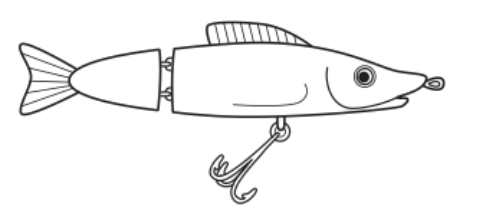
Tyler studied Jimmy’s drawing of the lure. It was shaped like a fish with bulging eyes and a long nose. Its oval body had grooved fins and was attached to a sharp hook for snaring a fish.
We’re moving away for the winter, and I found the perfect spot to hide my lure until I
return. Pa loves the cottonwoods bending over the river. These two are growing
together—like Pa and me. A massive old river rock will protect the lure.
Tyler closed the book but kept thinking about Jimmy and his fishing holes—they seemed so real, almost like he’d seen them before. Had Jimmy Sandberg lived here in his town? Tyler reread the journal with growing excitement and then sent Ellie a message to meet him at the library.
Ellie read Jimmy’s journal, looked up at Tyler with astonished eyes, and then led him into the
library’s reference section.
Searching together through old records, they found him: James Sandberg was the son of Werner Sandberg, a steamboat pilot from town. They compared modern maps of town to Jimmy’s drawn ones—either the river had changed or the names had.
Tyler gave up on finding Jimmy’s fishing holes, but what about his lure? He understood there was only a slim chance that the twisted trees still existed and that the lure was still there, but he had to try. He and Ellie rode their bikes along the river for days, inspecting every tree.
The next day, they helped Ellie’s mom again and then took their fishing rods to a shady spot behind the property.
The sun flashed on Ellie’s spinner lure as her line arced out and landed with a plunk. Tyler
stretched out and yawned—then stared, gaping at the wide-spreading tree above them and the rock Ellie was resting against.
This must be the spot!
They ran back to the house to grab a small shovel. Once they started digging, it wasn’t long until Tyler’s shovel struck metal. With Ellie’s assistance, they unearthed a tin can wrapped in a
waterproof cloth. Inside, wrapped in a square of blue velvet, was a copper fishing lure.
Tyler and Ellie went back to the library. They wanted to see if they could locate a relative of
Jimmy’s. Their efforts were successful. Matthew Sandberg lived in the next town down the highway. Ellie’s mom agreed to take them to meet him.
Matthew was very welcoming. He was curious about what the children knew about Jimmy
Sandberg. With pride, Tyler presented the antiques to Jimmy’s descendant, who carefully picked up the journal.
“I’ve read all of Jimmy’s journals except this one. His entries always transport me to a different era,” said Matthew.
“May I read his other journals?” asked Tyler.
Matthew nodded and picked up the lure. “Jimmy was a passionate fisherman; I think he’d like you to have this.”
1 point
1
Question 1
1.
Read the sentence from the passage.
Tyler read every entry, learning about Jimmy’s life.
What does the word 'entry' mean as it is used in the sentence 'Tyler read every entry, learning about Jimmy’s life.'?
2 points
2
Question 2
2.
This question has two parts. First, answer Part A. Then, answer Part B.
Part A
Which word best describes Tyler?
1 point
1
Question 3
3.
Which sentence from the passage best supports the answer to Part A?
1 point
1
Question 4
4.
Read the sentece:
Tyler would rather be fishing. The river would be dancing on a breezy day like this, the sun sparkling on its surface.
What does the underlined part of the sentence suggest?
2 points
2
Question 5
5.
Which sentences from the passage show how surprised Tyler was to find where the lure was hidden? Circle two sentences.
Space Race Advertisement
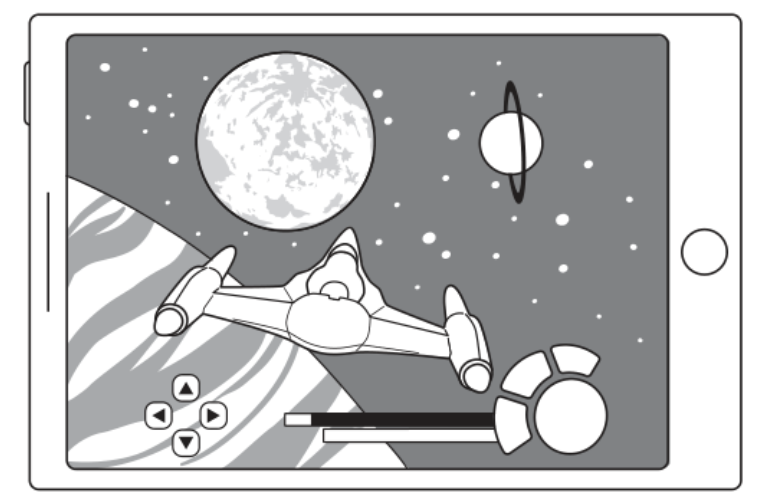
In Space Race, you will equip your spaceship with supplies to use on your journey and discover new planets while racing around the galaxy. As you visit new planets, you can interact with alien species, collect plant samples to study, and obtain additional supplies for your journey. Race to each checkpoint in the game to earn points and upgrade your ship. With thousands of planets to explore, Space Race is always exciting!
Features
• Two race modes: timed and player vs. player
• Online or offline play
• Thousands of different planets to explore
• Ability to choose and customize your ship
• Variety of plant and animal life waiting to be discovered
In addition, Space Race contains five mini games for even more fun and points:
• The Workshop: Use supplies you have gathered to craft upgrades to your ship.
• Match It: Match pictures of the planets.
• Singing Creatures: Create your own songs, using sounds from the creatures
you discover.
• Mixed-Up Messages: Decode scrambled messages for clues to help you reach
the next checkpoint.
• Maze Escape: Find your way out of the maze and get valuable supplies and
points.
Critics and players alike love Space Race!
“Space Race is a must-play game for this year.”—Games Review Online
“8/10: great graphics and a lot of fun!”—Video Game Shop
“It is the game everyone is talking about.”—Technology Today
“We give Space Race 4 out of 5 stars.”—Rayelle Edwards, Game Blogger
Do not wait; get your copy of Space Race today!
2 points
2
Question 6
6.
Which types of evidence are offered in "Space Race Advertisement" to support the claim that it is a great game? Choose two answers.
1 point
1
Question 7
7.
Which paragraph in "Space Race Review" describes how players can invent something new?
2 points
2
Question 8
8.
In "Space Race Review," the critic offers both positive and negative aspects about a video game. Complete the table by writing each detail in the Answer Bank under the correct heading.
1 point
1
Question 9
9.
How are 'Space Race Advertisement' and 'Space Race Review' alike?
The Bell of Atri
A folktale from Italy
Long ago in the village of Atri, King John thought about what would benefit the people. After
pondering many ideas, he called a smith of fine metals and asked him to make a bell.
“The bell must be large,” said the king, “and beautiful, and have a lovely sound loud enough to be heard throughout the countryside.”
“Certainly,” answered the smith. “I will begin immediately, but should it have an inscription?”
The king handed a note to the smith. “Engrave this on the bell,” he said.
When the bell was finished, the king had it hung in the town square. All the people of Atri admired the beautiful bell and strong rope that reached nearly to the ground. However, they were puzzled by the single word on it.
“Justice,” mused one man, “what does that mean?” Others shook their heads because they didn’t understand either.
“Here comes the king,” shouted a young girl. “Perhaps he will tell us.”
As the king drew closer, the crowd fell silent. “Citizens of Atri,” began the king, “this is your bell, but it has a single purpose—notice the word—Justice. Anyone who is wronged by another should ring the bell. Then judges will come, hear the complaint, listen to witnesses, and decide what needs to be done to set the matter right.”
“Will anyone be allowed to ring the bell?” asked one woman.
“Anyone who has been wronged,” answered the king.
“Even children?” asked a boy who longed to pull the bell-rope.
The king swallowed a smile. “Even children,” he said, “but only if they have been wronged. Let’s hear it now, so all may know what justice sounds like.” He beckoned to the boy and handed him the rope. The bell sang a clear note, powerful as thunder, that echoed back from the hillside. The crowd cheered.
During the course of time, the bell was heard when the people of Atri had disagreements. However, as they saw how fairly the judges ruled, they became kinder to each other, so the Bell of Justice was heard less and less.
On her way to the market one day, a woman noticed the bell-rope was weather-worn. “It is getting shorter every day. Soon,” she said with a smile, “only very tall people will be able to receive justice.”
“That is no joking matter,” said a man. “It must be replaced immediately.”
Alas, nowhere in the entire town was there a rope long enough to reach from the bell to the ground.
The merchant who sold such goods said, “A replacement will have to be ordered from the town across the mountain.”
A farmer spoke up: “Until a suitable rope arrives, I could fashion one from hay.” The townspeople agreed, so the farmer braided fresh strands into a thick rope and tied it to the bell.
Now it seems that living halfway up the hill from Atri was a man who at one time owned a great deal of land, cattle, and horses. Everyone knew he had become more interested in acquiring gold and less interested in maintaining his property. He had sold his cattle and most of his horses and let his barns go into disrepair. Rather than use his gold to buy hay and oats, he even turned out his old horse to fend for itself.
One day as the horse wandered the countryside looking for grass to eat, it came to Atri. The odor of fresh hay led the horse right into the town square, where it went directly to the bell-rope and began nibbling. As it chewed, the bell rang, but the horse kept on eating.
At the sound of the bell, a crowd gathered, and the judges came running. “Who rang the bell?” one asked.
“The horse did,” said a girl. “It’s the horse that belongs to the man who lives halfway up the hill.”
“Is that so?” said a judge. “Look at the poor beast; it’s hungry. Summon its owner immediately.”
Several citizens hurried up the hill and, finding the man counting his gold, brought him before the judges.
“See here,” said one judge, “your horse served you well for many years, and now you have turned it out while you count your gold—gold that could provide oats and hay and a fine barn for shelter.”
The man hung his head in shame as he heard the judge’s words. “You are hereby ordered to take care of this fine animal in the manner it deserves.”
“And,” said another judge, “you shall pay for a new rope for the bell.”
“After all,” said the third judge, “even an animal deserves justice.”
The townspeople cheered, and a small boy offered the horse an apple.
2 points
2
Question 10
10.
According to the passage, why would citizens ring the bell? Choose two answers.
2 points
2
Question 11
11.
Read the sentences from the passage.
“Certainly,” answered the smith. “I will begin immediately, but should it have an inscription?”
Which sentences best help the reader understand the meaning of the word 'inscription'? Circle two sentences.
1 point
1
Question 12
12.
Choose the correct words to complete the analogy: Metal is to __________ as __________ is to judge.
2 points
2
Question 13
13.
King John and the man who lives halfway up the hill are very different. For each character, choose the word that best describes the character. Then, choose the passage detail that best supports the word. Write your answers for each character in the chart.
Madam C. J. Walker
It is the year 1918. An automobile has arrived at a mansion near New York City. Stepping out of the automobile is an elegant African American woman. The woman is Madam C. J. Walker, and the mansion belongs to her. She is one of the wealthiest, most famous women in America.
How did Walker make her fortune? Hair! That’s right—hair.
Early Life
Walker’s original name was Sarah Breedlove. She was born in Louisiana in 1867. Her family
struggled to survive. Eventually, Sarah moved to St. Louis, Missouri, where her brothers lived. She worked hard to support herself and her young daughter, Lelia.
Sarah was determined to give Lelia an education. To earn money, Sarah washed laundry. And when Lelia was 17, Sarah was able to send her off to college.
Meanwhile, Sarah had a little problem: her hair was falling out. Back then, women usually didn’t wash their hair very often. When they did, many used soap that contained chemicals such as lye.
Lye was a common cleanser, but it was so harsh that it could burn flesh! A poor diet and lack of combing contributed to hair loss. Other complaints, like severe dandruff, itchy scalp, and thin, dry hair were very common.
Sarah wanted to feel and look better. She knew other women did too. She began working for
another woman who was trying to solve the same problem. They knew that a healthy scalp would grow healthier hair. Their treatment used a special scalp tonic. The process required more frequent washing and combing.
Fame and Fortune
In 1905, Sarah moved to Denver, Colorado, where she began making her own scalp tonic. To sell it, she knocked on doors. She met with people who could spread the word about her product. Sarah also trained women all over the country to sell her scalp tonic. By then, Sarah called herself Madam C. J. Walker. Each year, she and her sales agents increased their sales of Madam C. J.
Walker’s Wonderful Hair Grower.
Madam Walker’s was not the first, or only, product invented to help women’s scalp problems.
However, she was very ambitious and had a great mind for business. She traveled all over the United States to show off her products. She advertised and gave lectures. She had hundreds of sales agents, along with a huge mail-order business. Most importantly, her products worked. Sarah herself had grown a lovely head of long, thick hair.
In 1910, she moved to Indianapolis, Indiana. She built a factory there to make her Wonderful Hair Grower and other hair products. Madam Walker was experiencing a great deal of success. Helping others was important to her, so she gave money to charities and food baskets to needy families. In 1916, she moved to New York City to be near her daughter, Lelia.
By then, Madam Walker was the wealthiest African American woman in the United States. She was powerful and famous. In 1918, she moved into her beautiful new mansion north of New York City. It had 34 rooms and a garden with fountains and statues. She filled the rooms with art, books, and elegant furniture. The mansion became a gathering place for important guests. Madam Walker had come a long way from her humble beginnings and had experienced a great deal of success.
Lasting Influence
Madam C. J. Walker did much more than fix people’s hair problems. Along with teaching her agents how to sell hair products, she taught them to make smart decisions and to be independent. She also used her wealth and influence to support many causes. She made donations to African American schools and gave speeches on racial justice.
Madam Walker’s success inspired not only African Americans but women too. She proved that with focus and determination, anything is possible.
2 points
2
Question 14
14.
Which sentences best explain Sarah’s reasons for making a new hair product? Circle three sentences.
1 point
1
Question 15
15.
Read the analogy.
Tonic is to __________ as __________ is to sundae.
Choose the words that best complete the analogy. Choose one answer for each blank.
1 point
1
Question 16
16.
Part A
Which word describes the viewpoint the author most frequently expresses about Madam C. J. Walker?
1 point
1
Question 17
17.
Part B
Which evidence from the passage best supports the answer to part A?
1 point
1
Question 18
18.
The author states that Madam C. J. Walker “used her wealth and influence to support many causes.” Which evidence from the timeline supports this statement? Choose two answers.
1 point
1
Question 19
19.
A student is writing a research paper on how steamboats are powered. Which source would give the student the most useful information?
2 points
2
Question 20
20.
A student is sorting notes for a research report about the chickadee, a type of small bird. Read the notes in the table below. Use the words in the Answer Bank to choose the best headings for the notes. Write two headings in the correct places in the table.
2 points
2
Question 21
21.
A student is writing a research report on plant life in wetlands. The student found a source. Circle two sentences with information that the student can use in the report.
1 point
1
Question 22
22.
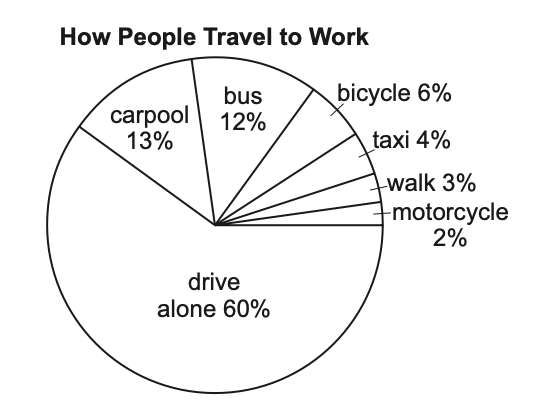
A student is researching the use of public transportation in her state. She found the pie chart and took notes about it.
Based on the pie chart, which note is accurate?
1 point
1
Question 23
23.
A student is writing a report on the benefits of playing the game of chess. He found several sources. Which sources would have the most useful information for the report? Choose two answers.
1 point
1
Question 24
24.
A student wrote this research question: Why was the Santa Fe Trail important? His teacher suggested that he make the question more specific. Which revision of the question best helps to focus the topic?
2 points
2
Question 25
25.
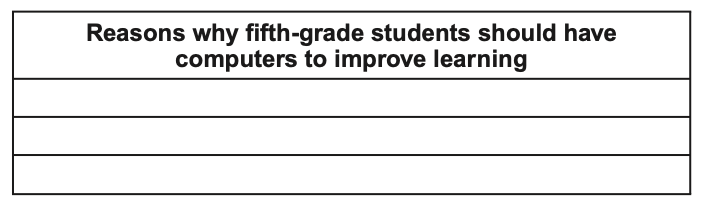
A student wants to persuade the principal to give fifth-grade students computers to improve student learning. She is using a chart to organize her notes for the letter.
Which three notes will best help her complete the letter?
1 point
1
Question 26
26.
A student has an assignment for gym class that requires her to convince the principal to create a bike lane on the school grounds. Which type of writing would work best for the purpose of the assignment? Choose two answers.
1 point
1
Question 27
27.
Read the paragraph.
1 A popcorn kernel has a soft, moist center made of starch. 2 A hard shell protects it. 3 The kernel is turned inside out, and the soft center fills with air. 4 When the kernel is heated, the moisture in the kernel turns to steam, builds pressure, and “pops.” 5 Popcorn kernels expand to almost double their size when they are popped.
Two sentences in the paragraph need to switch order. Which sentences should be switched to improve the organizational structure of the paragraph?
1 point
1
Question 28
28.
Read the sentences. Selected the underlined word that correctly completes each sentence.
Emil stood in the stage wings, waiting for his cue to enter. He had already adjusted the microphone __________he was using. He knew to avoid looking directly into the spotlights, __________ were very bright. All he had to do was gather the courage to walk on stage and start the show.
2 points
2
Question 29
29.
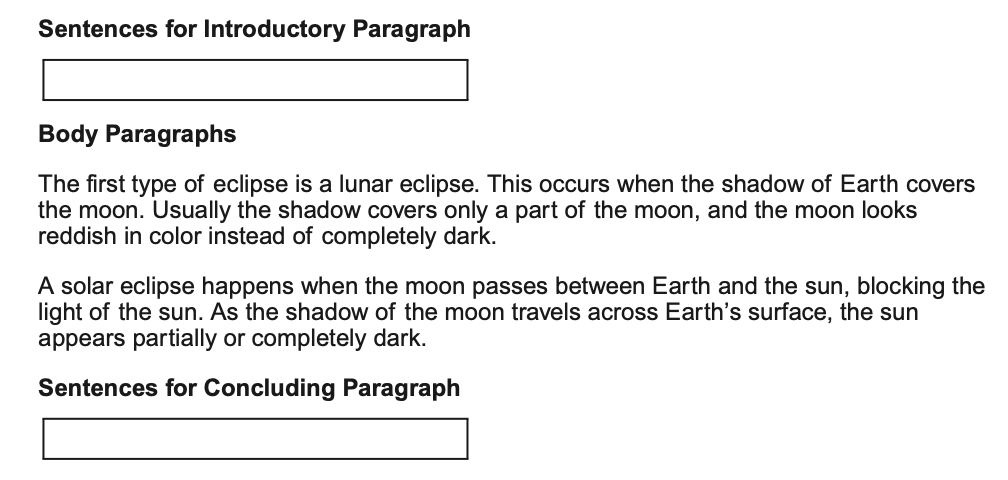
Read the body paragraphs from a student’s report about eclipses of the moon and sun (image left).
The student needs to add an introductory paragraph and a concluding paragraph to the report.
Choose 2 sentences for the introductory paragraph and 2 sentences for the concluding paragraph. Write the letters of your answers in the correct boxes.
1 point
1
Question 30
30.
Read the sentence: "Bees may make delicious honey, but they can harm people by stinging them." Why is the word “but” used in the sentence?
1 point
1
Question 31
31.
Read the following paragraph:
__________ They should make sure they include any homework that is due that day. It is
important that students make sure they have enough supplies, such as pencils, pens, and
paper. They should also make sure their backpack holds anything special required for the day, such as gym shoes.
Which topic sentence would best begin the paragraph?
1 point
1
Question 32
32.
Read the paragraph.
The beaches along the Atlantic coastline of Brazil are crowded with people on the weekends. Thousands of fans support soccer, the national sport, and the most popular athletes in Brazil are soccer stars. The Carnival of Rio de Janeiro is world famous for its beautiful floats, costumes, and dancing. Brazilian music features the rhythms of traditional and new styles of music. Monuments and sculptures decorate the cities and the countryside, telling the story of Brazil’s past. Colorful architecture, including buildings of bright and detailed design, shows the artistry of the Brazilian people.
Which topic sentence would best begin the paragraph?
2 points
2
Question 33
33.
Read the paragraph. Select the correct underlined verb in each sentence.
Because helicopters __________forward, backward, and sideways, they are useful in many ways. One of their uses __________to rescue people who are stranded. Helicopters also __________ as flying ambulances. Before helicopters came into use, these types of rescue efforts __________ impossible to carry out so quickly and easily.
1 point
1
Question 34
34.
Read the paragraph. Circle the sentence that should be moved to a concluding paragraph.
Listen to the presentation: Redbird Reef
1 point
1
Question 35
35.
Why do coastal towns want to create artificial reefs?
1 point
1
Question 36
36.
What two things are done to the subway cars before they can be dropped into the ocean?
1 point
1
Question 37
37.
Part A
What is the main point of the presentation?
1 point
1
Question 38
38.
Part B
Which evidence from the presentation best supports the answer to part A?
1 point
1
Question 39
39.
What happened as a result of the success of the Redbird Reef?
Listen to the presentation: The Story of My World Record
1 point
1
Question 40
40.
Why does the speaker know so much about world records?
1 point
1
Question 41
41.
The speaker made several different attempts to set a world record. Each attempt had a different type of result.
Complete the chart using the list of attempts in the Answer Bank. Write each attempt in the box next to its result.
1 point
1
Question 42
42.
What made the speaker’s last attempt to set a world record so difficult?