I spotted Philo at school, and I joined him. “Good morning, Philo,” I said.
“Hi, Amelia,” Philo replied, startled from his daydreams. “You’re up early.”
“I don’t have to be late to class anymore,” I said. “My father finally supports my education. Mother convinced him that a girl with my intelligence has a promising future, so no more morning chores.”
Philo listened, but I could tell he had something else on his mind. “Pondering some new invention?” I asked.
A huge grin appeared on Philo’s face. “Mr. Tolman is going to love it.”
Our chemistry teacher, Mr. Tolman, always approved of Philo’s crazy theories. Well, maybe they weren’t completely crazy. Last year, when he was only 13 years old, Philo won a national competition for inventing a magnetized tamperproof lock that no criminal could crack. This year, Mr. Tolman promoted Philo to senior chemistry with us older kids. Since I’m the only girl in the class, Philo and I formed a friendship over being different from the others. Most girls enrolled in cooking and sewing classes, but I craved scientific enlightenment.
When we arrived at the classroom, an obnoxious student by the name of Ethan stood in the doorway. “Password?”
“Tolman,” I said, glancing behind Ethan. Ethan turned, thinking our teacher had entered through the other door. This gave Philo and me enough room to slip past him. Ethan growled at being tricked and pursued us.
“Hey, kid. I think you’re in the wrong class,” Ethan said. The other students laughed at this, but I gave him a mean look, and he didn’t say anything more.
I decided to cheer Philo up with a surprise I brought. “I have the new issue of Popular Science magazine.” Philo and I marveled at all the fantastic new innovations and ideas in the periodical. His eyes brightened as I handed over the magazine.
But Philo was too excited about his own idea to focus on reading the new issue. Ethan pounced. “You have something exciting to tell the teacher today?”
“Maybe,” Philo replied, trying unsuccessfully to hide a smile.
“Let’s see. What did you turn electric this time? First there was the washing machine, then the sewing machine... you make an electric horse?” Ethan and his friends laughed.
“I added lights to the barn so we can extend our workday,” Philo said quietly.
“I guess that would be useful,” Ethan replied, deflated. Mr. Tolman entered, and we scattered to our desks.
Mr. Tolman wrote the date on the board and asked, “Before we get started, anyone wish to share any new ideas for your science projects?”
Ethan raised his hand. “I invented electric barn lights so we can work more hours on the farm.” Mr. Tolman looked surprised, but other kids chuckled and scoffed, revealing the lie. Ethan continued.
“Or was that Philo?”
“Barn lights. Most impressive, Philo. Do you want to tell us about that?” Mr. Tolman asked. The other students moaned and gave Ethan irritated looks for mentioning it.
Philo started to shake his head no, but I urged him to speak. “Ignore them. I know you really want to share your idea with Mr. Tolman. He and I would like to hear what you’re developing.”
Philo stood nervously. “I have a different concept to share.” Philo paused and looked at me, but I nodded and smiled, encouraging him to continue. “Every time I hear a radio, I keep thinking, wouldn’t it be phenomenal if we could see the people we are hearing?” Philo pulled out a sketch he drew to show us. “I believe I found a way to do this with my image dissector tube.” Philo could see our puzzled expressions, including Mr. Tolman’s. He pointed excitedly at his drawing. “When shooting a stream of electrons at a fluorescent screen inside a glass tube, an image can be
reflected.”
Everyone was still completely lost except for me. I understood. “It’s a bit like...a shadow? When you get between the sun and something else, your shadow is cast on that object.”
Philo continued, boosted by my support. “Yes! But instead of shadows, these would be actual images, like moving photographs.”
Mr. Tolman reached for Philo’s drawing. “May I have a look, Philo?” Philo happily handed over the sketch. “This is impressive.”
Philo continued. “The idea dawned on me when I was plowing our potato fields. The horse and plow cuts the field in parallel lines, back and forth, row after row. This is how the images can be produced by electrons, by directing light onto a fluorescent screen in a glass tube where the electrons will cause sections of the screen to glow to form the image.” Our reactions ranged from awed to dumbfounded.
I leaned over to Philo and said, “Incredible!”
“Thank you, Amelia,” Philo replied, smiling warmly. “I don’t know if I would have said anything if it hadn’t been for you. I was worried they were going to laugh at me.”
“Not while I’m around. I grew up with these boys, and they know when it is time to be serious and listen,” I said confidently.
As we left class, I overheard Ethan saying, “I have to figure out electric lights in the barn. My father would love that.”
Many years later, we all realized that we had been a part of something amazing that day: the birth of television, brought to life by an inventive Utah farm boy named Philo Farnsworth.
1 point
1
Question 1
1.
Read the sentences from the passage:
When we arrived at the classroom, an obnoxious student by the name of Ethan stood in the doorway. “Password?”
“Tolman,” I said, glancing behind Ethan. Ethan turned, thinking our teacher had entered through the other door. This gave Philo and me enough room to slip past him. Ethan
growled at being tricked and pursued us.
What does the word "obnoxious" mean?
2 points
2
Question 2
2.
Which sentences best develop the idea that Philo is a talented scientist in spite of his young age? Circle two answers.
1 point
1
Question 3
3.
PART A
Which statement best states a theme of the passage?
1 point
1
Question 4
4.
PART B
Which excerpt from the passage best supports the answer to part A?
1 point
1
Question 5
5.
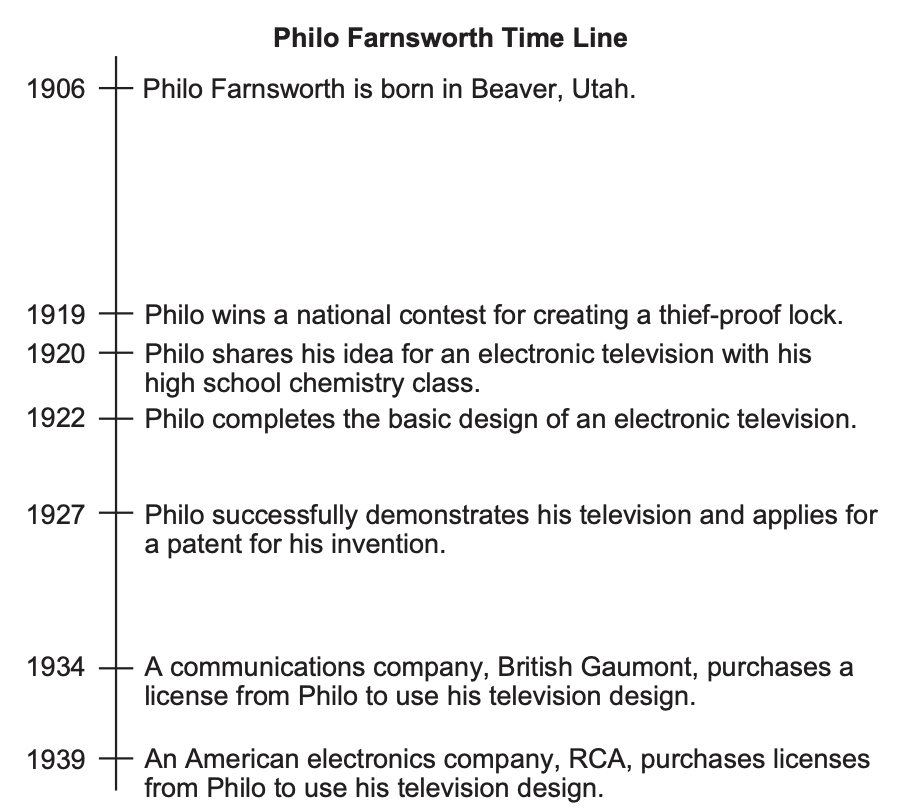
Based on the 'Philo Farnsworth Time Line,' which event occurred soon after the events that are described in the passage?
8 points
8
Question 6
6.
“The Birth of Television” mentions that an American electronics company called RCA purchased licenses from Philo to use his television design. Think about what may have happened when Philo presented his television design to the people at this company.
Write a narrative for your teacher about Philo presenting his ideas to a group of people at RCA. Be sure to use narrative elements such as sensory details, dialogue,
figurative language, and description as they are appropriate in your writing. Use details and information from the passage in your narrative.
Record-Breaking Day
A story set in 1927
Patrick and Kip walked the three blocks to the baseball diamond behind the schoolyard for some extra practice on the field before the big game. The two didn’t mind walking because it had been raining all week and this exceptionally beautiful spring day was a much welcomed break. The sun warmed their backs as they breathed in the fresh air and talked about baseball every step of their journey.
“Just think about it, Kip,” Patrick said as he tossed a ball and caught it in his baseball glove. “If we win our next game, we’ll have a perfect season... six wins with no losses.”
Kip thought about what Patrick said for a moment before responding. “That’s true,” Kip replied, “but the team we’re playing next week is really good. They haven’t lost any games this season either, and I heard they have a player who hits a home run nearly every time he’s up at bat.”
“If we keep practicing, I’m sure we can beat them,” said Patrick.
Before they got to the schoolyard, the two stopped by another friend’s house to see if he wanted to practice with them. John played first base and was the best hitter on the team. As they stepped up to the door, they could hear a commotion going on inside the house. Before they could knock, John opened the door and shouted so the entire neighborhood could hear. “He did it! Charles Lindbergh landed in Paris, France, early this morning!”
Patrick and Kip stared as though they didn’t comprehend a word of what John was saying.
“Don’t you understand?” John asked, an edge of excitement in his voice. “This is an extraordinary achievement. Charles Lindbergh—I call him Lucky Lindy—left New York in his airplane yesterday. He landed in Paris today! May 21, 1927—I’m going to remember this day the rest of my life!” John was so excited, he could barely contain himself. Patrick and Kip were puzzled.
“We want to practice before the big game next week,” Patrick said. “Why don’t you get your glove and bat and come along?”
“I’m going to keep listening to the news reports on the radio,” John said. “Besides, the team we’re playing next week is really good. We don’t stand a chance.”
“If we practice we’ll get better,” Patrick said. “When a team works together, nothing is impossible.”
“Listen, I have nothing against practice,” John said, “but Lindbergh’s achievement is historic. More than a hundred thousand people were waiting for him to land in Paris. I imagine the U.S. ambassador in France even showed up for the occasion. The announcer on the radio said that once the propeller on Lucky Lindy’s airplane stopped rotating, he was immediately surrounded by thousands of well-wishers.”
“What’s so special about landing an airplane in France?” Kip asked.
John sighed as he continued his explanation. “He flew all by himself, all the way across the Atlantic Ocean without stopping. No one has ever done that before; some thought it was impossible. This achievement is a testament to Lindbergh’s persistence and knowledge about flight. Just imagine the possibilities.” John’s voice drifted off as he thought about the open sky above.
Kip spoke up, “I guess this means that you’d rather listen to the radio than go to the diamond to play baseball with your teammates.”
“It’s not that, Kip,” John replied. “It’s just that something like this may never happen again in our lifetime. I don’t want to miss it.”
John could not understand why his friends were not more excited about Charles Lindbergh’s nonstop, solo flight across the Atlantic Ocean from Long Island, New York, all the way to Paris, France. “Think of this—” John said, “the Wright brothers were the first human beings to use an engine, a couple of wings, and a few gadgets for their first flight. Do you remember what year that happened?”
“The Wright brothers’ first flight was in 1903,” Patrick answered. “We learned that in school last week.”
“That’s right,” John noted. “Now think about this: When the Wright brothers flew for the first time, that was only twenty-four years ago. Imagine that! In only twenty-four years, powered flight has gone from traveling a few hundred feet to what occurred today, a nonstop, solo flight across an entire ocean.”
“Well,” Kip replied, “Patrick and I want to get in some practice today. Are you coming with us or not?”
“Go ahead without me,” John answered. “I guess you two just don’t realize how great an achievement this is. Just think, someday we’ll be building rocket ships that will punch through the stratosphere and take us to the moon, or maybe even to faraway planets.”
Patrick and Kip looked at each other and snickered.
“That’ll never happen,” Patrick added as he and Kip walked down the porch steps to continue on their way to the baseball diamond.
John spoke up, “I do believe it will happen someday.”
2 points
2
Question 7
7.
How do the author’s descriptions of the setting, Patrick, and Kip in the opening paragraph contribute to the overall meaning of the passage? Choose two answers.
1 point
1
Question 8
8.
PART A
Which sentence describes a theme in the passage?
1 point
1
Question 9
9.
PART B
Which sentence from the passage best supports the answer to part A?
2 points
2
Question 10
10.
Read the conclusions in the table. Choose the evidence in the Answer Bank that best supports each conclusion. Write the letter of the evidence in the appropriate box. Write one letter in each box.
Only two choices in the Answer Bank will be used.
1 point
1
Question 11
11.
Read the sentences from the passage:
Before they could knock, John opened the door and shouted so the entire neighborhood could hear. “He did it! Charles Lindbergh landed in Paris, France, early this morning!”
How do the sentences change the tone of the overall passage?
1 point
1
Question 12
12.
Circle the sentence that best supports how John’s attitude toward Charles Lindbergh differs from his friends’.
Columbia Basin Pygmy Rabbits
In the dry, wide-open country of eastern Washington state, a tiny rabbit pops its head from a dusty burrow. The rabbit is a Columbia Basin pygmy rabbit. It is North America’s smallest rabbit species, barely bigger than a kitten. It is also one of the only rabbit species in the United States that digs its own burrows.
But these days, spotting a pygmy rabbit here is very rare. Like many other animal species, it has declined because of shrinking habitat. Now, wildlife biologists are trying to bring back these little bunnies. Will they succeed?
Perfect Match
Columbia Basin pygmy rabbits are a perfect match for this landscape, which was once called “the sagebrush sea.” The rabbits eat almost nothing but that sagebrush, which is a tough, bitter plant that most other animals can’t digest. They have long claws, good for digging the burrows where they live and hide.
Pygmy rabbits can also survive eastern Washington’s harsh climate, where summers sizzle over 100 degrees Fahrenheit and winters dip far below freezing. Although small, they can hop up to 15 miles per hour. That helps them escape the coyotes and hawks that like to eat them.
For thousands of years, these tiny rabbits lived large here. They had everything they needed. There was endless sagebrush to eat. The loose, deep soil made for easy digging. And although they are a favorite snack item for predators, there were enough pygmy rabbits for the species to survive.
Bunnies in Peril
But that changed when people began to ranch and farm the region. They cleared vast areas of sagebrush to plant wheat. Their cattle trampled the soil, compacting it and making it harder to burrow. Cheatgrass, an invasive grass accidentally brought from Europe and Asia, overran the ecosystem, replacing sagebrush. Even worse, cheatgrass ignites easily, causing big brush fires that destroy even more sagebrush. Now, over 30 percent of the Columbia Basin pygmy rabbit’s habitat has disappeared. Gone along with it are most of the rabbits.
In 2001, biologists searching for pygmy rabbits in the region found fewer than 30 little bunnies. The Columbia Basin pygmy rabbit was a whisker away from extinction.
Operation Rabbit Rescue
It was time for a rabbit rescue operation. First, biologists whisked 16 of the survivors to safety. Without predators, perhaps the rabbits could breed and their numbers increase. Eventually, hoped the biologists, more pygmy rabbits could be released back into the wild.
But there weren’t enough left to build a new population. So the biologists brought in a similar species from Idaho to mate with the ones from Washington. More pygmy rabbits were born in this safe, captive environment. Then, in 2007, 20 were released into the wild. Freedom was short lived. Within months, all 20 disappeared, mostly eaten by predators.
A Hopping Head Start
Finally, wildlife biologists designed a way to ease the rabbits’ transition into the wild. They fenced in two enclosures of sagebrush in the rabbit’s native habitat. Each enclosure was as big as several football fields. The biologists installed artificial burrows so the rabbits wouldn’t have to dig their own.
Scientists added plastic dog houses for even more protection, put up netting to keep hawks from dropping in for a meal, and occasionally offered bunny food. Then, they introduced about 50 captive-bred pygmy rabbits to their new home.
Soon, the coyote-proof enclosures were hopping with new pygmy rabbits. About once a month, biologists captured a few, tagged them with tracking devices, and released them into the wild.
Within a few years, over 1,000 pygmy rabbits were released. Using the tracking devices, biologists can tell that many have survived. But has this rescue operation really saved the whole species from extinction? Time will tell.
Critical Balance
It’s easy to wonder if saving one small rabbit species is worth so much trouble. Like any animal or plant, Columbia Basin pygmy rabbits have special roles within their ecosystem. For example, when the rabbits dig their burrows, they loosen the soil. That makes it easier for plants to take root. Even the rabbit’s droppings may enrich the soil for specific plants. And, of course, the little rabbits are a crucial food source for predators. Those predators, in turn, play their own role in the ecosystem.
Anytime one species disappears, an entire ecosystem is thrown off balance. What’s more, every ecosystem is connected to others, affecting animal migrations, plants, and even weather patterns. No wonder rescuing a creature as tiny as the Columbia Basin pygmy rabbit is so important.
1 point
1
Question 13
13.
Read the sentence from the passage.
First, biologists whisked 16 of the survivors to safety.
How does the use of the word 'whisked' contribute to the tone of the sentence?
1 point
1
Question 14
14.
How does the author’s inclusion of the section 'A Hopping Head Start' contribute to the meaning of the passage?
2 points
2
Question 15
15.
Which sentences from the passage best support the conclusion that human actions have negatively impacted the pygmy rabbit population? Choose three answers.
1 point
1
Question 16
16.
PART A
Which statement best expresses a central idea of the passage?
1 point
1
Question 17
17.
PART B
Which statement best explains how the author develops the idea in Part A?
1 point
1
Question 18
18.
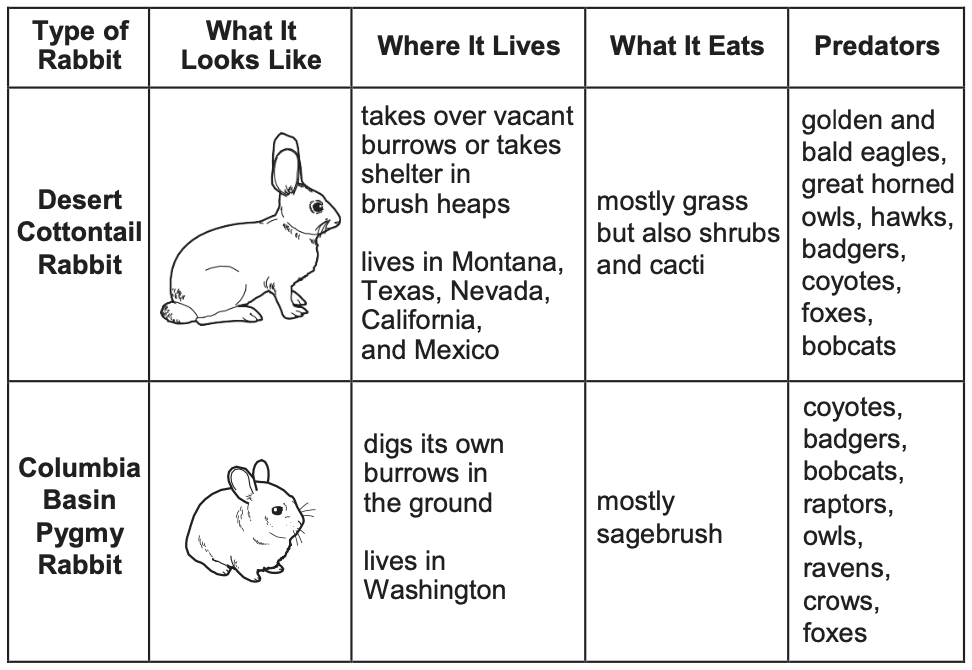
Based on the table at the end of the passage, how does the desert cottontail rabbit compare to the Columbia Basin pygmy rabbit?
Wanted: Volunteer Experience
Heather roughly closed the laptop computer and stood up in a huff. She grumbled to her mother, “The school advisor said I need volunteer experience this summer to be a new-student orientation leader in the fall, and you say that anything I do has to be close enough for me to bike or walk. But there is nothing available nearby!”
“I know it’s frustrating, Heather,” said Mom. “I’m working this summer, and I can’t be home to drive you places. Keep looking; I know that something is bound to come up.”
Heather sighed and opened the local newspaper, scanning each page for opportunities she hadn’t already read online. After careful examination, she noticed an article about a summer project in the city park near her house. Volunteers were working in the evening to clean up areas that would display new sculptures made by local artists. “Mom, will you help me check this out?”
Heather asked. “I think I could be a great worker on this one, and I could get there on my own.”
Mom quickly agreed. “Why don’t we walk there and check it out for ourselves after dinner?”
The city park was bustling with activity when Heather and Mom arrived. Community members were working all around the park. “Over there,” a man said, gesturing in Heather and Mom’s direction, “put those trash bags in the bed of the truck; then come help lift this fork-and-spoon sculpture and set it next to the oak tree.”
“You mean us?” Heather and Mom pointed to themselves.
“If you’re here to work, yes; we need all the assistance we can get. Tomorrow is our deadline, and if we don’t finish tonight, we won’t be able to show off this spectacular art at the reception tomorrow night,” the man explained.
Heather and Mom put on work gloves and dived into the tasks. Soon the evening air cooled, and the sky turned dusky blue. “Did I hear you correctly when you said that the project will be over tomorrow?” Heather asked the man in charge.
“Yes, you really helped us out tonight; your extra hands were just what we needed to finish,” said the man thankfully.
Heather and Mom said they would return as reception guests, but Heather’s shoulders slumped as she and Mom walked home. “How can I report only one night of volunteer experience to my school advisor? More bad luck,” Heather moaned.
“You never know what’s going to happen, sweetie. You found this opportunity, and I’m sure there will be another one coming your way. Let’s go to the reception and see who we meet,” Mom said.
At the moonlight reception, Mom and Heather joined Heather’s friend Ken and his mom, Ms. Lee, who, it turned out, knew about another volunteer project. “The plan was to build an outdoor structure near the lake out of sticks, but the woman who proposed it has given up and quit, leaving a partially finished project that has brought many complaints. Maybe we could help out,” said Ms. Lee. “Tomorrow I’m free to walk Heather and Ken to the lake to check out the details.”
“That sounds wonderful,” said Mom.
The next day at the lake, Heather, Ken, and Ms. Lee met a couple of dedicated folks ready to finish the project to help beautify the community. “Hi, I’m Carrie, and you’re all just in time to begin today’s work,” said a young woman with a big smile.
“We’re going to need three hundred to four hundred more sticks; I’ll show you where to start,” said Cal, another volunteer carrying a load of sticks as big as a suitcase. All afternoon the group gathered and positioned larger sticks along the foundation, weaving them in and out and around
the base. It became a giant jigsaw puzzle as each person selected and placed sticks to fit and complete each section.
Three days later the volunteer squad had grown to fifteen people of all ages from all across the area, and news of the unusual stick fort traveled quickly with many curious community members stopping by to chat about it. Heather and Ken cheerfully answered questions and guided the
newcomers in the building process. By the end of the day, the fort was complete, and the local newspaper crew arrived to photograph the incredible stick fort and the volunteers who had so graciously built it.
The following week, on a visit to the library, Heather was approached by the librarian. “Aren’t you one of the people who were featured in the article about the stick fort near the lake?” he asked as he held up the newspaper. “I’m looking for a volunteer to help with our preschool story time here at the library next week. You’re just the kind of experienced and responsible young person I’m looking for,” he said. Heather nodded enthusiastically.
“Mom, it’s even better than I expected!” Heather exclaimed when she saw her mother that evening. “Instead of one job, I can list three volunteer jobs from this summer.”
“You see?” Mom replied with a smile. “I knew it all would work out.”
1 point
1
Question 19
19.
How does the author’s word choice in the first paragraph contribute to the tone of the passage?
2 points
2
Question 20
20.
Read the inferences in the chart. Choose the evidence from the passage in the Answer Bank
that most strongly supports each inference. Write the letter of the evidence in the box beside
the inference it supports. Write one letter in each box. Only two choices in the Answer Bank
will be used.
1 point
1
Question 21
21.
Read the paragraph from the passage.
Three days later the volunteer squad had grown to fifteen people of all ages from all across the area, and news of the unusual stick fort traveled quickly with many curious
community members stopping by to chat about it. Heather and Ken cheerfully answered
questions and guided the newcomers in the building process. By the end of the day, the fort was complete, and the local newspaper crew arrived to photograph the incredible stick fort and the volunteers who had so graciously built it.
How does the author’s description of Heather’s day contribute to the tone of the passage?
1 point
1
Question 22
22.
PART A
Which statement best describes a theme in the passage?
1 point
1
Question 23
23.
PART B
Which sentence from the passage best supports the answer to part A?
1 point
1
Question 24
24.
Circle the underlined word that suggests a feeling of excitement.
1 point
1
Question 25
25.
A student is conducting research to gather support for his claim that a class on the basics of interpersonal communication and public speaking should be offered at his school.
Which source would give the student the most relevant information to use in his argument?
2 points
2
Question 26
26.
A student has written a draft paragraph from his research on honeybees, but the paragraph is overly broad. Read the paragraph:
The honeybees that buzz around flowers are worker bees that gather nectar. Honeybees suck up nectar from plants and store it until they can deposit it into the hive. There, the nectar is transformed into food. Honeybees also play an important role in the plant reproduction process. As they travel from flower to flower, they carry grains of pollen.
The student wants to develop the three topics in his paragraph by finding more specific information he can use to write three additional paragraphs about honeybees.
Read the topics in the table and the research questions in the Answer Bank. Write the letters of the research questions in the table beside the topic each question supports. Use each question one time. A topic may have one or two questions
One of the most important differences between the British and the American colonists was the question of titles of nobility. In England, nobles had great power because their titles went back for generations, and their families held great estates and wealth. In England, people were either royalty, nobility, or commoners. This was not the case in America. In the colonies, no one cared about noble titles. Instead, people were judged by their skills. Were you a blacksmith? Did you know how to build a house? Were you strong enough to cut timber and clear fields? People had to be very self-reliant to live in the New World. The people who rose to leadership in government in the colonies were not the descendants of nobility or royalty. Instead, they were the hardest working and most successful property owners, business people, shipbuilders, or craftspeople. They did not like answering to a king thousands of miles away.
1 point
1
Question 27
27.
Read the information from a source (left)
Which sentence avoids plagiarism and is the best paraphrase of the underlined sentences from the source?
2 points
2
Question 28
28.
A student is writing an argumentative report to support her claim that George Washington’s leadership helped win the Revolutionary War.
Which sources would provide the most relevant information for the student to use in her report? Choose two answers.
1 point
1
Question 29
29.
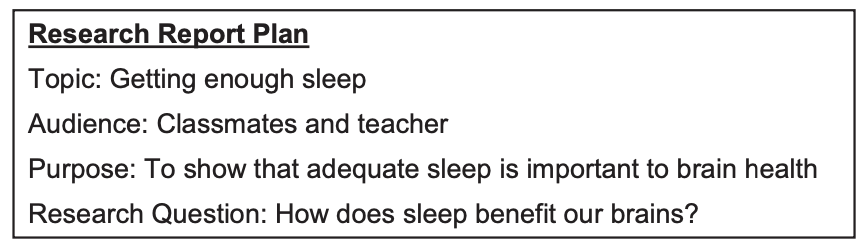
A student is writing a research report about sleep. Read the student’s research report plan.
Read the paragraph from a source. Circle the sentence containing information that best supports the student’s claim.
Put a cough drop into your mouth and immediately the stinging, minty, frosty sensation of eucalyptus fills your nose and throat, making it easier to breathe without coughing. The eucalyptus in cough drops comes from the leaves of the eucalyptus tree. These trees are most abundant in Australia, thriving in all of its varied climates. Eucalyptus oil is distilled from the leaves of the tree and can be used as a decongestant, disinfectant, and deodorizer.
1 point
1
Question 30
30.
A student is writing a report about eucalyptus trees. Read a draft paragraph from the report (left).
Which sentence would make the best conclusion for the paragraph?
1 point
1
Question 31
31.
Read the excerpt from a student’s narrative.
When Cecily entered from stage right, she was immediately struck by the brightness of the spotlights. She __________into the lights but then remembered to stay in character and relaxed her face. She turned her face slightly away from the direct glare so that she was looking at the other characters on the stage, and not into the audience.
Choose the most precise word to complete the sentence.
Listen to the presentation. Then answer the questions.
Handwriting
2 points
2
Question 32
32.
Read the sentence from the presentation.
Scientists have discovered that handwriting can create powerful connections in the brain.
Based on the presentation, what would psychologist Paul Bloom most likely credit for the 'powerful connections' created by handwriting?
Choose two answers.
1 point
1
Question 33
33.
Which counterargument to learning handwriting does the speaker acknowledge?
1 point
1
Question 34
34.
Part A: What is the primary claim the speaker makes about the value of handwriting?
1 point
1
Question 35
35.
PART B
Which detail from the presentation best supports the answer to part A?
1 point
1
Question 36
36.
Which reason does the speaker give for why 'mental connections are more difficult to form with keyboarding'?
Listen to the presentation. Then answer the questions.
The Elgin Marbles
1 point
1
Question 37
37.
Which claim by the speaker lacks sufficient support?
1 point
1
Question 38
38.
Which claim does the speaker make about the preservation of the Elgin Marbles?
2 points
2
Question 39
39.
Identify whether each point of view belongs to England or Greece. Mark an X in each row under the correct country name.
1 point
1
Question 40
40.
With which statement would the speaker most likely agree?