1
1
1
1
1
1
1
1
1
1
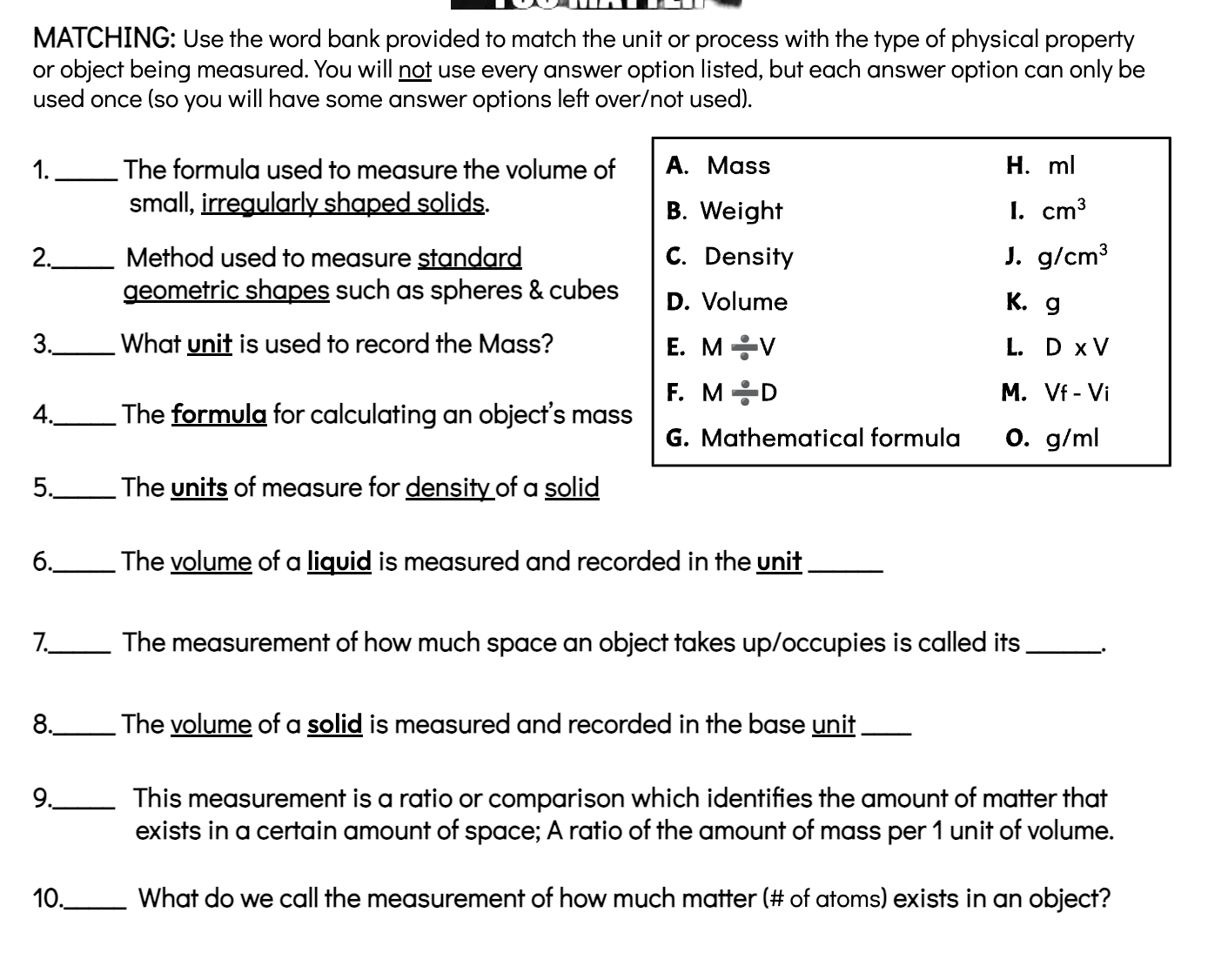
The formula used to measure the volume of a small, irregularly shaped solid.
Method used to measure the volume of standard geometric shapes such as spheres, cubes, or rectangular prisms.
What UNIT do we use to record the MASS of an object?.
The formula used to calculate an object's mass is ____
The units of measure we use for the Density of a solid
The unit of measure used for the volume of a liquid
The measure of how much space an object occupies (or takes up)
The volume of a solid is measured and recorded in the units ____
The measurement is a ratio or comparison that identifies the amount of matter [that exists] in a certain amount of space; a ratio of the amount of mass per 1 unit of volume.
The measurement of how much matter exists in an object.
________ Weight is actually a measurement of the force of gravity’s pull on an object’s mass and it changes based on location and motion.
________ Mass changes based on an object’s location (e.g. on the moon vs on earth).
________ Parallax refers to the change in the apparent position of an object when viewed from different points or angles.
________ An substance’s density changes based on its size (if we cut it in half) and/or location.
________ On a density graph, the line with the steepest slope has the smallest density.
________ Volume can only be obtained using direct methods of measurement.
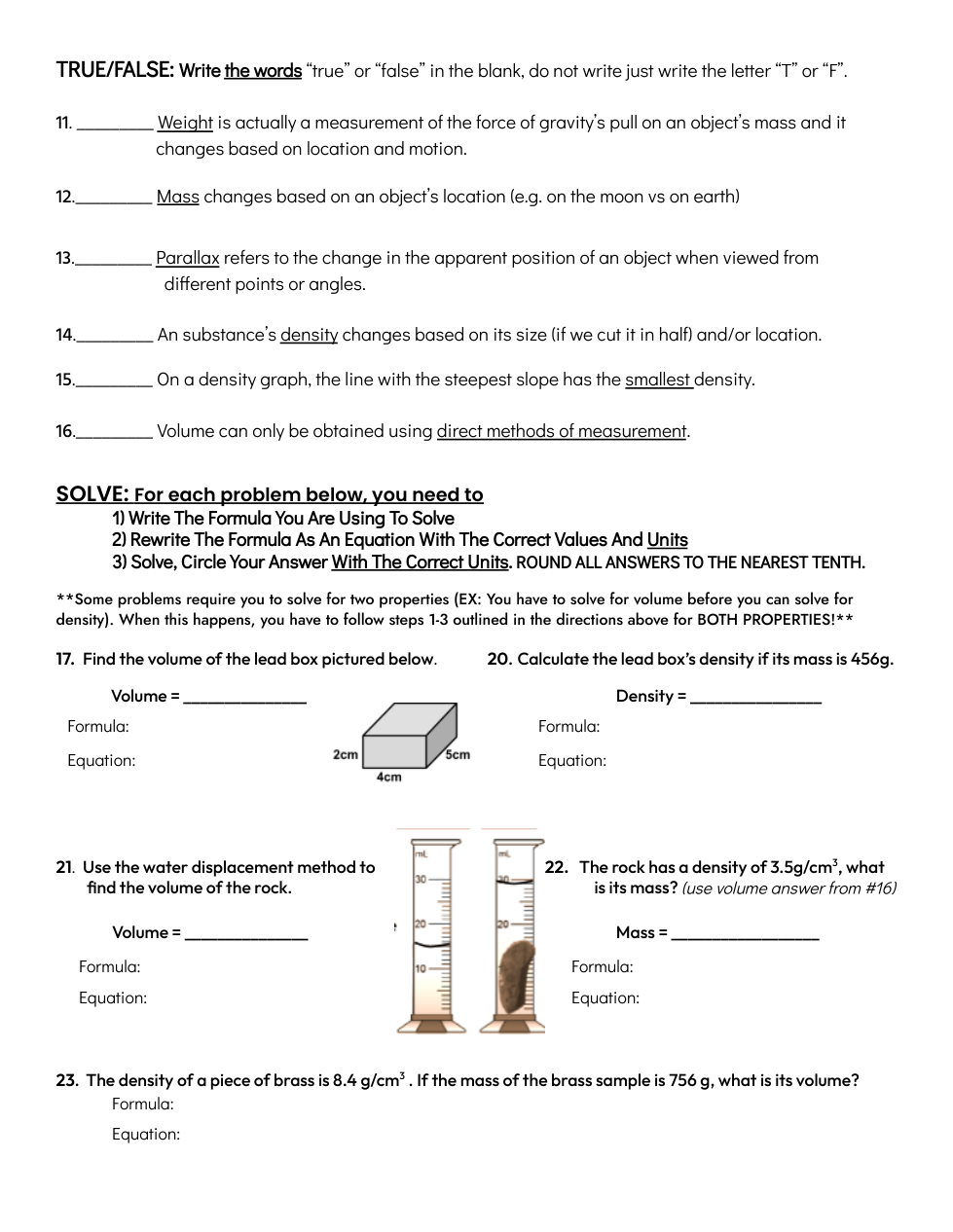
Select the Formula you used to solve for the volume of the lead box.
Volume = _______________

Answer Format: Number followed by units, no space.
Select the Formula you used to solve for the Density of the lead box.
Calculate the lead box’s density if its mass is 456g.
Density = _______________
Answer Format: Number followed by units, no space.
Select the Formula you used to solve for the volume of the rock.
What is the volume of the rock?
Volume = _______________
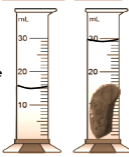
Answer Format: Number followed by units, no space.
Select the Formula you used to solve the mass of the rock
The rock has a density of 3.5 g/cm3. What is its mass?
Mass = _______________
Answer Format: Number followed by units, no space.
Select the formula you used to solve the volume of the brass sample.
The density of a piece of brass is
8.4 g/cm3. If the mass of the brass sample is 756 g, what is its volume?
VOLUME: __________
Answer Format: Number followed by units, no space.
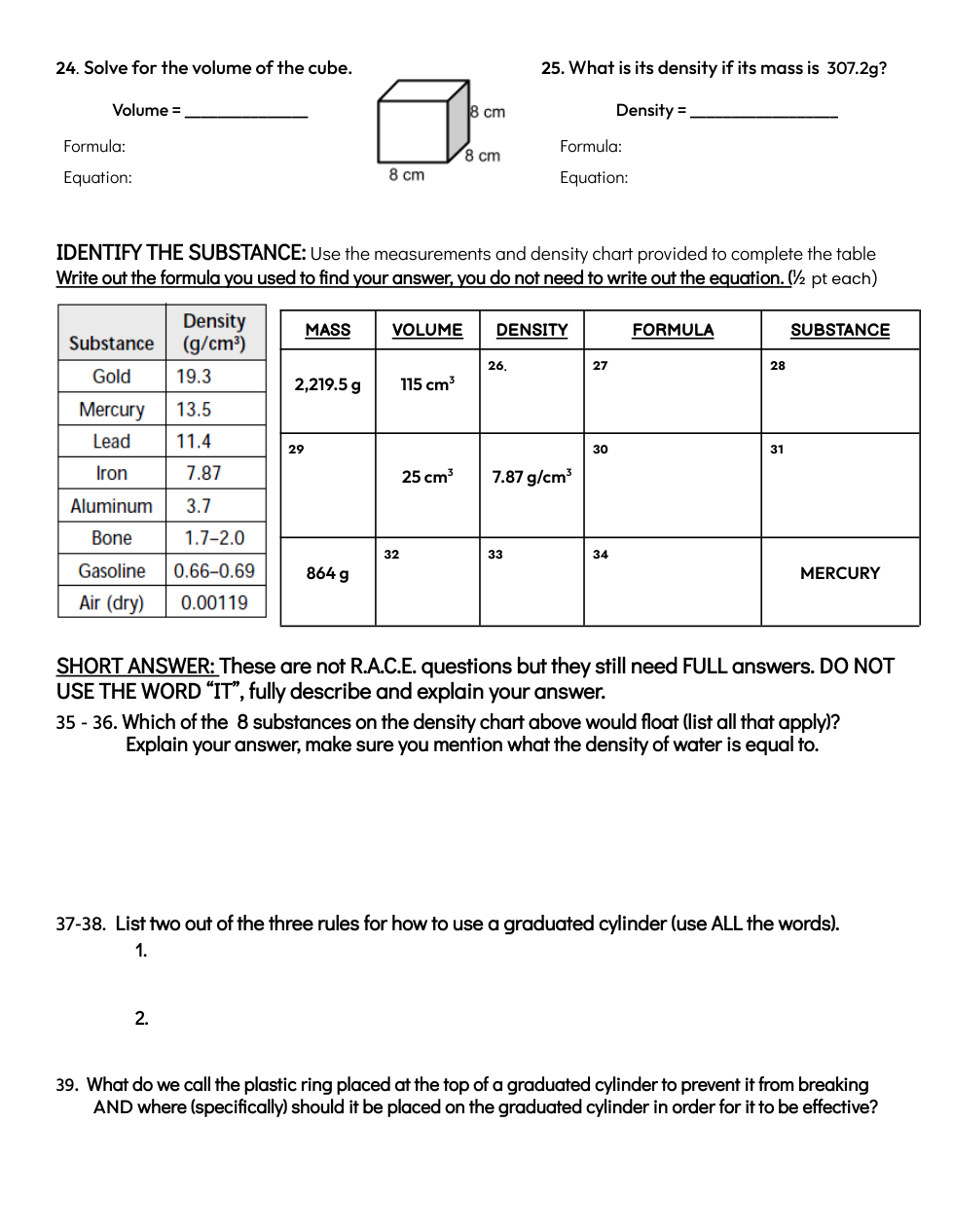
Select the formula you used to solve for the volume of the cube
Solve for the volume of the cube.
Volume = ___________
Select the formula you used to solve for the density of the cube
What is its density if its mass is 307.2g?
Density = ___________
(Doing so ensures you're using the right numbers and prevents any confusion when entering your answers).
Select your answer from the densities provided.
Which formula did you use to solve?
The substance is
What is the mass of this substance?
Type the number and unit, no space.
Which formula did you use to solve for the mass?
The substance is
Type the volume of LIQUID Mercury. Mercury is a liquid at room temperature, your units should reflect that.
Only type the number and unit, no space.
Select your answer from the densities provided.
Which formula did you use to solve for the volume?
Which of the 8 substances on the density chart above would float (list all that apply)? Explain your answer, make sure you mention what the density of water is equal to.
List two out of the three rules for how to use a graduated cylinder (use ALL the words).
What do we call the plastic ring placed at the top of a graduated cylinder to prevent it from breaking AND where (specifically) should it be placed on the graduated cylinder in order for it to be effective?
Which two measurements are constants?
Which two measurements are found using instruments like balances and scales?
Which two measurements have different units based on the state of matter of the substance being measured?
Round any answers with decimals to the nearest 100th (2 decimal places).

Density has to be a decimal - round to the nearest 100th when needed. (2 decimal places)
Don't forget units in your answers
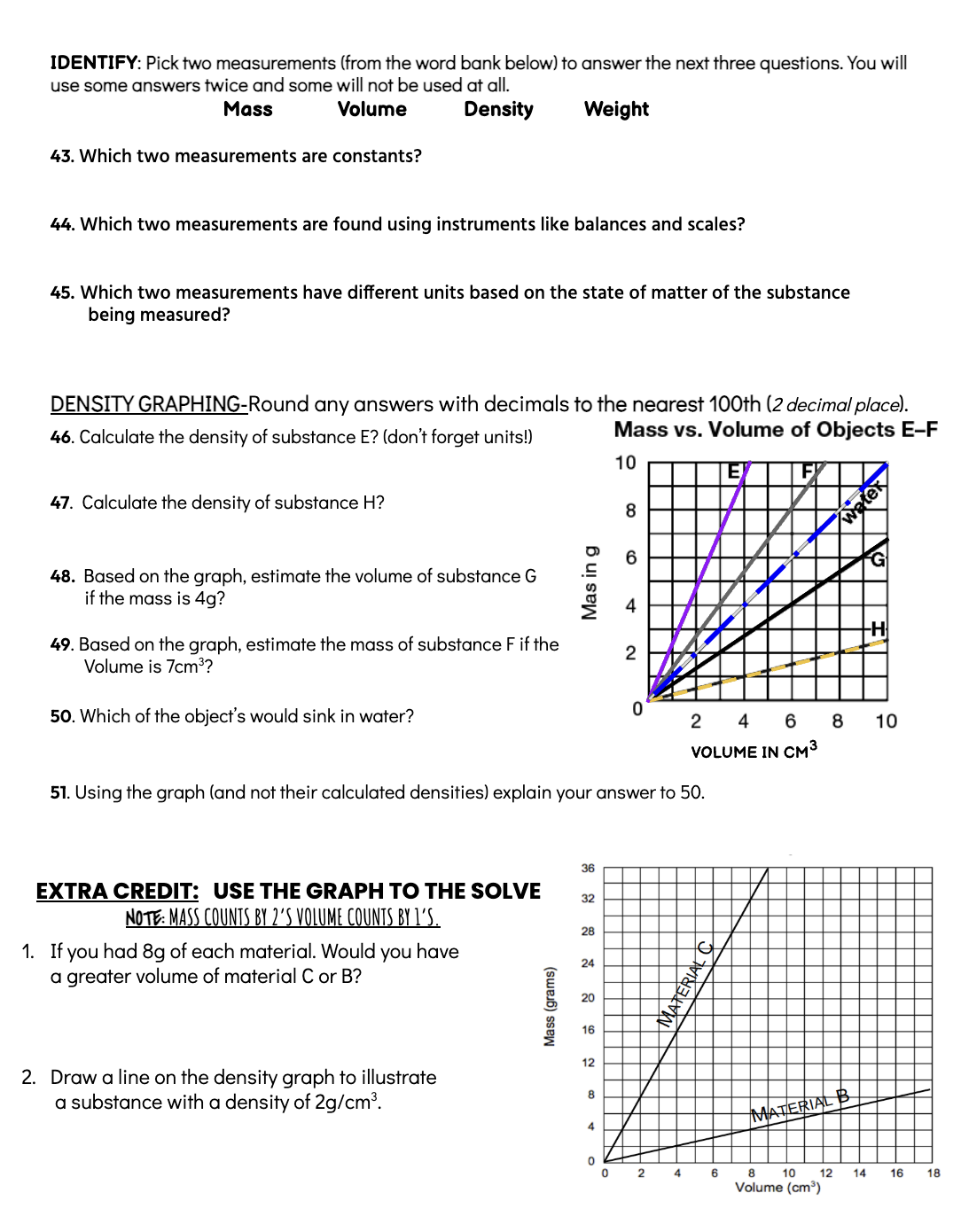
Calculate the density of substance E?
Answer Format: Number and unit, no space
Calculate the density of substance H?
Answer Format: Number and unit, no space
Based on the graph, estimate the volume of Substance G if the mass is 4g.
Answer Format: Number and unit, no space
Use the graph to estimate the mass of substance F when its volume is 7 cm3.
Answer Format: Number and unit, no space
Which of the objects would sink in water?
Answer Format: Type the capital letter representing the substance. If multiple, separate with a comma, no space.
Use the position of the lines on the graph (and not their calculated densities) to explain how you knew which substances would sink.
If you had 8 grams of each material. Would you have a greater volume of material C or B?
Draw a line to represent a subsgtance with a density of 2g/cm3