1
1
1
1
1
1
1
1
1
1
Explain using your knowledge of density why a small rock will sink when thrown into a river.
Have you ever wondered why a huge ship made of metal can float on the sea, but a small pebble sinks as soon as you drop it in water? The answer lies in the ideas of density and forces.
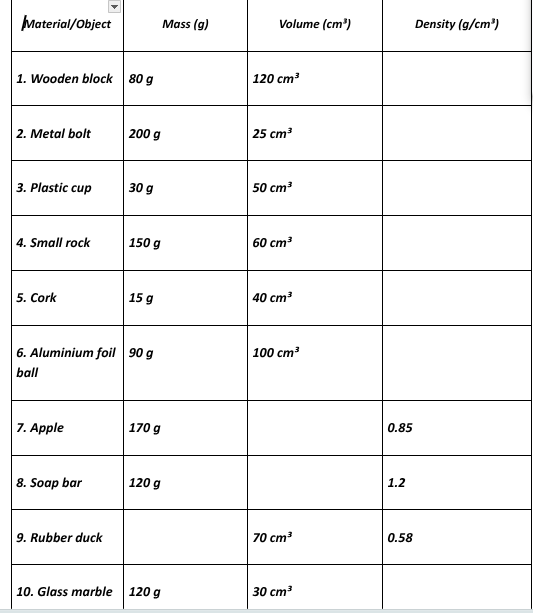
Density is a measure of how much mass is packed into a certain volume (space) of a material. We can calculate density using this formula:
Density = Mass/Volume
Something is dense if it has a lot of mass packed into a small space. For example, a metal block is usually denser than a piece of wood the same size.
Water has a density of 1 g/cm³. This means that if an object has a density greater than 1 g/cm³, it will usually sink in water. If it has a density less than 1 g/cm³, it will usually float.
Glass marble
Rubber duck
Soap bar
Apple
Aluminium foil ball
Cork
Small rock
Plastic cup
Metal bolt
Wooden block
Float in water
Sink in water
When you put an object into water, two main forces act on it:
Weight – this is the force of gravity pulling the object down.
Upthrust (Buoyant Force) – this is the force of water pushing up on the object.
If the upthrust is greater than the object's weight, the object will float. If the weight is greater than the upthrust, the object will sink.
A Ship Floats: Ships are made of metal, which is a dense material, but they are built with large hollow spaces filled with air. This gives the whole ship a low average density—less than water—so the upthrust can balance or beat the weight, and the ship floats.
A Stone Sinks: A stone is small but heavy for its size, meaning it has a high density—greater than water. The water can't push up hard enough to hold it up, so it sinks.
A Wooden Log Floats: Wood is less dense than water, so even though it may be quite big and heavy, the upthrust is enough to keep it afloat.
A Human Can Float or Sink: Human bodies are close in density to water. If you take a deep breath and fill your lungs with air, your overall density goes down and you float more easily. That’s why lying on your back and relaxing helps you float when swimming
Name two forces that act on an object when in water
Identify which force much be greater than an object's weight in order for it to float
Two objects are made from the same material—aluminium. One is a solid ball, and the other is a hollow boat shape made from a thin sheet of aluminium. When placed in water, the solid ball sinks, but the boat shape floats.
Explain why the same material can float in one shape but sink in another. Use your knowledge of density and forces in your answer
Density=
Density=
Density =
Density =
Density =
Density =
Volume =
Volume =
Mass =
Density =