Some landforms on Earth form as a result of weathering, erosion, and deposition over long periods of time.
Identify the force that created the landforms listed in the table by correctly labeling each column.
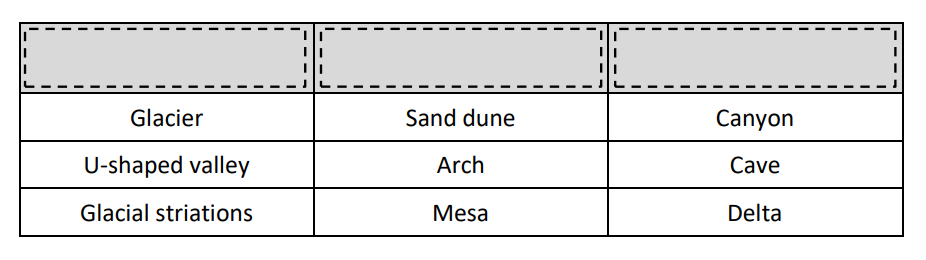
Mmuae Afoforo a Wobɛpaw:
Ice
Water
Wind
Some landforms on Earth form as a result of weathering, erosion, and deposition over long periods of time.
Identify the force that created the landforms listed in the table by correctly labeling each column.
Which characteristics describe a landslide?
Select TWO correct answers
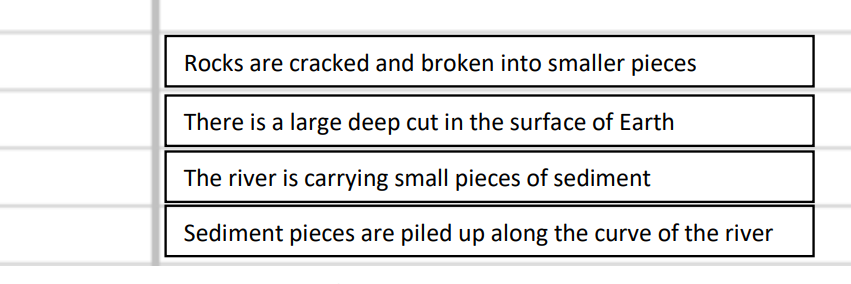
A student recorded observations during a visit to the Grand Canyon.
Which observations describe weathering and erosion?
Select TWO correct answers.
How is a delta formed?
How is a canyon formed?
What process leads to the formation of a U-shaped valley?
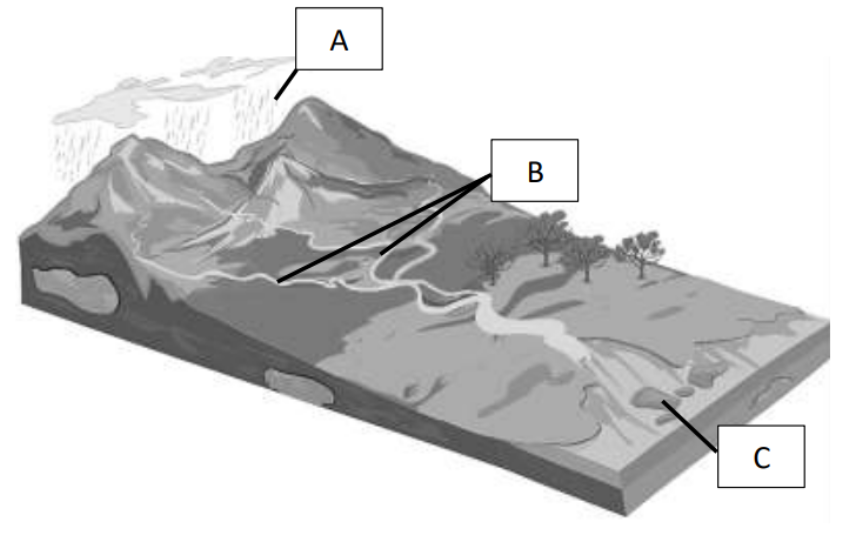
Answer the questions using the diagram.
What processes can the rainwater at Point A eventually cause?
Match the words to their definition.
- when sediments, soil, and rocks are dropped or settled in a new place after being carried by wind, water, or ice.
- a natural process that slowly breaks apart or changes rock.
- when wind, water, or ice slowly move rocks and soil from one place to another, shaping the land over time.
Sediment is being carried by the river at Point B. What is this process called?
What landform is at Point C?