OSTP: Grade 3 ELA

Last updated 7 months ago
18 questions

Gone Fishing

by Kristine O'Connell George

1 No one else was awake
when we got up at dawn
to go fishing.
Walking the steep path

5 down to the lake,
we could see the circle flop
and splash of trout.
I warned my little brother not to go
too close to the edge.

10 He said:
You can’t tell me what to do.
No one else was awake
when we got up at dawn
to go fishing. All I caught

15 was one little brother—
hauled up out of the cattails,
sputtering, soggy, and still stubborn.

----
“Gone Fishing” from TOASTING MARSHMALLOWS: Camping Poems by Kristine O’Connell George. Text copyright © 2001 by Kristine O’Connell George. Reprinted by permission of Clarion Books, an imprint of Houghton Mifflin Harcourt Publishing Company. All rights reserved.
1

"Gone Fishing" is mainly about

1

How does the reader know "Gone Fishing" is a poem?

1

Why did the author most likely write the poem?

1

The reader knows the poem is told from the first-person point of view because

1

Which word best describes how the speaker feels at the end of "Gone Fishing"?

2

Explain why the speaker of the poem can be described as helpful. Provide details from the poem to support your answer.

Look! It's an Armadillo!

1 Have you ever seen an armadillo? Most people in the United States never will. But if you live in Oklahoma, you just might get the chance!

2 Armadillos are the most unusual animals ever! If you ever see an armadillo, the first thing you’ll notice is that it’s covered in leathery scales. It may even remind you of the shell of a turtle. These gray scales are hard and strong. They protect armadillos from their enemies and other dangerous things in their environment such as thorns.
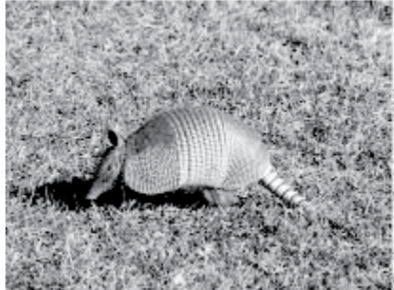
The word “armadillo” means “little armored one” in Spanish. It is the perfect name for this little creature because it has bony scales that cover it from head to tail. Believe it or not, armadillos are the only living mammals that have shells like this. Their shells often lead people to believe they are related to turtles. This lack of fur explains why armadillos live in warm climates.


3 Armadillos also have short legs and long bodies. Even though they are close to the ground, adult armadillos can be over 2 1/2 feet long, including their stringy tails. That’s about as long as your leg.

4 You might think armadillos are related to turtles because of their shells. Don’t be fooled, though! Armadillos are mammals, like cats, dogs, and people. However, it is their shells that make the curious animals different.

5 Many mammals are covered in fur that keeps them warm like a winter coat. Not armadillos! Their shells are sturdy, but the shells don’t protect them from freezing temperatures. That is why armadillos have to be careful about where they live; don’t waste your time searching for armadillos in Alaska or Maine! It’s too cold for them to live there. Oklahoma, on the other hand, is a great place for these creatures. They can also be found in Texas, Louisiana, and Florida.

6 Armadillos need good weather, but they also need to live where the soil is soft. Armadillos make their homes in holes in the ground called burrows. Although the animals have long, sharp claws perfect for digging, a cold climate can make the dirt difficult to get through. These burrows are extremely important to armadillos. They use them to live in, raise their families, and hide from other animals.

7 The ground isn’t just an armadillo home—it’s also a supermarket! Armadillos dig for their food. They often feast on insects, worms, and lizards. They also eat plant roots and berries. If they can’t dig, they can’t survive.

8 Like any wild animal, armadillos have predators. Sometimes, coyotes chase them. Other times, humans hunt them because they destroy crops while digging for food. Many people love armadillos, however. Some kind farmers trap the pesky creatures and release them far away from their crops. There is also a town that loves armadillos so much that it celebrates Armadillo Day. You might even see an armadillo race at a county fair.

9 Don’t forget—you could spot an armadillo in your own backyard. It might be wandering in the woods or grazing in your garden right now. Seeing an armadillo is something most kids in the United States will never experience.
1

A student wants to write a report about armadillo babies.
What should the student do first?

1
Drag two sentences into the paragraph to create an organized paragraph.

To place a sentence in the paragraph, click and hold the sentence, then drag it to the desired space.

Mother armadillos are very busy. Mother armadillos usually give birth to their babies, or pups, in the spring.
______________________________________________
Mother armadillos keep their young in their burrows. This helps keep them safe. When they are a few weeks old, baby armadillos can leave the burrow. Mother armadillos provide milk to their pups until they are about 2 months old. They only stay with their mothers for a few months.
_____________________________________________________________________
Other Answer Choices:
Armadillos use their noses to find food in the wild
When baby armadillos leave the burrow, then the mothers can rest
They usually have four babies at one time
Armadillos are able to hold their breath for as long as six minutes
1
Select the two correctly spelled words that complete the sentence.

They __________ armadillos are the most __________ animal in the world
1

Which word from paragraph 2 has a similar meaning to the word predators in paragraph 9?

1

Knowing the meaning of the prefix un- helps the reader to know that the word unusual means

1

Read the definition for the word waste.

waste verb. 1. to slowly destroy 2. to cause something to weaken in size or strength 3. to use in a foolish way 4. to slowly wear away

Which definition of the word waste is used in paragraph 5?

1

Which information can only be found in the caption?

1

After reading the passage, a student still has questions about armadillo behavior and wants to do further research. Which question would help them find new information?

1

Read the question a student wrote after reading the passage.

How do armadillos care for their young?

What is the best source the student could learn the answer to their question?

1

Read the sentence.
The two trees leaves are turning brown.
What change, if any, should be made to trees in the sentence?

1

Read the sentence.
Doe'snt your uncle live near your grandmother?

What change, if any, should be made to Doe'snt in the sentence?

1

Read the sentence:

Ed must be home by dinner.

What changes should be made to the sentence to make it an interrogative sentence?