3.04BM What is a Bond?
star
star
star
star
star
Last updated 2 months ago
24 questions
Note from the author:
Warm-Up:
Notes:
Yield = Interest rate = Coupon or coupon rate
1
Your friend asks to borrow $50 and offers to pay you back with interest. What factors would you consider in your decision to accept or decline their request?
EDPUZZLE: Investing Basics: Bonds 📷8 min
Just as you might loan money to a friend, you can loan money to a government or corporation through a bond. Bonds are one of the most common investment options available to you. Watch this video to learn more about bonds and follow your teacher's directions to answer the questions either in your student activity packet or within the EdPuzzle itself.
NOTE: EdPuzzle videos shuffle answer choices and do not always match the order provided in the lesson here.
1
All of the following are true about bonds EXCEPT…- Bonds are considered a riskier investment option than stocks.
- A bond is a loan given to a company or government by an investor who receives interest in return.
- Companies and governments issue bonds to fund new projects or ongoing expenses.
- Bonds are a way for investors to diversify their portfolios and generate additional income.
All of the following are true about bonds EXCEPT…
- Bonds are considered a riskier investment option than stocks.
- A bond is a loan given to a company or government by an investor who receives interest in return.
- Companies and governments issue bonds to fund new projects or ongoing expenses.
- Bonds are a way for investors to diversify their portfolios and generate additional income.
1
By the end of a bond's maturity, the investor will have received…- Only the face value of the issued bond
- The face value of the bond issued and interest payments
- Only interest payments
- Half the face value of the issued bond and interest payments
By the end of a bond's maturity, the investor will have received…
- Only the face value of the issued bond
- The face value of the bond issued and interest payments
- Only interest payments
- Half the face value of the issued bond and interest payments
1
What is default risk?- The risk that the investor is not able to pay the face value of the bond.
- The risk that the company or government is not able to make interest payments.
- The risk that the investor demands the face value of the bond before the bond fully matures.
- The risk that the company or government is unable to pay back the investor
What is default risk?
- The risk that the investor is not able to pay the face value of the bond.
- The risk that the company or government is not able to make interest payments.
- The risk that the investor demands the face value of the bond before the bond fully matures.
- The risk that the company or government is unable to pay back the investor
1
You've decided you want to sell a bond before its maturity date. Interest rates are currently higher than when you bought the bond. What will you likely have to do to make your bond more appealing to investors?- Lower the interest rate
- Sell your bond at a discounted price
- Increase the interest rate
- Sell your bond at a higher price
You've decided you want to sell a bond before its maturity date. Interest rates are currently higher than when you bought the bond. What will you likely have to do to make your bond more appealing to investors?
- Lower the interest rate
- Sell your bond at a discounted price
- Increase the interest rate
- Sell your bond at a higher price
INFOGRAPHIC: What are the Main Types of Bonds?
As you learned in the previous video, you can buy a corporate bond or a government bond. There are different types of bonds within these two categories as well! Read through the infographic on this page to learn about the different bond types. Then, answer the questions.
4
The higher the risk associated with a bond, the _______ (more/less) likely a corporation might default on paying the investor. Interest rates for riskier bonds tend to be _______ (higher/lower) so that investors are _______ (more/less) willing to take on that risk.
BONUS: A riskier bond usually comes from a corporation that has a_______ (low/high) credit rating.
2
Which tends to be a riskier investment - corporate bonds or government bonds?_______ Why?_______
1
Which type of bond would you be comfortable investing in? Explain.
INFOGRAPHIC: The Bond See-Saw
VIDEO: Back to Basics: Understanding Yield and the Effects of Rising Rates 📷9 min
If you buy a bond and hold it through its maturity date, the ups and downs of the bond market will not impact your investment. However, if you decide to sell a bond before its maturity date, you need to understand how the current market’s interest rates impact the price of your bond. Read through this infographic and watch the video to learn more about this relationship. Then, answer the questions.
6
- When overall interest rates rise (to 10%), the bond you already own (with 5% coupon rate) becomes _______ (less/more) valuable to potential buyers, so its price will _______ (increase/decrease).
- When overall interest rates fall (to 2%), the bond you already own (with 5% coupon rate) becomes _______ (less/more)valuable to potential buyers, so its price will _______(increase/decrease .
- Generally, the longer the duration of the bond, the _______ (lower/higher) the chance the bond price may change due to changes in yield.
- Explain why someone who is not interested in selling their bond before its maturity date does not have to worry about the current bond market and its impact on the price of their bond._______
VIDEO: Individual Bonds vs. Bond Funds: What’s the Difference? 📷5 min
When investing in bonds, most investors choose to invest in bond funds, rather than selecting individual bonds. Watch this video to learn about bond funds and how they differ from bonds. Then, answer the questions.
6
Bond:
How you make money:_______
Pros:_______
Cons: _______
Bond Fund:
How you make money:_______
Pros:_______
Cons: _______
ACTIVITY: FINE PRINT: Bond Fund Fact Sheet
When selecting a bond fund to invest in, it’s important to analyze its fund fact sheet. In this activity, you’ll practice reading a bond mutual fund fact sheet. Follow the directions on the worksheet to complete this activity.
Before doing this activity watch this video: How to Read a Bond Fund Fact Sheet,
1
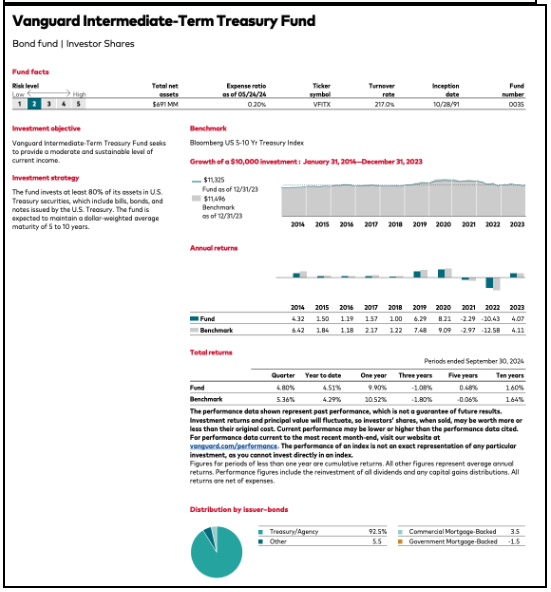
What does this fund primarily invest in?- U.S. Treasury securities
- An index of large-capitalization stocks
- Corporate investment-grade bonds
- An equal mix of stocks and bonds
What does this fund primarily invest in?
- U.S. Treasury securities
- An index of large-capitalization stocks
- Corporate investment-grade bonds
- An equal mix of stocks and bonds
1
What is a key risk of investing in this fund?- This fund invests in very speculative, small companies
- You are guaranteed only a small amount of interest income each year
- If interest rates increase, this fund could lose value
- The fund tracks the S&P 500, which is a risky short-term investment
What is a key risk of investing in this fund?
- This fund invests in very speculative, small companies
- You are guaranteed only a small amount of interest income each year
- If interest rates increase, this fund could lose value
- The fund tracks the S&P 500, which is a risky short-term investment
1
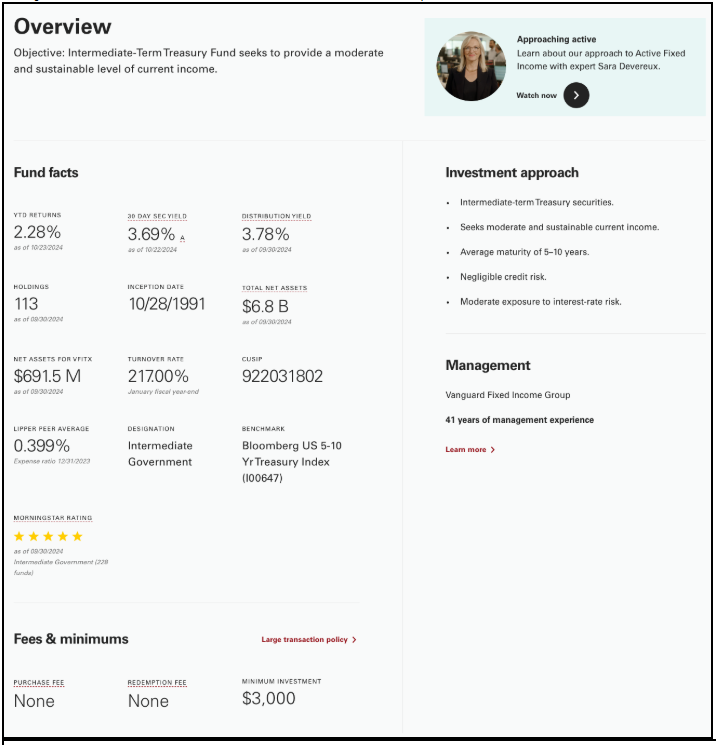
What are this fund’s total net assets?- $4.07 billion
- $6.8 billion
- $9.2 billion
- $11.325 billion
What are this fund’s total net assets?
- $4.07 billion
- $6.8 billion
- $9.2 billion
- $11.325 billion
1
Which benchmark is this fund tracking?- Vanguard Intermediate Term Treasury Fund Index
- Bloomberg US 5-10 Year Treasury Index
- Issuer Bonds Index
- Vanguard Fixed Income Group Index
Which benchmark is this fund tracking?
- Vanguard Intermediate Term Treasury Fund Index
- Bloomberg US 5-10 Year Treasury Index
- Issuer Bonds Index
- Vanguard Fixed Income Group Index
1
What is the level of risk of this investment?- Lowest risk
- Low risk
- Medium risk
- High risk
What is the level of risk of this investment?
- Lowest risk
- Low risk
- Medium risk
- High risk
1
This fund’s expense ratio is _______. You would pay _______ in fees on a balance of $10,000.- 0.01%; $1
- 0.20%; $20
- 3.78%; $378
- 4.07%; $407
This fund’s expense ratio is _______. You would pay _______ in fees on a balance of $10,000.
- 0.01%; $1
- 0.20%; $20
- 3.78%; $378
- 4.07%; $407
1
What is the minimum investment for this fund?- $3,000
- $5,271
- $10,000
- There is no specified minimum investment
What is the minimum investment for this fund?
- $3,000
- $5,271
- $10,000
- There is no specified minimum investment
1
If you invested $10,000 in this fund in January 2014, how much would it be worth in December 2023?- $10,000
- $10,407
- $11,325
- $11,496
If you invested $10,000 in this fund in January 2014, how much would it be worth in December 2023?
- $10,000
- $10,407
- $11,325
- $11,496
1
What was this fund’s rate of annual return in 2023?- 2.28%
- 4.07%
- 4.11%
- 217%
What was this fund’s rate of annual return in 2023?
- 2.28%
- 4.07%
- 4.11%
- 217%
1
In the last 10 years shown, how many years did this fund have NEGATIVE returns?- 0 years
- 2 years
- 5 years
- 8 years
In the last 10 years shown, how many years did this fund have NEGATIVE returns?
- 0 years
- 2 years
- 5 years
- 8 years
2
Part II: What Did You Learn?Based on this information, do you think this fund is a good investment? Explain why or why not.
Part II: What Did You Learn?
Based on this information, do you think this fund is a good investment? Explain why or why not.
Exit Ticket:
1
Which of the following most accurately describes what a bond is?
1
Juan buys a bond with a fixed coupon rate of 3%. Six months later, similar bonds that are issued have a coupon rate of 4%. Which of the following is TRUE if he chooses to sell the bond before maturity?
1
One difference between bonds and bond funds is…