3.05 Managing Risk

Last updated 2 months ago
17 questions
Note from the author:
Intro:

PROMPT:

Use the space below to answer the prompt.
  1. Hypothetical scenario: Your teacher rolls a 20-sided die. You have the opportunity to receive a specific amount of money if you correctly guess which number is rolled:
  • Guess the number exactly: $500
  • Guess even or odd: $50
  • Guess it will fall between 1 and 19: $5
2

Which option would you pick and why?

VIDEO: What is Investment Risk?

In the previous prompt, your decision was likely influenced by how much risk you were willing to take. Learning to manage your risk is an important part of creating an investing strategy that works for you. Watch this video to learn about effective risk management strategies for investing. Then, answer the questions.
1

Even though risk seems like a bad thing, why is that not always the case with investing?

1
In your own words, explain the three strategies the video suggests using to manage risk.
Time:_______
Diversification:_______
Invest over time:_______

VIDEO: What Is Diversification?

Let’s take a closer look at the second strategy mentioned in the previous video to manage investment risk: diversification. Watch this video to learn about the difference between diversifying by asset class and diversifying across investments. Then answer the questions.
3
Fill in the blanks: Diversification means choosing a _______ of _______ to help reduce _______.
2
The video describes two ways to diversify. Give an example for each one.
Diversify across asset classes (i.e. choosing the main parts of your portfolio)_______
Diversify within each asset class (e.g. choosing which stocks to buy)_______
1

The video says “keep in mind that diversification does not mean you’re guaranteed to profit or that you’re protected against loss.” Why is it still a good idea to diversify your investments?

DATA CRUNCH: How Does Your Asset Mix Impact Your Returns? 📷10 min

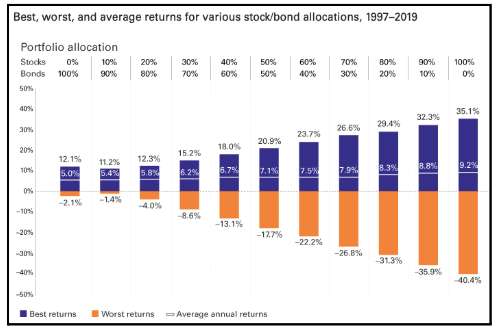
Continue exploring the strategy of diversification by taking a look at how it can affect the returns on your investment. Analyze the data and answer the questions on this worksheet to complete the Data Crunch.
7
  1. What is the average annual return if someone invested 100% in bonds?_______
  2. What is the average annual return if someone invested 100% in stocks?_______
  3. Calculate the range of potential annual returns if you invested 10% in bonds and 90% in stocks_______Calculate the range of potential annual returns if you invested 10% in stocks and 90% in bonds_______. What is the difference between the two ranges?_______
  4. What might you say to someone whose reason for investing in 90% bonds and 10% stocks is that they want a 5.4% return on investment?_______
  5. Use evidence from this graph to explain the value of investing in both stocks and bonds - not justone or the other._______
Watch: Is Dollar-Cost Averaging Better Than Lump-Sum Investing?, before you complete the following activity.

CTIVITY: ANALYZE: Dollar Cost Averaging 📷25 min

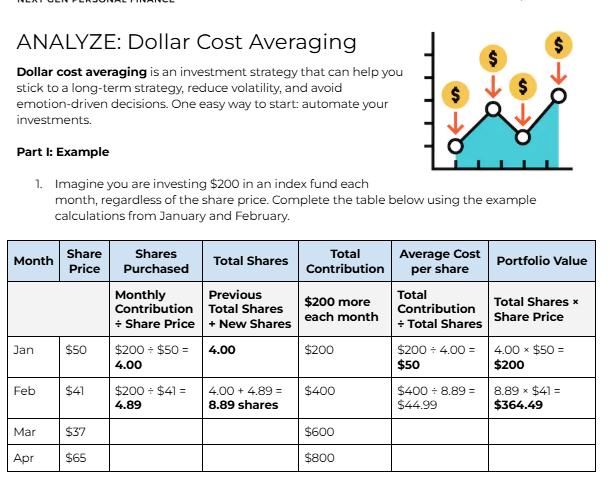
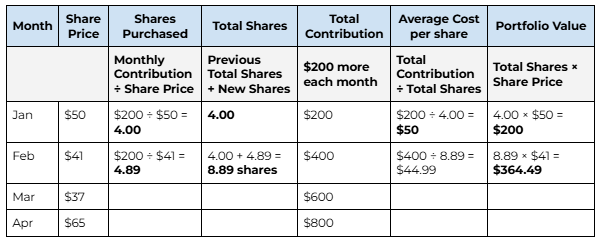
The very first video you watched recommended focusing on three factors to minimize risk: time, diversification, and investing over time, also known as dollar cost averaging. In this activity, you’ll explore how dollar cost averaging can help minimize risk by taking a look at the numbers! Follow the directions on the worksheet to complete the activity.

8
Mar $37_______ _______ $600_______ _______
Apr$65_______ _______ $800_______ _______
1

Why were more shares purchased in March despite spending the same amount in both February and March?

1

Why did the portfolio value increase in April, even though fewer shares were purchased?

4
Let’s imagine that you bought $600 of stock in January at $50 instead of using dollar cost averaging.
  1. How many shares would you have purchased?_______
  2. When the price dropped to $37 in March, what would your portfolio have been worth?_______
  3. What was your portfolio worth in March using dollar cost averaging?_______
  4. How does spreading out your investment over time reduce the impact of price changes like the drop in March?_______
1
Part II: Dollar Cost Averaging in the Real World
Let’s see what would have happened if you contributed the same amount per month to purchase an individual stock in 2023.
  1. Use Google Finance to find the stock ticker symbol for a stock you are interested in purchasing. Write the ticker symbol below._______
7
  1. Make a copy of this Dollar Cost Averaging Spreadsheet and enter:
  2. The ticker symbol in cell B1
  3. The amount you want to invest each month in cell B2.
The spreadsheet will pull actual historical data for your chosen stock and populate the spreadsheet.
  1. What was the average price you paid, per share, over the course of the year?_______
  2. Compare the amount of money you invested in 2023 to the value of your portfolio when 2023 ended. Was this a wise investment strategy? _______ Why or why not?_______
On January 1, 2023, If you had had a way of knowing the close prices for each month in the year…
  1. Which month would you have invested ALL of your money if you had the chance?_______
  2. During which month would you have sold all your shares?_______
  3. How much money would you have made using this transaction?_______
  4. Why is this strategy not possible to execute in the real world? _______
2
Part III: Summarize
  1. In your own words, describe dollar cost averaging._______
  2. How can you benefit from dollar cost averaging as an investor?_______
Exit TIcket:
1

All of the following are strategies to reduce risk EXCEPT…
  1. Holding your investments for at least five years
  2. Making sure your investments are diversified
  3. Hiring an investment manager who you think can beat the market
  4. Investing small amounts of money over longer periods of time

1

Leaving your investments in the stock market alone for at least five years is a good way to reduce risk because…
  1. It allows your investments to earn more interest
  2. It keeps you from reacting to dips in the market and selling at too low of a price
  3. Fees are waived for investments held for over five years
  4. You get a bonus from the company if you invest for five years

1

Which of the following is an example of diversification?
  1. Putting the majority of your money into a savings account and investing the rest
  2. Investing different amounts of money every month
  3. Purchasing shares of stock in a variety of companies and industries
  4. Using multiple investment managers to get different opinions