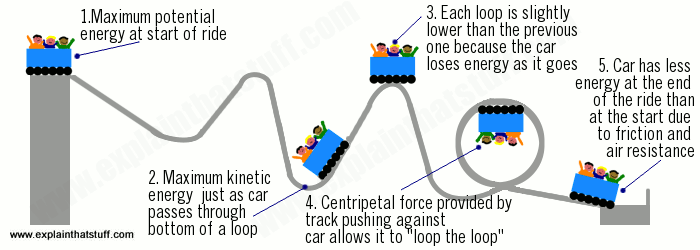
If there were no friction or air resistance, the track could go higher than the original start height later in the ride.
If there were no friction or air resistance, the track could go higher than the original start height later in the ride.
Review questions: Energy in a battery is a form of
Sound energy is a form of
If there were no friction or air resistance, the track could go higher than the original start height later in the ride.
In the image above, because there is air resistance and friction, the track can never go as high as the starting
We've talked about a few things in physics so far. Do you remember what is and is not a vector?
kinetic energy
momentum
potential energy
acceleration
speed
mass
velocity
force
inertia
energy
Vector
scalar
watch this video on vector addition:
Do you have any questions?
To add vectors you
These vectors have been drawn head to tail already. draw the resultant vector for each problem
match
| Draggable item | arrow_right_alt | Corresponding Item |
|---|---|---|
scalar | arrow_right_alt | vectors that you are adding together |
component vectors | arrow_right_alt | vector you get when you add other vectors |
resultant vector | arrow_right_alt | something with direction and magnitude |
vector | arrow_right_alt | something with magnitude but no direction |
Play with this phet simulation https://phet.colorado.edu/sims/html/vector-addition/latest/vector-addition_all.html
working in the "explore 2d" one do the following:
put a couple of vectors out there and click on the sum button. can you line up the vectors so that they look like the vector addition in the video?
Can you create two vectors that are exactly the same length, but whose directions are opposite? what happens when you add them together?
clear your board on the phet simulator and just have one vector on there (unclick sum to get rid of the dark blue one too). click on one of the buttons under "components". what do you notice about the components given?
which view of components makes the most sense to you?
What happens to the sum vector when you put together several vectors that go head-to-tail and the last head ends with the first tail?
Newtons second law is that force = mass x acceleration. If the object isn't moving, what is its velocity? (don't worry about units)
Newtons second law is that force = mass x acceleration. If the object isn't moving, what is its acceleration? (don't worry about units)
Newtons second law is that force = mass x acceleration. If the object is moving at a constant velocity, what is its acceleration? (don't worry about units)
Honors and 8th grade from here out. Is 1+2=1.5?
Can I add a vector of magnitude 1 and a vector of magnitude 2 and get a resultant vector of 1.5?
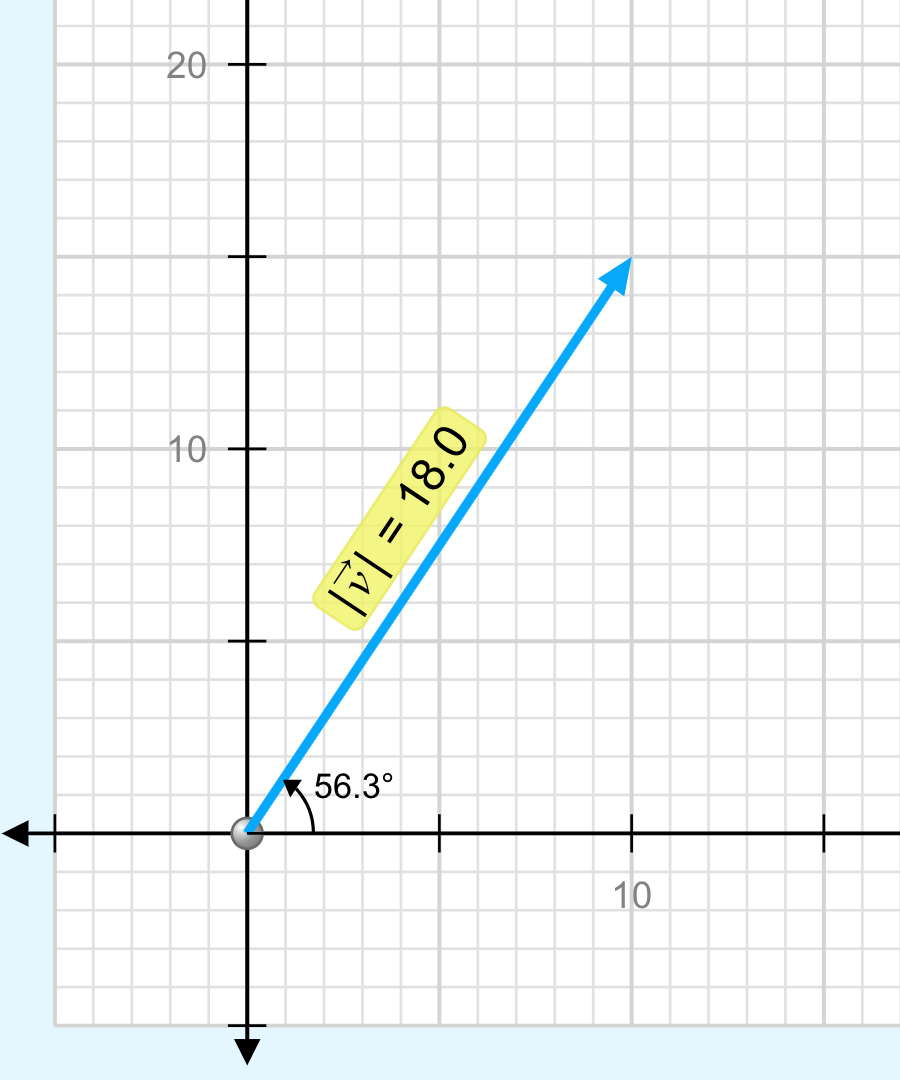
What is the polar form of this vector? if you type \angle into the field it will give you the right symbol.
What is the rectangular form of this vector?
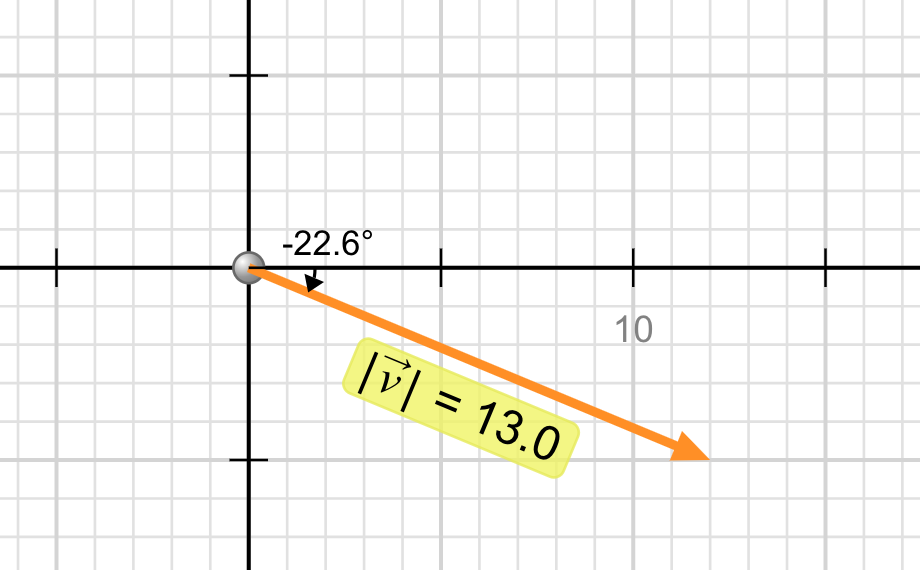
What is the polar form of this vector? notice that the angle is negative.
What is the rectangular form of this vector? notice that the y component is negative.
Go back to phet and create both of these vectors, then add them geometrically. What do you get? try adding the x and y components of each vector in rectangular form, and then add the 4 and the theta in polar form. what do you notice?