Log in
Sign up for FREE
arrow_back
Library

STAAR Blitz Day 10 - Adaptations & Life Cycles

star
star
star
star
star
Last updated about 1 year ago
8 questions
3
5.13.A
2
5.13.A
1
5.13.A
1
5.13.A
1
5.13.A
Question 1
1.
The characteristics of four different types of plants are listed in the table below. Determine which environment each plant is best adapted to live in.
Other Answer Choices:
Prairie
Rainforest
Desert
Question 2
2.
This question has two parts. First, answer Part A. Then answer Part B.

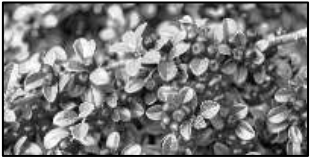
An image of a bearberry plant is shown below.


Part A
The bearberry plant is a low-growing evergreen with leathery leaves and silky hairs that provide protection from the cold and wind.

How does growing low to the ground benefit the bearberry plant? __________

Part B
Which statement best supports the answer to Part A? __________
Question 3
3.

Question 4
4.

Question 5
5.

Answer the questions using the diagram.

1
5.13.A
1
5.13.A
1
5.13.A
Ducks and fish are both aquatic organisms. What structure of each organism allows them to move through water?
Ducks use their beaks, and fish use their tails.
Ducks use their feathers, and fish use their scales.
Ducks use their webbed feet, and fish use their fins.
Ducks use their wings, and fish use their fins.
Which example explains the difference between complete metamorphosis and incomplete metamorphosis?
Complete metamorphosis has three stages, while incomplete metamorphosis has four stages.
Incomplete metamorphosis includes a pupal stage, while complete metamorphosis does not.
Complete metamorphosis and incomplete metamorphosis are the same.
Complete metamorphosis includes a pupal stage, while incomplete metamorphosis does not.
At which stage in a plant’s life cycle can it produce seeds?
Dormant stage
Mature plant stage
Germination stage
Seedling stage
Question 6
6.

Question 7
7.

Question 8
8.

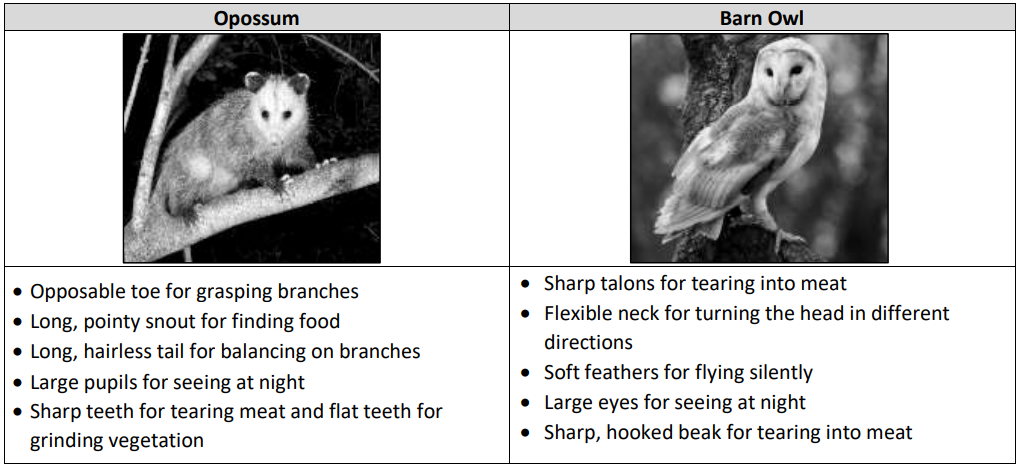
What structure do these organisms have in common, and how does this structure benefit the organisms?
Large pupils/eyes: Both the opossum and barn owl have large pupils or eyes that enhance their ability to see at night, aiding them in hunting or finding food in low-light conditions.
Sharp teeth/talons/beak: Both animals possess sharp structures (teeth in opossums and talons/beak in barn owls) that help them tear into meat, making it easier to consume prey.
Adaptations for balance/grasping: The opossum's opposable toe and long tail help it grasp branches and maintain balance, while the barn owl's flexible neck allows it to turn its head efficiently to spot prey.
Nocturnal adaptations: Both species have developed features such as large eyes/pupils (for better night vision) which are crucial adaptations that allow them to thrive as nocturnal hunters.
Is the barn owl more likely to be a predator or prey? Explain.
The barn owl is equally likely to be predator or prey due to its physical characteristics.
The barn owl is more likely to be prey because it has soft feathers that might make it vulnerable.
The barn owl is more likely to be a predator because it has sharp talons and a hooked beak designed to tear into meat.
The barn owl's role as predator or prey cannot be determined from the given information.
In which environment would these organisms most likely live?
Forest
Desert
Ocean
Arctic