Which basic reaction type is NOT shown here?
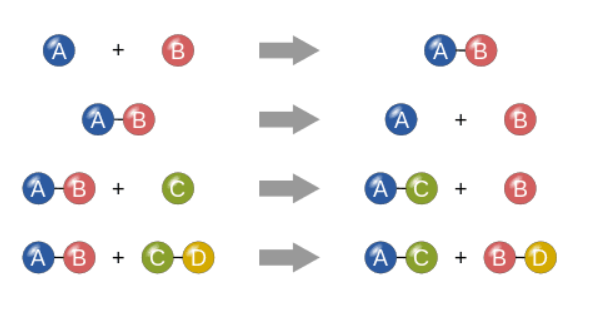
Which basic reaction type is NOT shown here?
The skeleton chemical equation for the reaction between zinc metal and hydrochloric acid is shown. What change needs to be made in order to balance this reaction equation?
Zn + HCl → ZnCl2 + H2
Examine the following reaction, then identify the reactants and products:
H2O2 --> H2O + O2
O2
H2O
H2O2
Reactant(s)
Product(s)
Identify the reaction type: Ca + 2HCl → CaCl2 + H2
Identify the reaction type: 2Na + Cl2 → 2NaCl
Identify the reaction type: CH4 + 2O2 → CO2 + 2H2O
Identify the reaction type: Pb(NO3 )2 + 2KI → PbI2 + 2KNO3
Identify the reaction type: Zn + 2HCl → H2 + ZnCl2
Which basic reaction type is NOT shown here?
When two solutions are mixed and a cloudy substance forms, it is called a

PRECIPITATE. Which substance is the precipitate in the reaction above?
Is it possible to have a chemical reaction where there is only one reactant?
If a gas is produced in a chemical reaction, does that gas count as a product?
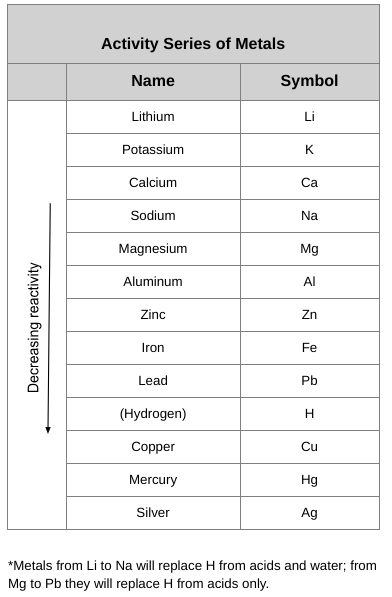
Based on the understanding of the way the metals are placed in the activity series, the student correctly predicted the outcome of four reactions. According to the student, which reactions are most likely to take place? Select all that apply.
Balance the Equation(use the format of 2, 4, 1,3)
Balance the Equation(use the format of 2, 4, 1)
The reactants for a certain chemical reaction are shown. Cu(NO3)2 + NaOH → Which of the following shows the correct product or products of this reaction?
What is the main product of the reaction between magnesium and oxygen?
Students want to gather evidence for the claim that the number of atoms before a chemical reaction is equal to the number of atoms after the chemical reaction. They decide to react vinegar and baking soda in a sealed plastic bag. Which of the following would provide the evidence the students need?
Which of the following is true regarding the atoms involved in a chemical reaction?
Match the metal with its possible reaction product. (Some of these might be NR based on activity series-)
| Draggable item | arrow_right_alt | Corresponding Item |
|---|---|---|
Zinc with magnesium sulfate | arrow_right_alt | Barium chloride and hydrogen gas |
Aluminum with copper sulfate | arrow_right_alt | Zinc sulfate and magnesium metal |
Barium with hydrochloric acid | arrow_right_alt | Aluminum sulfate and copper metal |
Match the nonmetal with its expected reaction product.
| Draggable item | arrow_right_alt | Corresponding Item |
|---|---|---|
Fluorine with potassium iodide | arrow_right_alt | Iron oxide and sulfur dioxide |
Chlorine with sodium bromide | arrow_right_alt | Potassium fluoride and iodine |
Oxygen with iron sulfide | arrow_right_alt | Sodium chloride and bromine |
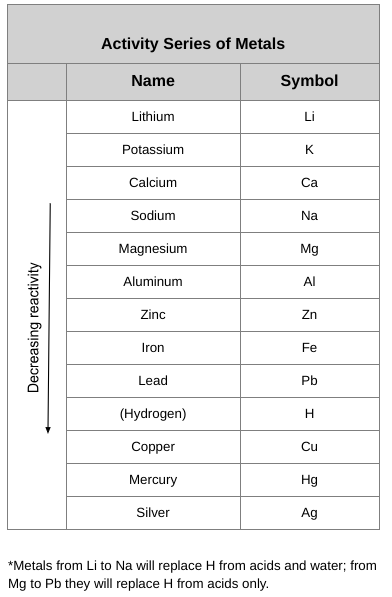
Match these metals with their activity series positions.
| Draggable item | arrow_right_alt | Corresponding Item |
|---|---|---|
Aluminum | arrow_right_alt | More reactive than copper |
Zinc | arrow_right_alt | Less reactive than aluminum |
Copper | arrow_right_alt | More reactive than zinc |
Identify the reaction types based on these metals.
| Draggable item | arrow_right_alt | Corresponding Item |
|---|---|---|
Iron with hydrochloric acid | arrow_right_alt | Produces sodium hydroxide and hydrogen |
Calcium and sulfur | arrow_right_alt | Gives iron chloride and hydrogen gas |
Sodium reacts with water | arrow_right_alt | Results in calcium sulfide |