Log in
Sign up for FREE
arrow_back
Library

Biology STAAR Mini-Test

star
star
star
star
star
Last updated about 1 year ago
20 questions
Required
2
Required
1
Required
2
Required
1
Required
1
Required
1
Required
2
Required
1
Required
1
Required
2
Required
2
Required
1
Required
1
Required
1
Required
1
Required
1
Required
1
Required
1
Required
1
Required
1
This is a (very) shortened version of the actual STAAR test! It includes some of the different question types that may appear on the actual STAAR test.

Answer all questions to the best of your ability, without using any notes, online resources, or other students to help you. Just try your best and give yourself a chance to see how you would actually do on these questions on the real STAAR test!

You can navigate back and forth between questions as much as you need to before your final submission. Make sure you are happy with your answers before you submit at the end of the assignment!
Question 1
1.

Question 2
2.
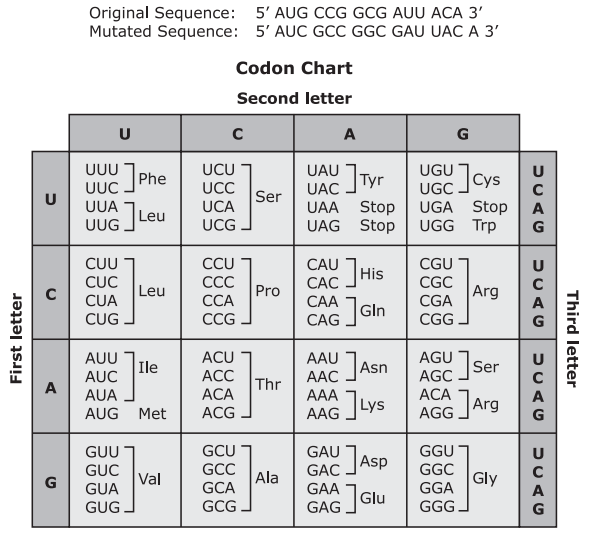
A genetic sequence undergoes a mutation. The original sequence, the mutated sequence, and a codon chart are shown.
How many amino acid changes can be identified from the mutated sequence shown?

Record your answer in the space provided.

_______
Question 3
3.

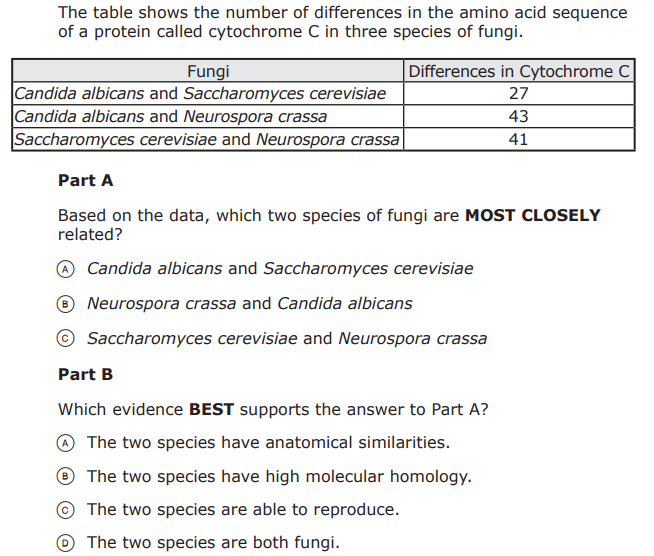
This question has two parts. First, answer Part A. Then, answer Part B.

Question 4
4.

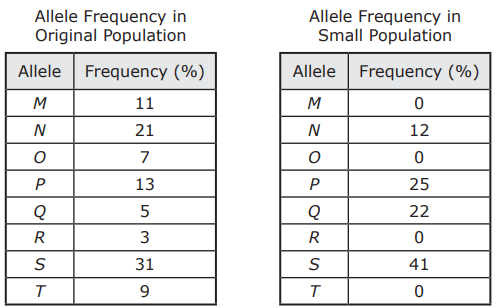
A population of organisms contains multiple alleles for a particular trait. A biologist assigns each allele a letter from M through T and tracks the frequency in a population. A small group of organisms travels to a new location and begins a new population.

The biologist tracked the allele frequency for the trait in the original population and the small group and recorded the data in the tables shown.

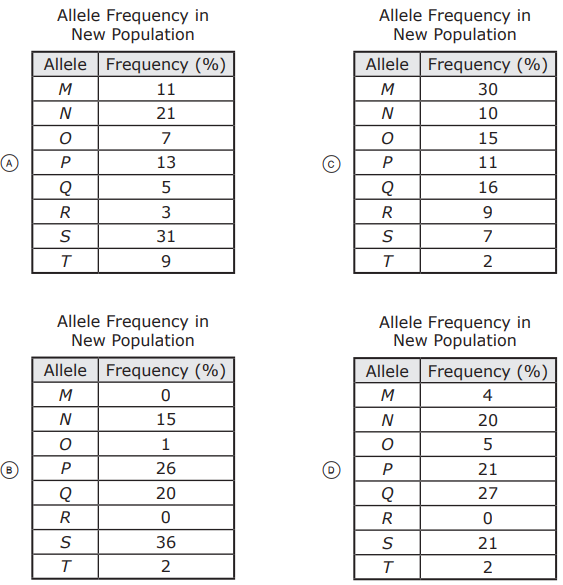
Which table shows the MOST LIKELY allele frequency of the new population?

Question 5
5.

Question 6
6.

Question 7
7.

In animal cells, the sodium-potassium pump moves sodium and potassium ions against a concentration gradient across the cell membrane.

What type of transport is used, AND why is this type of transport necessary?

Read the question carefully. Then enter your answers in the space below.

Question 8
8.

Question 9
9.

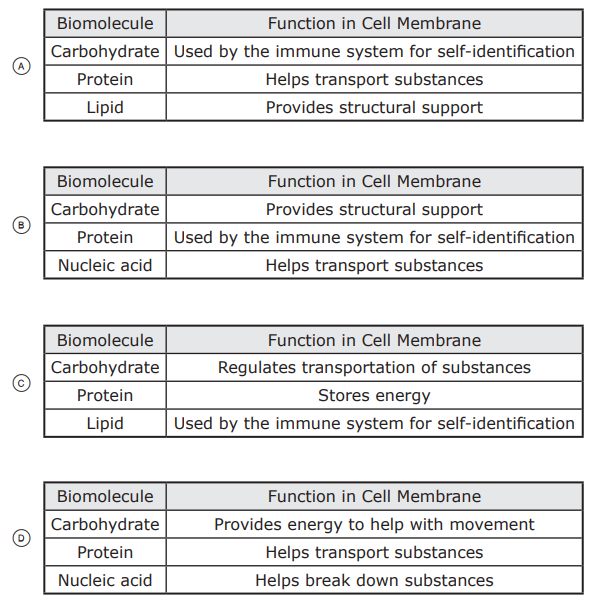
Which table correctly matches each type of biomolecule with its function in the cell membrane?

Question 10
10.
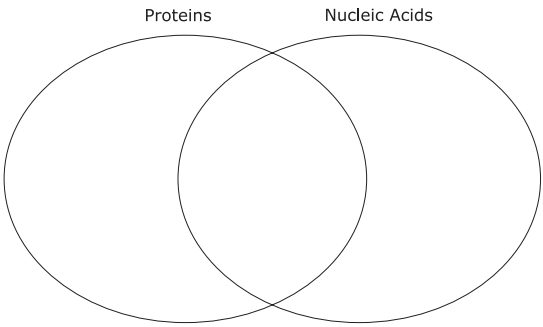
A Venn diagram comparing the functions of proteins and nucleic acids is shown.

Which functions BEST complete the Venn diagram?

Select the correct answer for each box. Not all answers will be used.
Other Answer Choices:
Are involved in translation
Transport substances
Encode genetic information
Are stored as glycogen
Provide insulation
Provide energy
Question 11
11.

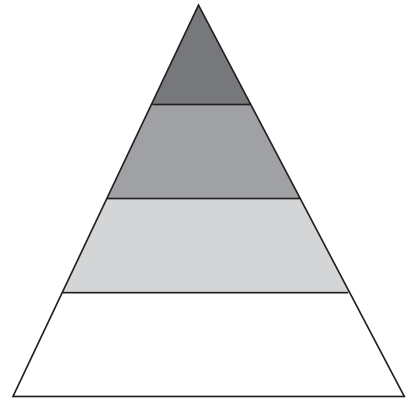
A student is drawing an energy pyramid.

Examine the diagram and answer these questions:
  • What is the original source of all energy for the energy pyramid?
  • How does the amount of energy available at each level of the pyramid change from the bottom to the top?

Question 12
12.

Question 13
13.

Question 14
14.

Question 15
15.

Question 16
16.

Question 17
17.

Question 18
18.

Question 19
19.

Question 20
20.
Leguminous plants, such as bean plants, share a mutualistic relationship with certain rhizobium bacteria. The plants develop harmless nodules on their roots, where the bacteria live. In return, the bacteria convert an important element from the atmosphere into a nutrient form that the plants can use.

What essential element is converted to a useable form by the rhizobium bacteria?

Record your answer in the space provided.
_______

This is the end of the practice test! Make sure you have finalized all of your answers before you submit this assignment.


After you submit the assignment, you will be able to see whether or not you got the answers correct for each question, except for the short constructed response (free response) questions that can't be auto-graded.

DO NOT CLOSE THIS TAB AFTER YOU SUBMIT! You will need to keep this tab open while you complete the reflection assignment, as it will require you to look back at your responses throughout the assignment.

A student studying mitosis captures an image of cells from an onion root tip with a camera mounted on a microscope.
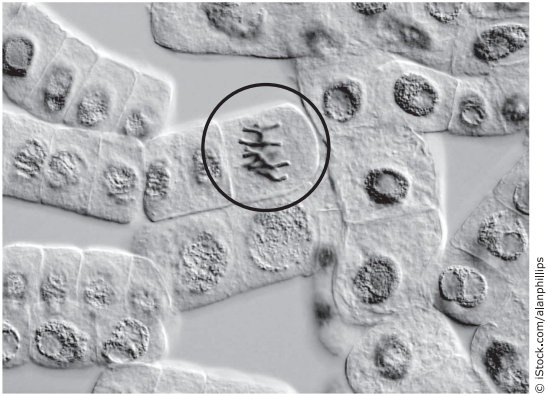
Which events occur after the phase circled in the student’s image?

Select TWO correct answers.
Chromosomes condense.
Chromosomes attach to spindle fibers.
Spindle fibers form.
Paired chromosomes separate.
The cytoplasm separates into two cells.
The nuclear membrane disappears.
A student is sweating after playing basketball.

Which body systems are MOST DIRECTLY interacting as a response to maintain homeostasis?
Immune and integumentary systems
Digestive and circulatory systems
Circulatory and nervous systems
Nervous and integumentary systems
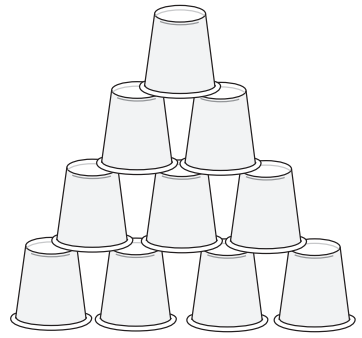
A student makes a model of an energy pyramid by stacking cups as shown. The producers are represented by the bottom level of four cups.
How much energy will be obtained at the top of this energy pyramid if the cups representing the primary consumers have 37,000 kilojoules (kJ) of energy?
37,000 kJ
3.7 kJ
3,700 kJ
370 kJ
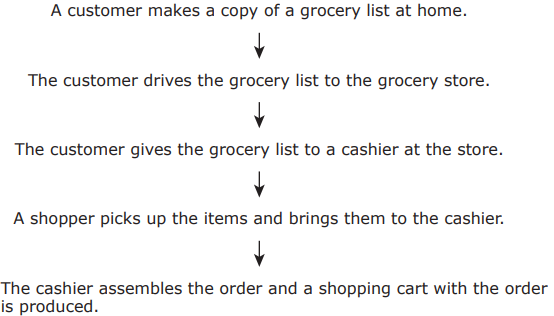
A student makes a model to compare the process of transcription and translation to the process of using a grocery store that prepares orders for customers.
Based on the student’s model and your knowledge of the biological process, which person or object represents tRNA?
The grocery list
The cashier
The shopping cart
The shopper
Microorganisms are known to be present in some food products such as yogurt. One student claims that microorganisms in food always have a negative effect on human health, while a second student disagrees. The second student claims that some microorganisms in food can have a positive effect on human health.

Which statement BEST supports the second student’s claim?
Microorganisms can aid in the absorption of nutrients from food within the digestive system.
Microorganisms reproduce too slowly to affect the immune system.
Microorganisms known to be in food are no longer living and would not affect the digestive system.
Microorganisms can destroy any pathogens that affect the immune system.
There are different types of human blood cells. Depending on what type they are, some blood cells either carry nutrients throughout the body or destroy foreign substances in the body.

Which statement explains how genes control the differentiation of
different types of blood cells?
Genes found in all blood cells can change the cell to perform any function needed.
Different genes are expressed in the different types of blood cells.
Some genes are deleted in one type of blood cell, changing the type of cell it is.
Specific genes in blood cells are expressed only in response to an external environmental change.
Which two components are MOST LIKELY found in both viruses and prokaryotic cells?
Proteins and nucleic acid
Nucleic acids and carbohydrates
Lipids and proteins
Carbohydrates and lipids
Which cellular components are the same in all living organisms?
DNA sequences
Nucleotides
Mitochondria
Nuclei
Which statement BEST describes how genes are expressed in an organism?
Genes are on until all the genes have been simultaneously expressed.
Genes are continuously turned on and off at random intervals of time.
Genes are turned on and off in response to the environment.
Genes are always off even when resources are available.
Which environmental condition would MOST LIKELY result in the appearance of punctuated equilibrium in the fossil record?
An environment that undergoes steady changes over time
An environment that remains in a state of stasis
An environment that experiences rapid large-scale destructive change
An environment with many transitional fossils
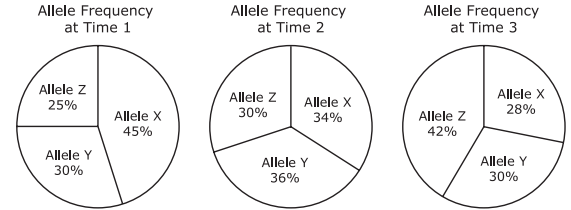
The graphs show changes in allele frequencies in a population at three points in time as a drought becomes more severe.


Which statement best describes how natural selection affects alleles?
Natural selection affects allele frequencies in individuals, not in populations.
Natural selection always affects how the same allele influences an organism’s reproductive success.
Natural selection affects alleles randomly, leading to small changes in allele frequencies.
Natural selection affects allele frequencies differently depending on how helpful an allele is to an organism’s fitness for its environment.
Which statement BEST describes the roles of glucose and oxygen in photosynthesis?
Glucose stores chemical energy during photosynthesis, and oxygen is a reactant in photosynthesis.
Glucose releases chemical energy during photosynthesis, and oxygen is a reactant in photosynthesis.
Glucose releases chemical energy during photosynthesis, and oxygen is a product of photosynthesis.
Glucose stores chemical energy during photosynthesis, and oxygen is a product of photosynthesis.