The Challenger Disaster
Content Standard:
6.10 Identifying policies and programs that had an economic impact on society since WWII.
6.11 Identify technological advancements in society in the U.S. since WWII.
Objective:
Summarize the impact the Challenger Disaster had on the U.S. during the 1980s.
Evaluate the decisions made by NASA to continue with its launch despite issues it faced.
Vocabulary words to watch for: disintegrate, civilian, inclement, posthumously, approximately
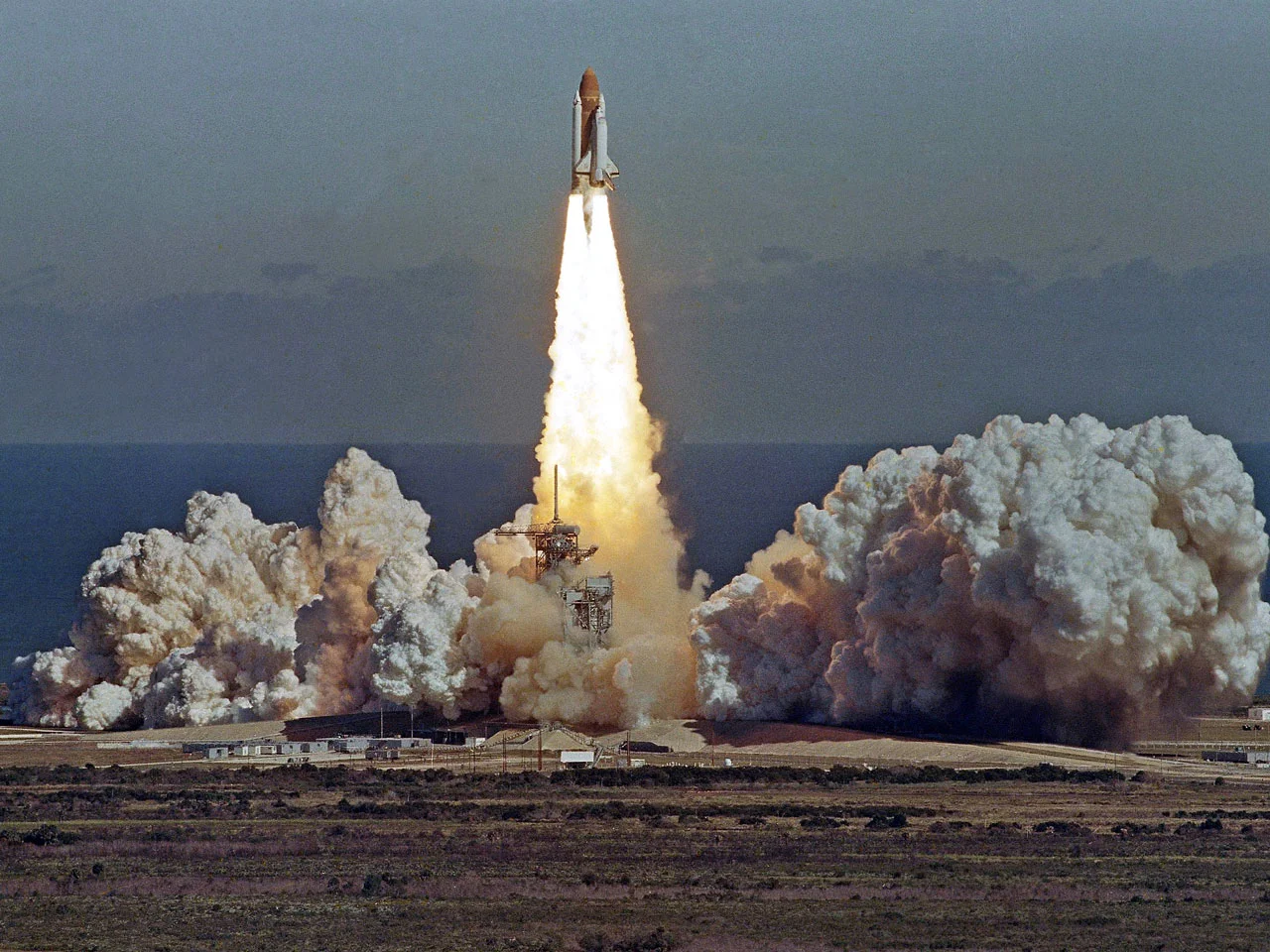
In 1986, a horrific tragedy occurred. What happened that day? Why did the event occur?
The Space Shuttle Challenger first went into operation in April of 1983, and it quickly became the most frequently used of all of NASA’s shuttles. From 1983-1985, Challenger averaged three missions each year.
On the morning of January 28th, 1986, Challenger was scheduled for its 10th launch. This launch had been delayed several times over the course of multiple days due to a combination of inclement weather and mechanical difficulties. The weather was unusually cold that morning, but NASA was determined to proceed with the operation.
Challenger lifted off at 11:38 AM from NASA’s Kennedy Space Center in Cape Canaveral, Florida. Seventy-three seconds into the flight, one of the shuttle’s rocket boosters exploded, causing the entire spacecraft to disintegrate. The crew of seven onboard was either killed instantly or within moments of the disaster.
Following the tragedy, further shuttle flights were temporarily suspended, pending the result of an investigation. An examination of the wreckage revealed that the cause of the accident had been rubber O- rings which were designed to seal joints. These O-rings were not intended to work in cold temperatures, and as a result, did not seal properly. NASA had received warnings to wait until the temperature rose to carry out the launch, but the warnings had been ignored.
The astronauts aboard Challenger that day were Francis Scobee, Michael Smith, Ronald McNair, Ellison Onizuka, Judith Resnik, and Gregory Jarvis. In addition to the astronauts, a teacher, Christa McAuliffe, was also onboard. McAuliffe was a participant in NASA’s “Teachers in Space” program. This was a program designed to take non-astronaut civilian teachers into space so they could return to their classrooms and share the experience with students.
McAuliffe’s presence on Challenger had evoked considerable media interest in the flight. Many school children were watching the shuttle launch, and the Cable News Network (CNN) broadcasted the launch live. It is estimated that approximately 17% of Americans tuned in that morning, meaning that around 41 million Americans watched live as the disaster unfolded.
In the days following the Challenger explosion, a memorial service was held in honor of the departed astronauts. President Ronald Reagan spoke at this event, and it was attended by more than 10,000 people. Countless more watched on television.
The Challenger crew has been memorialized in many ways since the accident. A number of schools have been renamed in honor of civilian Christa McAuliffe or one of the astronauts. Some have also adopted “Challengers” as their mascot. In Webster, Texas, there is a Challenger Seven Memorial Park, and a mountain range on Pluto has also been named in memory of the crew. In 2004, President George W. Bush posthumously awarded the members of the Challenger crew with the Congressional Space Medal of Honor.
The Challenger crew will continue to live on in the hearts and minds of Americans for years to come. At the memorial service for the astronauts, President Reagan reminded the country, “Sometimes, when we reach for the stars, we fall short. But we must pick ourselves up again and press on despite the pain.”