Log in
Sign up for FREE
arrow_back
Library

LRHS STAAR Review Categories 3&4 part 2

star
star
star
star
star
Last updated about 1 year ago
12 questions
1
1
1
1
1
1
1
1
Question 1
1.

Question 2
2.

Question 3
3.

1
Question 5
5.

1
Question 7
7.

1
Question 9
9.

Question 10
10.

Question 11
11.

1
Which of these best demonstrates mutualism between certain types of bacteria and humans?
Intestinal bacteria obtain nutrients from the gut and produce vitamin K used by humans.
Bacteria become resistant to antibacterial medication that humans use for treatment.
Invasive bacteria at an area of injury produce toxins that damage healthy tissues of the human body.
Bacteria in improperly prepared food is consumed by humans, causing food poisoning.
In the mid-1980s an aggressive strain of algae known as Caulerpa was accidentally introduced into the Mediterranean Sea when a seaside aquarium cleaned out its tanks. The algae contains a toxin that prevents native herbivores from consuming it. Caulerpa quickly spread over the sea floor, crowding out many species including sponges, corals, sea fans, and lobsters.

Which statement explains the most likely impact Caulerpa has had on the biodiversity in the Mediterranean Sea?
The presence of Caulerpa within an ecosystem is an indicator of the ecosystem’s health.
The spread of Caulerpa improved the habitat for many species of sea grasses, and increased the biodiversity.
Caulerpa became dominant within the ecosystem and reduced the biodiversity.
A small town in the piney woods of East Texas has a soccer field composed of native grasses. The soccer field is mowed once a week.

What effect does continual mowing have on the ecology of the field?
Mowing increases the likelihood of nonnative species displacing native species.
Mowing increases the number of species found in the field.
Mowing causes different types of communities to form across the field.
Mowing maintains a low species diversity by inhibiting further succession.
Question 4
4.

Conservation biologists studying cheetah populations have determined that the lack of genetic diversity among the cheetahs is due to genetic drift.

Which statement explains the most likely consequence of having a low genetic diversity on the cheetah population?
The chances of a mutation occurring in the cheetah population are decreased, increasing the cheetah survival rate.
The gene pool remains in equilibrium and future generations of cheetah offspring are stronger and better adapted to their environments.
The cheetah population becomes less likely to survive an outbreak of a disease or an environmental change, increasing the chance of species extinction.
Genetic variability is maintained from older cheetah populations that have survived and endured environmental stressors.
Question 6
6.
Grassland ecosystems in Texas have evolved to depend on periodic fires to return nutrients to the soil and encourage plant reproduction. Humans have prevented fires in many of these grassland areas, resulting in plant and animal communities with little diversity. Wildlife biologists often recommend purposefully starting fires called prescribed burns, which are monitored and controlled, in grassland ecosystems every 3 to 4 years. These biologists observe greater diversity in plant and animal life in the years following a prescribed burn.

What natural processes are the biologists attempting to imitate?
Biomagnification
Succession
Population bottleneck
species extinction
Question 8
8.

Some organisms have genes that improve their ability to survive and reproduce. If the genes also help their offspring survive and reproduce, then which of the following will most likely increase?
The frequency of the genes in one individual
The frequency of the genes in the population
The number of genes in one chromosome
The number of genes in the species
Lord Howe Island is a volcanic island in the Tasman Sea that is about 11 km long and 2.8 km wide. The island has two species of palm trees, Howea forsteriana and the more abundant Howea belmoreana. The two species do not interbreed even when they grow very close to each other.

Which evolutionary process fails to occur?
Genetic drift of Howea forsteriana
Natural selection of adaptive traits in both species
Gene flow between the two species
Mutations in Howea belmoreana
Dead zones are low-oxygen areas that develop on the seafloor. Scientists hypothesize that phytoplankton blooms cause these dead zones. Phytoplankton blooms occur when excess nutrients are introduced by pollution from fertilizers, sewage plants, and the burning of fossil fuels.

Which of the following would most likely cause an increase in these contributors to dead zones?
Rainfall patterns that increase freshwater runoff from terrestrial ecosystems
Replacing coal-fired power plants with windmills
Farming practices that reduce nitrate and phosphate applications
Constructing efficient water-recovery and treatment plants
Question 12
12.

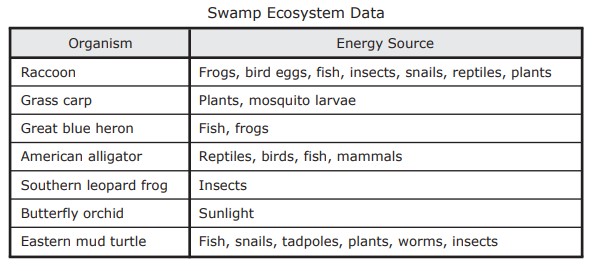
The table lists some organisms found in a swamp ecosystem and their sources of energy.

When constructing an energy pyramid of the swamp ecosystem, which of these would be placed at the top of the pyramid?
Grass carp
American alligator
Eastern mud turtle
Great blue heron
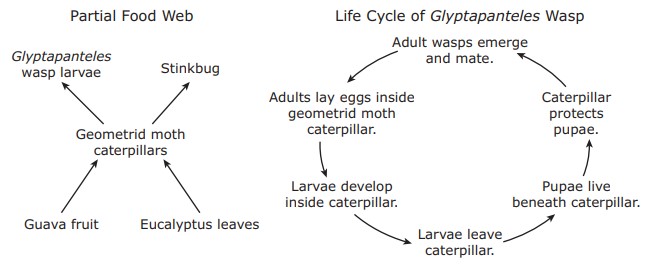
Competition: stinkbugs / Parasitism: geometrid moths
Competition: geometrid moths / Commensalism: stinkbugs / Mutualism: guava and eucalyptus trees
Competition: stinkbugs and geometrid moths / Commensalism: guava and eucalyptus trees
Parasitism: geometrid moths / Commensalism: stinkbugs / Mutualism: guava and eucalyptus trees
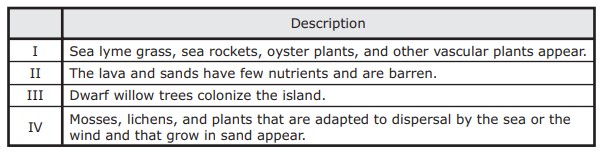
Surtsey is an island located south of Iceland. The island was formed by a volcanic eruption and first appeared in 1963. The table below contains descriptions of changes in the population and diversity of species on Surtsey.

Which of these lists the descriptions in the correct order of ecological succession on Surtsey?
I, II, IV, III
III, I, II, IV
IV, III, I, II
II, IV, I, III
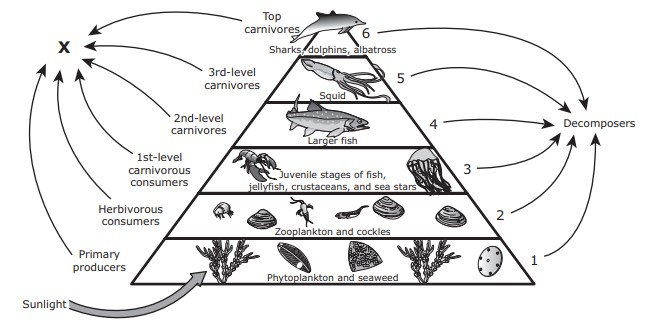
A marine ecosystem is represented below.

What is lost to the environment at each of the trophic levels of this ecosystem?
Nutrients from the soil
Living space for the organisms
Food sources
Heat