Log in
Sign up for FREE
arrow_back
Library

10.3 - Circulatory & Lymphatic System [Mastery Check]

star
star
star
star
star
Last updated 11 months ago
11 questions
Required
0.4
Required
0.2
Required
0.5
Required
0.5
Required
0.5
Required
0.2
Required
0.5
Required
0.2
Required
0.2
Required
0.3
Required
0.5

Complete this mastery check assignment AFTER completing the tutorial assignment. Both must be completed before 8 AM on Mon/Tue (4/21 - 4/22).

This Mastery Check will NOT allow you to check your answers before submitting. You should already have completed the Tutorial assignment, which did let you check your answers before submitting!

It is VERY important that you take detailed notes & fully complete both of these assignments!

Question 1
1.

Match each component of blood below with the description or function that best fits it.

Draggable itemarrow_right_altCorresponding Item
Platelets
arrow_right_alt
The liquid extracellular matrix that blood cells are found in.
arrow_right_alt
arrow_right_alt
arrow_right_alt
arrow_right_alt
Question 2
2.

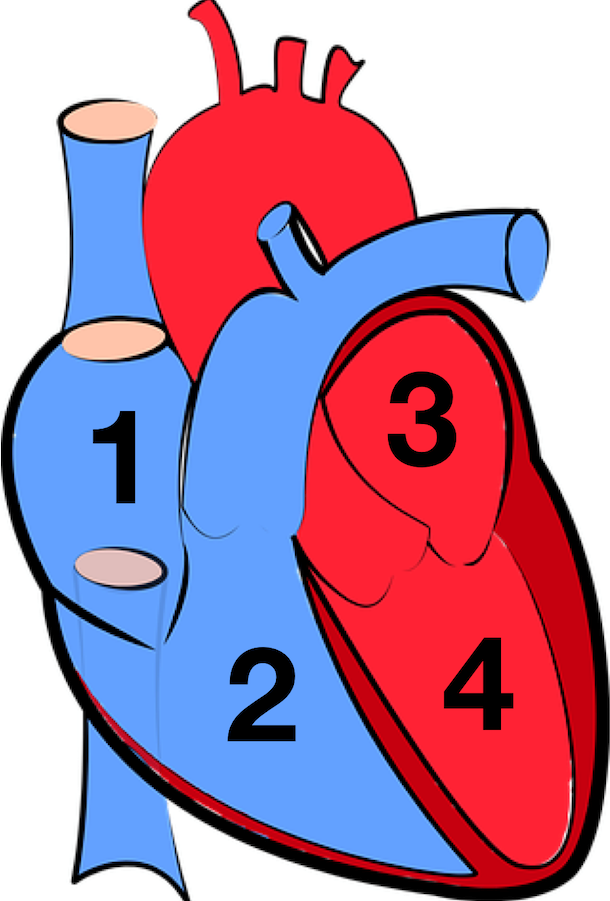
Below is a diagram of the human heart.

Which of these chambers is the last chamber that blood would be in, right before it leaves to go to the rest of the body?
Question 3
3.

Question 4
4.

Question 5
5.

Question 6
6.

Leakage from the circulatory system would then....

Question 7
7.

Question 8
8.

Which choice below is most accurate for the number of lymph nodes found in the human body?

Question 9
9.

A red blood cell is currently located within a capillary.

After it leaves the capillary, which of the following would it enter FIRST?

Question 10
10.
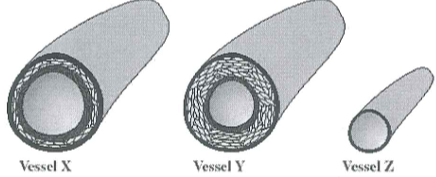
Based on what you know about the different types of blood vessels, identify each blood vessel shown in the image below. Each blood vessel type is only used once!

Vessel X = __________

Vessel Y = __________

Vessel Z = __________
Question 11
11.
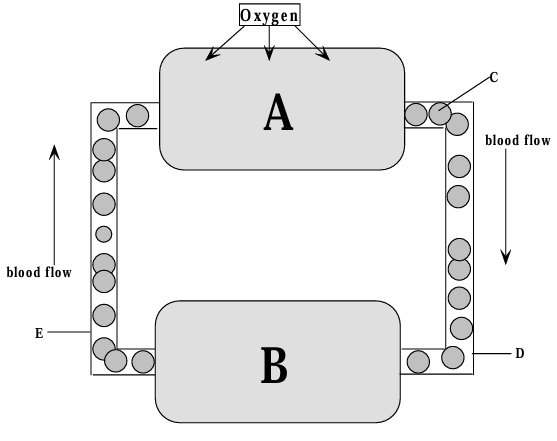
Use the diagram below to correctly answer each question:

In this diagram, Organ A likely represents __________ and Organ B likely represents __________.

The blood vessel labeled "D" is most likely __________, and the blood vessel labeled "E" is most likely __________.

Compared to the cells currently found in blood vessel D, the cells currently found in blood vessel E would likely have a __________ oxygen concentration and a __________ carbon dioxide concentration.
White Blood Cells
These carry oxygen throughout your body to deliver to your body's cells.
Solutes
These help fight off infectious bacteria and/or viruses.
Red Blood Cells
if you're injured, these will help your blood clot to seal the wound
Plasma
Includes various wastes, salts, proteins, etc.
[MARK ALL THAT APPLY!]

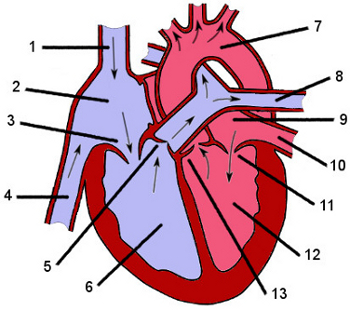
Below is a diagram of the heart, with different parts labeled.
Mark all statements below that are TRUE based on this diagram.
#8 is carrying de-oxygenated blood
#1 and #4 are carrying oxygenated blood
#1 represents a vein that is returning blood to the heart
the blood within #1, #4, and #8 would be blue in color in real-life
#5 represents a valve that prevents blood from accidentally flowing backwards
#10 represents a vein
[MARK ALL THAT APPLY!]

Below are a series of true or false statements.

Mark each statement that is TRUE!
the heart contains four main chambers
circulation is the transport of materials in living things
capillaries are the smallest blood vessels
arteries always carry oxygenated blood
veins always carry blood to the heart
blood is pumped by the brain
[MARK ALL THAT APPLY!]

Below are a series of true or false statements.

Mark each statement that is TRUE!
the heart has a total of 2 chambers in it
veins are typically larger in size than arteries
arteries tend to be stretchier/more elastic, than veins
veins tend to have lower pressure blood within them than arteries
capillaries connect arteries and veins
blood circulates through the body only a few times per day
[MARK ALL THAT APPLY!]

Choose all of the following that can be found in both the circulatory system and the lymphatic system.
white blood cells
red blood cells
plasma
pathogens
blood
fluid
Less than 50
6-20
2-5