MCAP PRactice ELA 6 Section 3
star
star
star
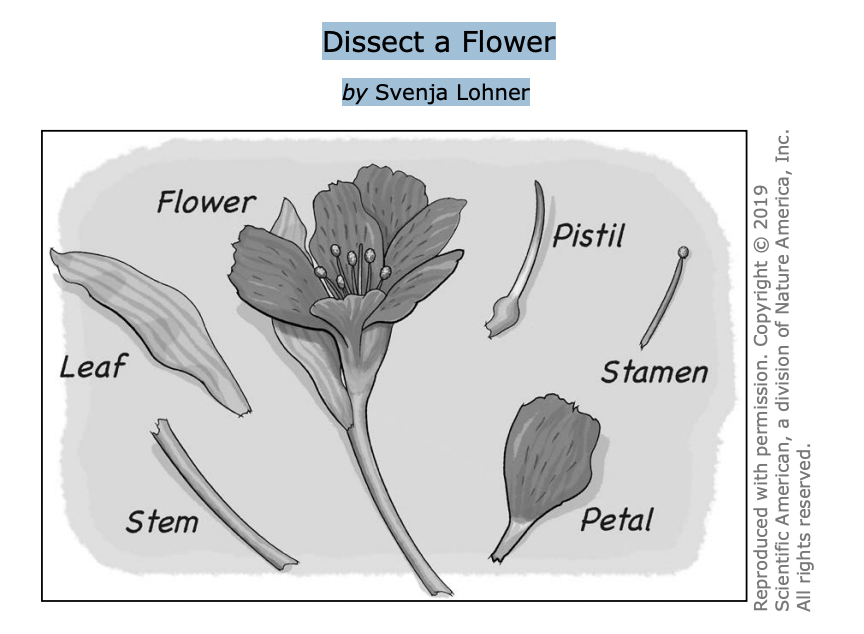
star
star
Last updated over 1 year ago
12 Nsɛmmisa
1 Springtime is when nature appears to come back to life after winter. Trees grow leaves, grass gets green, and flowers sprout, displaying beautiful colors and sometimes spreading a delightful scent. But have you ever looked at a flower in more detail? What parts do flowers consist of? Are all flowers alike? In this activity you will find out by dissecting, or taking apart, a flower piece by piece. How many plant parts do you think you can identify?
Background
2 Plants that make flowers are known as flowering plants. But do flowers only exist to make plants look pretty? Not quite! Although they can be beautiful to us, flowers are made to attract pollinators for reproduction. This means the flowers are a crucial part of the process in growing seeds to make more plants. If you look closely at a flower, you might see that it is made of many different parts, each of which has a specific purpose.
3 Some flowering plants have a stem, which is a long stalk that carries water and nutrients and supports the flower. Leaves produce the food for the plant by photosynthesis, a process that helps makes plant food from light, carbon dioxide, and water.
4 When you look at the flower of a flowering plant, the most obvious parts are probably the petals. They can vary in size and shape but are usually brightly colored. Their purpose is to attract the bees and other insects that help to pollinate the plants. You might be surprised to learn that some flowers— in the botanical world they are called “perfect flowers”— have male parts and female parts, and each plays an important role during pollination.
5 The male parts, called stamens, look like long stalks (known as filaments) with a little round shape at their end (called the anther), which contains the plant pollen. This bright yellow or orange dust is what insects carry from one plant to another. Pollination occurs if the pollen gets carried to the female parts of a new flower, called the pistil. The pistil is usually a long stalk located in the center of the flower and is also made up of several parts. Most importantly it contains the ovary at its bottom, which houses the female plant eggs called ovules. When pollen is dropped into the pistil of a flower, the eggs, or ovules, inside the plant ovaries are fertilized. The fertilized ovules then grow into plant seeds, and the ovary becomes the fruit.
6 As you can see, a flower is much more than just beautiful to look at: it is essential for a plant to create more plants. Take a closer look at the many different plant parts in this activity, and see how they differ from one flower to another!
Materials
• Three different large fresh flowering plants, such as roses, tulips, lilies, petunias, carnations or irises. You will need at least the stem with a flower attached for each of these. Note: Make sure you select “perfect flowers,” which have male (stamen) and female (pistil) plant parts, such as those listed above. If you have allergies to certain plants, make sure that you use an alternative.
• Glass or cup with water
• Six paper plates
• Tweezers
• Scissors
• Magnifying glass or hand lens (optional)
• At least one additional (intact) specimen of each of the flower types you chose to dissect (optional)
• Paper (optional)
• Colored pencils (optional)
• Poster- sized paper or poster board (optional)
• Tape (optional)
• One or more vegetables or fruits, such as carrots, beets, asparagus, broccoli, cauliflower, tomatoes, apples, peppers, lettuce, peas, corn or cabbage (optional)
Preparation
• Label each of the paper plates with one plant part (“Stem,” “Petal,” “Leaf,” “Pistil” and “Stamen”).
• Label one extra paper plate “Other.”
• Draw lines onto each paper plate to divide it into three sections.
• Label each section on each plate with a name of one of the three flowering plants.
Procedure
• Carefully look at each of the flowering plants. If you have a magnifying glass, you can use it to examine your plants and their flowers. What does each plant and flower look like?
• Choose one of your flowering plants, and start your plant dissection. Use your hands, scissors or tweezers and carefully take apart your plant. Which plant parts can you identify?
• Once you have removed one part of the plant, try to identify it, and place it on the corresponding plate. Put it in the section that is labeled with the right plant name. Can you find a plant part for each plate?
• If you cannot identify a specific plant part, place it on the “Other” plate.
• When you have finished taking the first plant apart look at all its different parts. How do different parts within one plant compare?
• Next repeat the dissection with the remaining two flowering plants. Then compare the plant parts on each paper plate. What do you notice about the same plant part from different flowering plants?
• Look at all the plant parts that you placed on the “Other” plate. What do you think these plant parts are? How can you find out?
“Dissect a Flower” by Svenja Lohner. Copyright 2019 by Scientific American. Reproduced with permission of Scientific American via Copyright Clearance Center.
Question 9 - You have read two passages about plants. “Dissect a Flower” provides an experiment a reader can perform to learn about plants, while “Venus Flytrap” provides facts and descriptions to help the reader learn. Which type of passage provides a better opportunity for learning? Write a response arguing whether a reader learns more from thinking through an experiment or from thinking through facts and descriptions. Use information from both passages in your argument.
Question 1 - In paragraph 5 of “Dissect a Flower,” the pistil is the part of the plant that
Question 2 - What are two purposes for including the picture of the flower in “Dissect a Flower”?
Question 3 Part A - Which central idea about flowers is best supported in the passage “Dissect a Flower”?
Question 3 Part B - Which quotation from the passage best supports the answer to Part A?
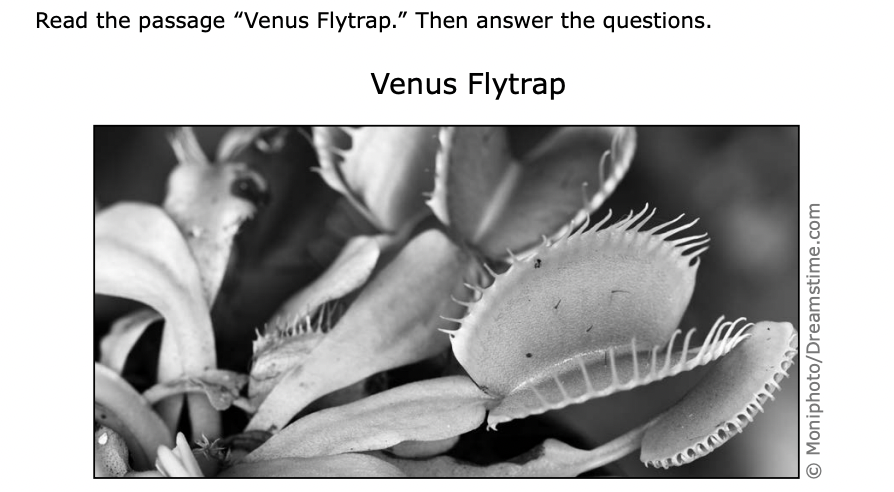
1 The Venus flytrap is a flowering plant best known for its carnivorous eating habits. The “trap” is made of two hinged lobes at the end of each leaf. On the inner surfaces of the lobes are hair- like projections called trichomes that cause the lobes to snap shut when prey comes in contact with them. This type of movement is called thigmonasty— a nondirectional plant response to being touched. To prevent the plant from wasting energy if prey isn’t actually there, the trap will only shut when the trichomes are touched multiple times. The hinged traps are edged with small bristles that interlock when the trap shuts to ensure the prey can’t squirm out. There are other carnivorous plants in the wild, but the Venus flytrap is one of the very few that exhibits motion to actively trap its prey.
RANGE
2 The Venus flytrap is endemic to North and South Carolina, but it has been introduced to a few other states, including Florida and New Jersey. It is popular as a potted plant in many parts of the world, but unfortunately most of the Venus flytraps sold have been cultivated or collected from declining wild populations.
3 The plant grows in moist, acidic soil that may be poor in nutrients. Venus flytraps need an open understory (the part of the forest below the canopy) to live. Part of what keeps the understory open is natural fires that sweep through and burn away parts of trees and shrubs. These fires can become dangerous to humans, so often we stop them before they have a chance to provide benefits to the forest. This results in less suitable habitat for the sun- loving Venus flytrap.
DIET
4 The Venus flytrap gets some of its nutrients from the soil, but to supplement its diet, the plant eats insects and arachnids. Ants, beetles, grasshoppers, flying insects, and spiders are all victims of the flytrap. It can take a Venus flytrap three to five days to digest an organism, and it may go months between meals. LIFE HISTORY
5 Venus flytraps are perennial plants, which means they bloom year after year. The flowers are white with green veins running from the base of the petal toward the edges. Pollinated flowers eventually give rise to seeds.
6 Each trap on the plant can only open and close several times before it dies and falls off. Then the plant produces a new trap from its underground stems. The lifespan of the Venus flytrap isn’t known for certain, but it’s been estimated to live up to 20 years and possibly longer.
CONSERVATION
7 The Venus flytrap is internationally listed as vulnerable. It is also under consideration for federal listing on the U.S. endangered species list. This species is threatened by overcollection, habitat destruction, and fire suppression.
FUN FACT
8 Like all plants, the Venus flytrap gets its energy from the sun in a process called photosynthesis. It digests insects and arachnids to get nutrients that are not available in the surrounding environment.
© 2021 National Wildlife Federation. All Rights Reserved.
Question 4 Part A - What is the meaning of digest as it is used in paragraph 4 of “Venus Flytrap”?
Question 4 Part B - Which quotation from paragraph 4 best supports the answer to Part A?
Question 5 - According to “Venus Flytrap,” what effect do forest fires have on the survival of Venus flytraps?
Question 6 - In “Venus Flytrap,” the author’s concluding opinion about the plant is that it
Question 7 Part A - What is a central idea in “Venus Flytrap”?
Question 7 Part B - Which two details from the passage best support the answer to Part A?
Question 8 - According to “Dissect a Flower” and “Venus Flytrap,” what are two ways in which Venus flytraps are similar to other plants? A They use photosynthesis to