MCAP Practice ELA 8 Section 3
star
star
star
star
star
Last updated over 1 year ago
9 Nsɛmmisa
Today you will read “Testing Thinking” as well as an excerpt from “Am I Human?” Then you will answer questions about the selections and write a response in which you analyze both texts.
Read the passage “Testing Thinking.” Then answer the questions.
Testing Thinking by Susan Berk Koch
1 Twenty years ago, computer program Deep Blue defeated a human grandmaster in a six- game chess match. Computers can quickly analyze huge amounts of data. This ability leads to remarkable results. Today, they can drive cars and identify people in photos. Does this mean computers can think? TALKING THE TALK
2 It probably takes some serious thinking for you to complete your math homework. But a computer armed with the right program will arrive at the right answers to almost any math problem quicker than any human. Computers excel at complicated mathematics. But they don’t have the imagination and common sense that humans take for granted. A computer assistant such as Siri may struggle to devise solutions to the question, “What do we do if it rains on our picnic?” And if you suggest standing on your head and chanting to the rain gods, it won’t understand that was a joke.
3 Artificial intelligence (AI) is a broad field of computer science. Researchers in the field program computers to do things that normally require a human brain, like learning, solving problems, or conversing with people.
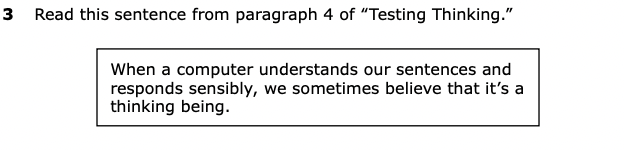
4 To talk to people, computers need to grasp the different meanings of words and how they fit together to form ideas and stories. This is called natural language processing. It gives a computer the ability to interpret human text or even speech. When a computer understands our sentences and responds sensibly, we sometimes believe that it’s a thinking being. In fact, some people have proposed that a program that can successfully converse must really be thinking. They have even devised tests that involve striking up conversations with computers. INVENTING A TEST
5 British mathematician and code breaker Alan Turing was a pioneer in the fields of computer science and AI. He proposed the Turing test in 1950 as a way to answer the question, “Can machines think?” His original proposal for the Turing test is a simple game that looks for how closely a computer mimics a human. A human judge text chats on two screens with two partners. One is a computer program. The other is another human. The chat lasts five minutes. After time’s up, if a judge mistakenly thinks the computer is a human in seven out of ten rounds, the computer passes.
6 To judge this sort of test, the human would want to ask questions that are difficult for a computer to answer. Asking questions that involve the outside world is one possible tactic. A judge may say, “What did you think of the weather today?” An AI chatbot may answer, “Here’s the forecast for today.” A human could say, “Not the best, I can barely see in all the fog.”
7 In 2014, a computer program seemed to pass the Turing test by convincing 10 out of 30 judges that it was human. The test has limitations, though. For one thing, it depends on which questions are asked. And experts can’t quite agree on what is a passing score. TAKING THE PRIZE
8 Each year since 1990, chatbots have competed in a contest based on the Turing test. It’s called the Loebner Prize. First place goes to the most human-like AI. Unlike the original Turing test, this is not a pass-or-fail test. And this competition begins with an elimination round of questions that all the computer programs must answer. In 2015, each entrant fielded 20 questions. One was: “If Alex lent money to Joe because they were broke, who needed the money?” AIs often have trouble with twisty phrasing like this. Another was: “Are you on Twitter?”
9 In the final round, judges chat with a human and with a computer. They spend 25 minutes asking the contestants anything, like in the Turing test.
10 AI programmer Bruce Wilcox won the Loebner Prize four times in seven years. His computers made the finals by answering questions such as “Do you like tea?” with “Sure, I like tea. Haven’t had any recently though.” GETTING TO “UNDERSTANDING”
11 It has become clear over time that a computer probably doesn’t need to think like a human to converse. Often, the conversations make sense— to a point. Wilcox says that the difference between how humans and computers think is that humans plan ahead. They reason about consequences. People often decide what to do based on personal goals, or motives. If you asked an AI chatbot, “Where were you yesterday?” it may answer, “In Chicago.” But if you asked why, it wouldn’t know.
12 Bodies allow people to sense the outside world. And we have years of experience interacting with that world. Most AI programs don’t have senses or experience living in a physical world. If you ask a computer, “If I keep pouring this pitcher of water into a glass, what will happen?” the computer likely won’t understand how to answer. It’s never held a glass, touched water, or taken a drink. Everything about the real world that requires common sense is a challenge for an AI. In the Loebner competition several years ago, the AIs were asked, “Would it hurt you if I stabbed you with a towel?” Humans have all used towels before, so we’d be able to answer, “No, because towels are soft.” But none of the AI contestants had an answer that made sense.
13 AIs experience thousands of terabytes of data, accessible in an instant. They never feel frustrated, sad, or angry while trying to solve a problem. They have abilities people can only dream of. AIs beat humans at chess and correctly identify pictures of Persian cats. But they might not be able to tell you what it means if a cat hisses. And AIs don’t feel the sun’s warmth, the exuberance of making that winning shot, or the pain of stubbing a toe. Not yet, anyway.
Read the passage from “Am I Human?” Then answer the questions.
from “Am I Human?” by Gary Marcus
1 In 1950 Alan Turing devised a thought experiment that has since been revered as the ultimate test of machine intelligence. He called it the “imitation game,” but most people know it as the Turing test. Anticipating what we now call chat bots— computer programs that masquerade as humans— Turing envisioned a contest in which a machine tries to trick an interrogator into believing it is human, answering questions about poetry and deliberately making mistakes about arithmetic. Today, in the eyes of the general public, the Turing test is often seen as a kind of a Rubicon, a measure of whether machines have truly arrived. But it shouldn’t be: the Rubicon can be passed, though for the wrong reasons. It is now possible to build machines that fool people, at least for brief periods— but the victories are fleeting, and they do not seem to be carrying us even close to genuine intelligence.
2 The problem is that Turing’s test is too easily gamed. One can “win” simply by being deceptive or feigning ignorance. As Turing himself partly anticipated, the trick to winning is mostly not to answer the questions. If a judge asks a machine, “Do you have feelings?” the machine must lie to win. But that odd twist is not an exception— it is the rule. The way to win the Turing test is to deceive. 3 In 2014, for example, a chat bot named “Eugene Goostman” supposedly “won” the Turing test by pretending to be a sarcastic 13- year- old boy from Odessa, Ukraine, who never answered questions directly. Some judges were fooled (about a third, enough to count as a shallow victory). But so what? The judges got only a few minutes to conduct their interviews, and they undoubtedly would have ferreted out the truth soon enough. In reality, Eugene knew— and understood— almost nothing. Consider this dialogue, which computer scientist Scott Aaronson had with the bot:
SCOTT: Which is bigger, a shoebox or Mount Everest?
EUGENE: I can’t make a choice right now. I should think it out later. And I forgot to ask you where you are from . . .
SCOTT: How many legs does a camel have?
EUGENE: Something between 2 and 4. Maybe, three? :-))) By the way, I still don’t know your specialty— or, possibly, I’ve missed it?
SCOTT: How many legs does a millipede have?
EUGENE: Just two, but Chernobyl mutants may have them up to five. I know you are supposed to trick me.
SCOTT: No, I need to know that you’re not a chatbot. Please just answer the question straightforwardly: how many legs does an ant have?
EUGENE: Something between 2 and 4. Maybe, three? :-))) Oh, what a fruitful conversation ;-).
4 Clearly, Turing’s original test has not withstood the test of time
Question 8 - After reading both the article “Testing Thinking” and the excerpt from “Am I Human?” write a response to analyze how each author examines the differences in the ways that humans and artificial intelligence process information. Be sure to use evidence from both passages in developing your response.
Question 1 - Which statement best explains the structure of paragraph 2 in “Testing Thinking”?
Question 2 - What is the main purpose of paragraph 3 in “Testing Thinking”?
Question 3 - Which statement best explains the significance of this sentence?
Question 4 - Which phrase best helps the reader understand the effect of the word masquerade as is used in paragraph 1 of the passage from “Am I Human?”
Question 5 - In paragraph 2 of the excerpt from “Am I Human?,” which two phrases best help the reader determine the meaning of feigning?
Question 6 Part A - According to the author of the excerpt “Am I Human?,” what is the main reason the Turing test is not effective?
Question 6 Part B - Which quotation from the excerpt best supports the answer to Part A?
Question 7 - The authors of both “Testing Thinking” and the excerpt from “Am I Human?” establish connections between which two concepts?