Log in
Sign up for FREE
arrow_back
Library

U5 Quiz: Economic Geography

star
star
star
star
star
Last updated about 2 months ago
10 questions
Required
3
Required
3
Required
3
Required
2
Required
3
Required
1
Required
5
Required
2
Required
2
Required
3
Question 1
1.

Sort the following descriptions and examples into the proper category based on the economic sector that it represents.

  • jobs that connect products with customers OR operate in the service industry
  • examples: factory worker, builder, oil refinery worker
  • jobs that create a new, finished product out of a natural resource
  • jobs that deal directly with the earth or a natural resource
Question 2
2.

Match the descriptions to the economy it best fits:

  • GDP is high
Question 3
3.

Why are natural resources important to economic development? (select all that apply)

Question 4
4.

Match the descriptions to the term that it best describes.

  • example: "The farm is on a plain in an area that has a temperate climate and adequate rainfall."
  • This is MOST important for primary industries, such as mining and farming.
  • Describes what a location is like in terms of what is near the location
  • This is MOST important for tertiary industries, such as furniture stores, education, and banks.
  • example: "The barber shop is in the center of town, near a busy restaurant and minutes from a major highway."
Question 5
5.

Which of the following might IMPROVE the "quality of life" found in a location? (select all that apply)

Question 6
6.

What is the BEST measure of a country's economy?

Question 7
7.

Match each term with its definition.

Draggable itemarrow_right_altCorresponding Item
trade barrier
arrow_right_alt
something that is brought IN from another country
trade agreement
arrow_right_alt
arrow_right_alt
arrow_right_alt
arrow_right_alt
Question 8
8.

What are positive impacts of trade agreements? (mark all that apply)

Question 9
9.

Why would a country choose to have trade barriers? (select all that apply)

Question 10
10.

Match the descriptions with the appropriate trade bloc.

  • members: ten countries in southeast Asia including Singapore and the Philippines
examples: teacher, salesman, delivery driver
examples: farmer, miner, fisherman
Primary Sector
Secondary Sector
Tertiary Sector
Country has some infrastructure (roads, education, public services)
GDP is improving but moderate
Countries considered "developed," such as Norway in Northern Europe
Country has very little infrastructure (roads, public services, little education)
Country has well-developed infrastructure
GDP is low
Countries considered "developing," such as China
Countries considered "under-developed," such as Somalia in eastern Africa
Economy Based on Primary Sector
Economy Based on Secondary Sector
Economy Based on Tertiary Sector
Natural resources provide jobs in the primary sector.
Natural resources can be sold for money.
Countries cannot be recognized by other nations unless they have natural resources.
Tertiary jobs require direct access to natural resources.
Describes an exact location, including physical features and climate
Site
Situation
Well-maintained roads and infrastructure
A high crime rate
A lack of parks or entertainment options
something that is sold and shipped OUT to another country
import
something that stops or limits trade between countries
export
designed to increase trade or make trade easier between countries
globalization
increased interconnectedness between countries' economies
agreement includes free trade only
Trade bloc on the map in teal (light blue):
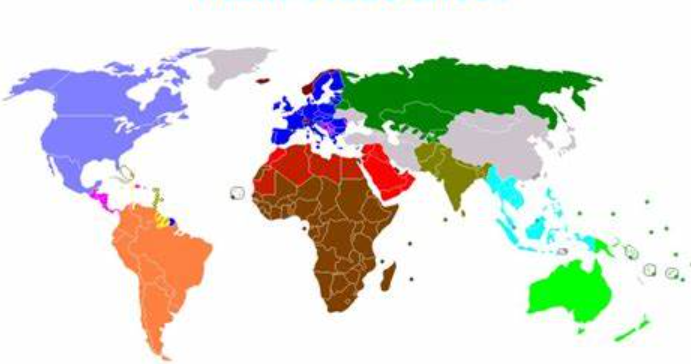
agreements include free trade, a common government, free travel between countries, and a common currency (money)
members: 27 countries in Europe including France, Italy, and Germany
Trade bloc on the map in dark blue:
Trade bloc on the map in purple:
agreement includes free trade, cooperation for peace, and environmental controls
members: United States, Mexico, Canada
NAFTA/ USMCA
European Union
ASEAN