Log in
Sign up for FREE
arrow_back
Library

8G Corrosion Quick Quiz

star
star
star
star
star
Last updated 8 months ago
20 questions
1
1
1
1
1
1
1
1
1
1
1
1
1
1
1
1
1
1
Question 1
1.

Question 2
2.

Question 3
3.

Question 4
4.

Question 5
5.

Question 6
6.

Question 7
7.

Question 8
8.

Question 9
9.

Question 10
10.

Question 11
11.

Question 12
12.

Question 13
13.

Question 14
14.

Question 15
15.

Question 16
16.

Question 17
17.

Question 18
18.

1
Question 19
19.

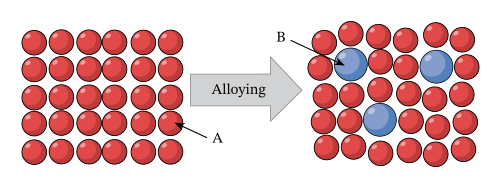
Give on difference in the particle structure of an alloy compared to a pure metal

2
Which of the following is not a property of most metals?
solid
brittle
strong
malleable
Which of the following statements is true?
Copper is used as a roof covering because it conducts heat well.
Copper is used as a roof covering because it changes to a green colour.
Copper is used as a roof covering because it is malleable.
Copper is used as a roof covering because it is a good conductor of electricity.
The product formed when calcium reacts with fluorine is:
calcium fluoride.
fluorine calcide.
calcium chlorine.
calcium fluorate.
Which of the following best describes a catalyst?
A catalyst is a reactant in a chemical reaction.
A catalyst is produced in a chemical reaction.
A catalyst speeds up a chemical reaction.
A catalyst causes a different product to be made in a chemical reaction.
Which of the following metals is so reactive it is stored under oil?
aluminium
copper
magnesium
sodium
Complete the word equation : calcium + water ->
calcium oxide + oxygen
calcium sulfate + hydrogen
calcium + oxygen
calcium hydroxide + hydrogen
The test for hydrogen gas is that it:
relights a glowing splint.
turns limewater milky.
burns with a squeaky pop.
turns pH indicator purple.
The products of the reaction of iron and hydrochloric acid are:
iron sulfate and hydrogen.
hydrogen and iron chloride.
iron chloride and iron oxide.
iron oxide and sulfuric acid.
Look at these diagrams showing some metals in acid. Choose the correct order of reactivity for metals X, Y and Z (most reactive first).
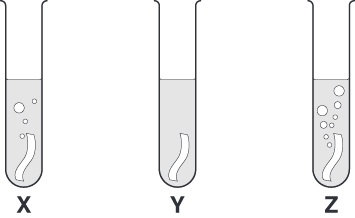
Z, X, Y
Y, Z, X
X, Y, Z
Z, Y, X
Magnesium and potassium both burn in
oxygen. Zinc reacts with oxygen but does
not burn. Potassium burns when added to
water. Magnesium and zinc react with
water but do not burn. What is the order of
reactivity of these metals (most reactive
first)?
Which of the following is the correct order of reactivity with acids (most reactive first)?
sodium, magnesium, iron, copper
copper, iron, sodium, magnesium
magnesium, sodium, iron, copper
sodium, iron, copper, magnesium
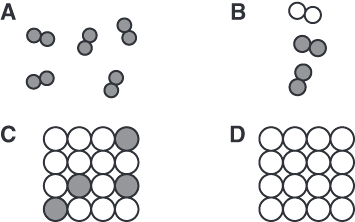
Which of these pictures shows the particles in a solid, pure metal?

A
B
C
D
Which of the following best describes an alloy?
a pure metal
a mixture of compounds
a metal with one or more other elements mixed in
compound of a metal with a non-metal
A small amount of tin is added to lead. Compared to lead the melting point of the mixture will be:
unchanged.
no longer one exact temperature.
will become the same as tin.
the same as the boiling point.
Compared to the pure metals that they contain, alloys:
are stronger.
are weaker.
have the same strength.
are insulators.
Name the salt made in the below reaction

Zinc + sulfuric acid --> _________ + hydrogen
sulfate
zinc sulfate
zinc sulfuric
zinc chloride
Aluminium oxide is Al2O3. This means that
for every 2 aluminium atoms there are:
2 oxygen atoms
2 oxide atoms
3 oxygen atoms
3 oxide atoms
Painting stops iron rusting because the
paint:
is a catalyst for rusting
stops the iron coming into contact with air and water
reacts with the air instead of iron
dries up any moisture in the environment
When scratched to remove its surface,
which of the following metals will react
most quickly with the air?
aluminium
copper
lead
tin
Question 20
20.

Explain why alloys are harder than pure metals