Freshwater Ecosystems

Last updated 7 months ago
3 questions
The major freshwater ecosystems include ponds, lakes, streams, rivers, & wetlands. Plants and animals in these ecosystems are adapted to the low salt content in freshwater and are unable to survive in areas of high salt concentration. Only about 2.5% of the water on Earth is freshwater. Of that 2.5%, 68.9% is frozen in glaciers, 30.8% is groundwater, and only 0.3% is found in lakes, ponds, rivers, streams, and wetlands. Interestingly, almost all of the freshwater species live in this 0.3% of water.
Lakes & Ponds

An inland body of standing water is called a lake or a pond. It can be as small as a few square meters or as large as thousands of square meters. Some ponds might be filled with water for only a few weeks or months each year, whereas some lakes have existed for thousands of years. In temperate regions, the temperature of lakes and ponds varies depending on the season.
During the winter, most of the water in a lake or pond is the same temperature. In the summer, the warmer water on top is less dense than the colder water at the bottom. During the spring and fall, as the water warms or cools, turnover occurs. The top and bottom layers of water mix, often due to winds, and this results in a uniform water temperature. This mixing circulates oxygen and brings nutrients from the bottom to the surface.
Nutrient-poor lakes, called oligotrophic lakes, often are found high in the mountains. Few plant and animal species are present as a result of small amounts of organic matter and nutrients. Nutrient-rich lakes, called eutrophic lakes, usually are found at lower altitudes. Many plants and animal species are present as a result of organic matter and plentiful nutrients, some of which come from agricultural and urban activities.
4

Categorize each characteristic.

Oligotrophic Lake
Eutrophic Lake
Nutrient-poor
Nutrient-rich
found high in mountains
found at lower altitudes
very few plants live here
typically no animal species present
many different plant species present
a variety of animal life found here
Zones of a Lake
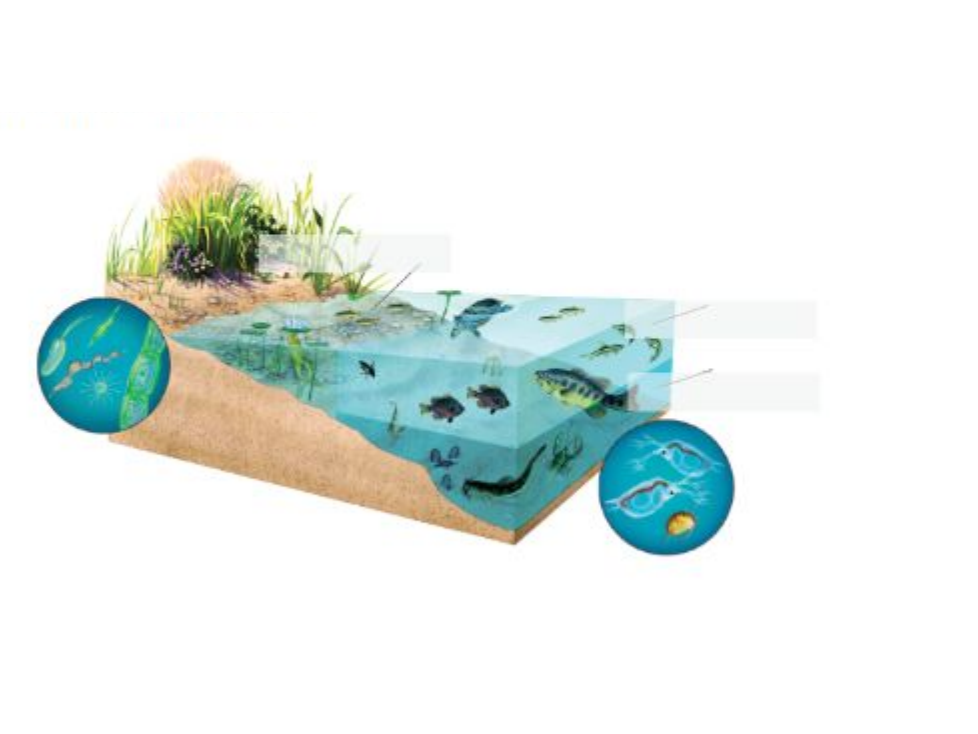
Lakes and ponds are divided into 3 zones based on the amount of sunlight able to penetrate the water.
The area closest to the shore is the littoral zone. The water here is shallow, sunlight is able to reach all the way to the bottom. There are an abundance of producers present and lots of photosynthesis occurring. Many consumers (frogs, worms, crustaceans, ect) live in this area as well.
The limnetic zone is the open water area that is well lit and is dominated by plankton. Many species of fish live in this zone as well, due to the abundance of food.
The deepest zone is the profundal zone. Minimal light is able to penetrate through the limnetic zone and reach the profundal zone. Its much colder & lower in oxygen than the other two zones. There's only a limited number of species live in this harsh environment.
3
Other Answer Choices:
Limnetic Zone
Littoral Zone
Profundal Zone
5

Categorize each characteristic.

Littoral Zone
Limnetic Zone
Profundal Zone
close to shore
Deepest part
open water area that is well lit
Cold
Many aquatic plants
low in oxygen
has lots of plankton
area of high photosynthesis
sunlight able to reach the bottom
no sunlight
lots of fish