Log in
Sign up for FREE
arrow_back
Library
Life in Medieval Europe Unit
By Sydney Glover
star
star
star
star
star
Share
share
Last updated 10 months ago
38 questions
Add this activity
zoom_in
zoom_in
zoom_in
Required
1
Required
1
Required
1
Required
1
zoom_in
zoom_in
Required
1
Required
1
Required
1
Required
1
zoom_in
Required
1
Required
1
Required
1
Required
1
zoom_in
zoom_in
Required
1
Required
1
Required
1
Required
1
zoom_in
Required
1
Required
1
Required
1
Required
1
zoom_in
Required
1
Required
1
Required
1
Required
1
Required
3
Required
3
zoom_in
zoom_in
Required
1
Required
1
Required
1
Required
1
zoom_in
Required
1
Required
1
Required
1
Required
1
zoom_in
Required
1
Required
1
Required
3
Question 37
37.
What were guilds? Why were they established?
Required
1
Question 38
38.
How did guilds help their members and the families of their members?
Question 1
1.
What should you do with every slide?
Only read the titles.
Focus on only one slide.
Listen to every slide carefully.
Ignore some of the slides.
Question 2
2.
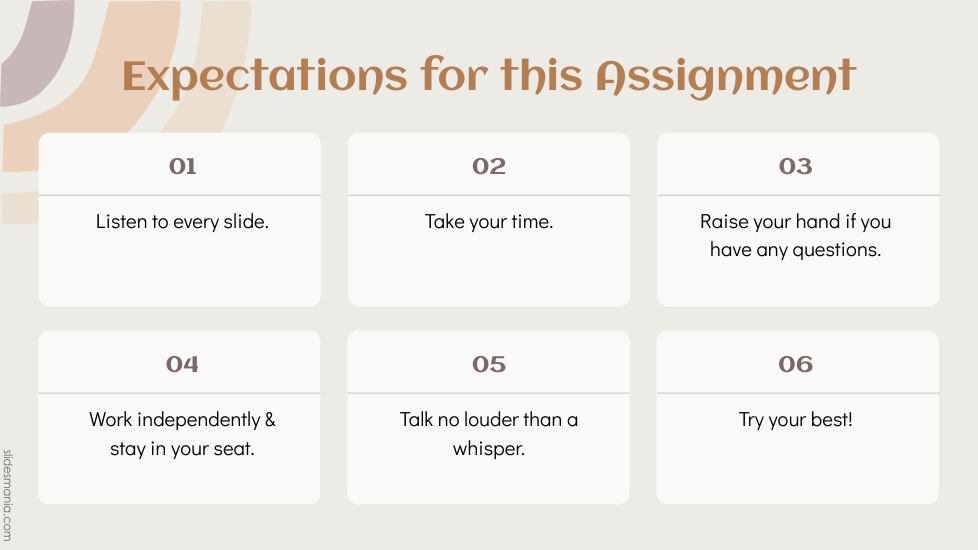
What is expected regarding working in class?
Talk to classmates during the assignment.
Work independently and stay in your seat.
Leave your seat freely.
Work in groups on everything.
Question 3
3.
What should you do if you have questions?
Wait until the class is over.
Ask your neighbor quietly.
Raise your hand if you have questions.
Ignore your questions altogether.
Question 4
4.
How loudly should you talk during assignments?
Talk normally like outside.
Speak as loudly as you want.
Feel free to shout questions.
Talk no louder than a whisper.
Question 5
5.
What was a common living arrangement in the Late Middle Ages?
In ancient Rome
As wandering nomads
In large cities only
In castles only
Living on feudal manors or in religious communities
Question 6
6.
What characterized towns in the Late Middle Ages?
Had no stone walls
Emerging around castles and along trade routes
Built only for farming
Excluded visitors entirely
Always surrounded by water
Question 7
7.
What types of businesses lined medieval town streets?
Only blacksmiths and inns
Shops with colorful signs and pictures
No businesses existed
Houses of nobles
Only bakeries and markets
Question 8
8.
What served as gathering places in medieval towns?
Open squares in front of public buildings
Dark alleys
Private homes and gardens
Only church basements
Town walls and gates
Question 9
9.
What was common about medieval streets?
They were wide and clean.
Garbage was always collected daily.
They were very narrow and crowded with people.
They had many streetlights.
Horses never used the streets.
Question 10
10.
What typically filled the air in medieval towns?
Pleasant music from the streets.
Sweet scents from flowers.
Unpleasant smells from garbage and animals.
Clean, fresh air all day.
Freshly baked bread aroma.
Question 11
11.
How did people dispose of garbage in medieval towns?
Burned it in the streets.
They threw it into canals and ditches.
Gave it to the animals.
Buried it in their yards.
Used it as fertilizer.
Question 12
12.
What type of buildings blocked sunlight in towns?
Barns next to the houses.
Second stories of houses jutted out.
Stalls for merchants in squares.
Taller cathedrals on corners.
Market spaces for trade.
Question 13
13.
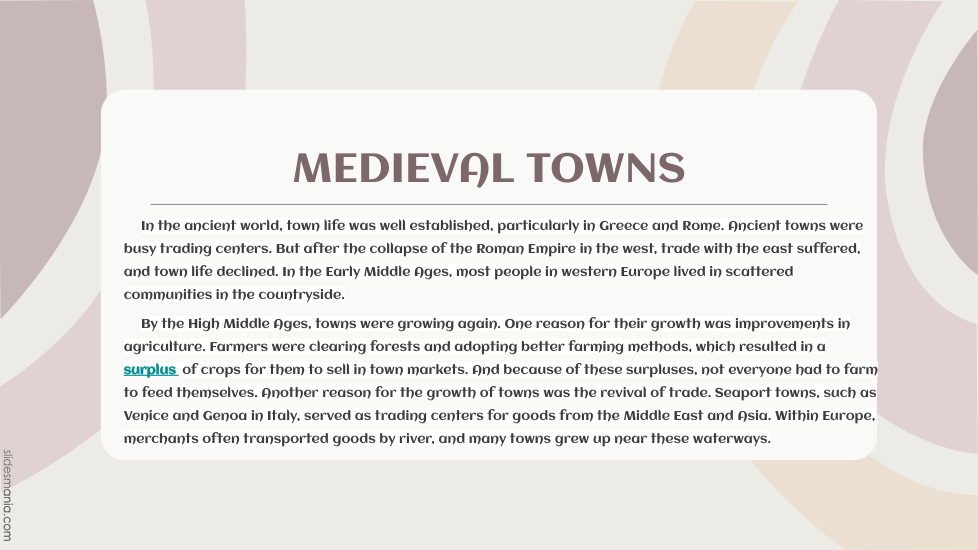
What caused the decline of town life after ancient times?
Collapse of the Roman Empire in the west
Rise of agriculture in cities
Surplus of goods in towns
Lack of farming methods
Question 14
14.
Why did towns begin to grow in the High Middle Ages?
Fewer towns near rivers
Rise of population in cities
Improvements in agriculture led to surpluses
Decrease in trade with Asia
Question 15
15.
What role did seaport towns serve in medieval Europe?
Military strongholds for defense
Religious hubs for worship
Education centers for peasants
Trading centers for goods from the Middle East
Question 16
16.
Farmers cleared forests for what purpose during the Middle Ages?
To find gold and jewels
To build more towns
To start new trade routes
To improve farming methods and create surpluses
Question 17
17.
What became permanent in medieval towns?
Trade routes stopped existing entirely.
Merchants and residents became permanent.
Only nobles lived in towns.
Feudal lords controlled the towns.
Question 18
18.
How did towns grow wealthier during the Middle Ages?
By expanding their land ownership.
By reducing the number of trades.
By specializing in specific types of goods.
Through farming only, no trades.
Question 19
19.
What was a common trade in Flanders?
No trades were happening there.
Glass production only in Venice.
Woolen cloth production.
Metalworking and farming exclusively.
Question 20
20.
Why did townspeople resent feudal lords?
There were no lords in towns.
Lords provided too much protection.
Townspeople liked paying more taxes.
They disliked taxes and interference from lords.
Question 21
21.
What did towns in Europe struggle for during the medieval period?
Tax exemption from the king
Independence from feudal lords
Total control over trade
Land ownership by merchants
Question 22
22.
How did towns become independent in many places?
Overthrowing the mayor
Purchasing a royal charter
Forming alliances with lords
Building walls around towns
Question 23
23.
Who governed free towns during the medieval period?
Only local merchants
Feudal lords exclusively
Royal advisors and priests
A mayor and a town council
Question 24
24.
What class gradually gained power in medieval towns?
Monks and scholars
Peasants and serfs
Nobles and knights
Merchants and craftspeople
Question 25
25.
Where were towns in medieval Europe often located, and why?
Question 26
26.
What contributed to the growth of towns in medieval Europe?
Question 27
27.
What are guilds primarily responsible for in medieval towns?
Creating laws for medieval kings.
Building roads and bridges.
Tax collection for the government.
Trade and production regulation for craftspeople and merchants.
Question 28
28.
What are the two main types of guilds mentioned?
Military guilds and trade guilds.
Artisan guilds and farmer guilds.
Merchant guilds and craft guilds as main types.
Religious guilds and merchant guilds.
Question 29
29.
How did guilds help their members?
They offered loans and housing.
They provided support and maintained high work standards.
They controlled local politics.
They governed all trade agreements.
Question 30
30.
What could guilds do if a member cheated customers?
Send complaints to the king.
Expel members from towns permanently.
Increase taxes on dishonest merchants.
Punish members who had bad practices and behaviors.
Question 31
31.
What did guild members pay dues for?
Travel expenses for members only.
Training apprentices and their parents.
Construction of guildhalls and member support.
Buying supplies for festivals.
Question 32
32.
At what age could someone start as an apprentice?
At birth, no specific age required.
Around age 12, boys and sometimes girls.
Only after reaching age 18.
Only if they were wealthy.
Question 33
33.
What was rarely paid to apprentices by guild masters?
A payment directly from guild members.
Shelter and food for their families.
A sum of money for their work.
Wages according to their trade skill.
Question 34
34.
Why did guilds take care of sick members?
To ensure they returned to work.
To support members and their families in need.
To encourage more members to join.
To prevent them from leaving the guild.
Question 35
35.
What was the piece of work an apprentice created called?
Master piece
Trade draft
Guild application
Craft document
Question 36
36.
What did apprentices need to prove to become masters?
Completed a book
Built a workshop
Mastered their trade
Traveled for experience