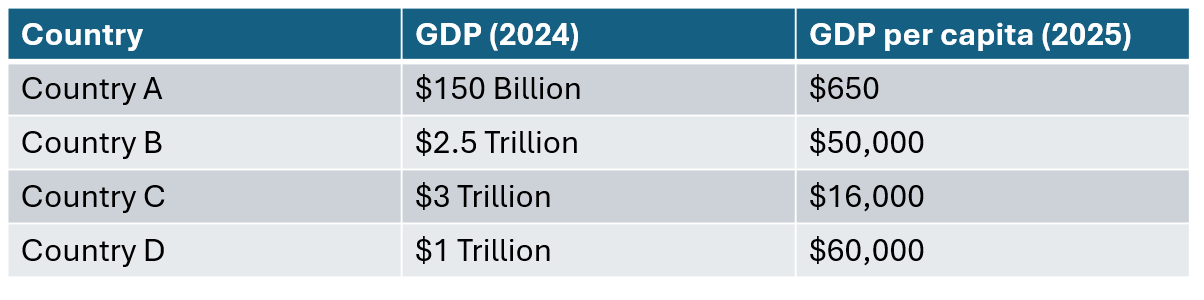
Based on the chart, which country would you expect to be the most developed?
Based on the chart, which country would you expect to be the most developed?
Place each job in the correct sector.
farmer
chef
factory worker
restaurant waitress
fisherman
construction worker
Primary Sector Jobs
Secondary Sector Jobs
Tertiary Sector Jobs
Which indicators would be typical for each of the types of countries?
High percentage of tertiary sector jobs
High infant mortality rate
Low life expectancy
High literacy rate
Less developed infrastructure
High GDP per capita
Country that has high economic success
Country that has low economic success
Which of the following best explains why China has the highest GDP but is ranked 56th for GDP per capita?
Match the sector with its role in the economy.
| Draggable item | arrow_right_alt | Corresponding Item |
|---|---|---|
Secondary sector | arrow_right_alt | Sector of the economy that extracts natural resources |
Tertiary sector | arrow_right_alt | Sector of the economy that uses natural resources to create a finished product |
Primary sector | arrow_right_alt | Sector of the economy that connects finished products with consumers |
Which factor caused people to FIRST move to cities?
Match each scenario to the correct consequence of urbanization.
| Draggable item | arrow_right_alt | Corresponding Item |
|---|---|---|
Gentrification leads to... | arrow_right_alt | the development of squatter settlements. |
Air pollution leads to... | arrow_right_alt | the displacement of people. |
Lack of housing leads to... | arrow_right_alt | food shortages. |
Increased stress on infrastructure leads to... | arrow_right_alt | health and environmental issues. |
Depletion of arable land leads to... | arrow_right_alt | a declining level of healthcare and poor road systems. |
The unrestricted growth of cities is called
Sort the positive and negative impacts of gentrification.
Displaced communities
Loss of historical buildings
Better "look" for the city
Increased economic activity
Positive impacts of gentrification
Negative impacts of gentrification
How do trade agreements impact the world economy? (select all that apply)
Determine which statements below about illegal trade are true and false.
Governments might not enforce laws against illegal trade because it benefits the entire economy.
If governments were to legalize some "black market" activities, the government regulation could make them safer.
Underground economy activities are taxed by the government.
All governments work with and oversee the underground economy.
TRUE
FALSE
International trade has led to an increase in
Match each description and example to the correct term.
used to increase trade with other countries
used to improve relationships with neighboring countries
used to stop or prevent trade
used to penalize a country for its policy decisions
Examples: USMCA, ASEAN, EU
Examples: quota and tariff
Trade bloc (agreement)
Trade barrier
Match the descriptions to the term that it best describes.
example: "The farm is on a plain in an area that has a temperate climate and adequate rainfall."
This is MOST important for primary industries, such as mining and farming.
This is MOST important for tertiary industries, such as furniture stores, education, and banks.
Describes an exact location, including physical features and climate
example: "The barber shop is in the center of town, near a busy restaurant and minutes from a major highway."
Describes what a location is like in terms of what is near the location
Site
Situation
Based on the chart, which country would you expect to be the most developed?
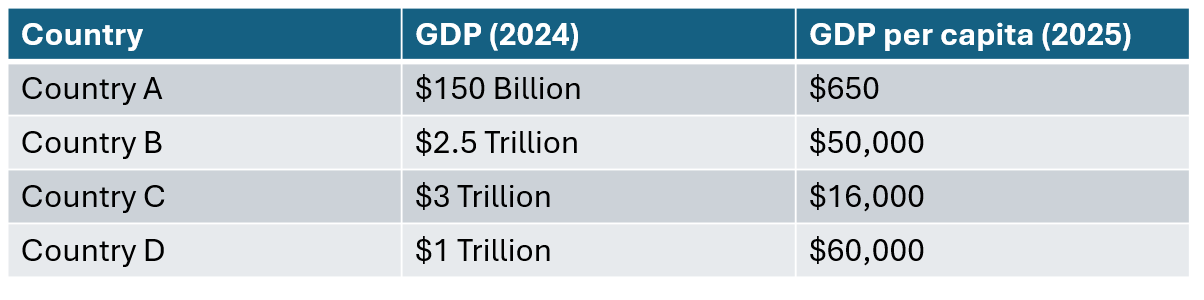
Based on the chart, which country's economy would be based almost entirely on the primary sector?
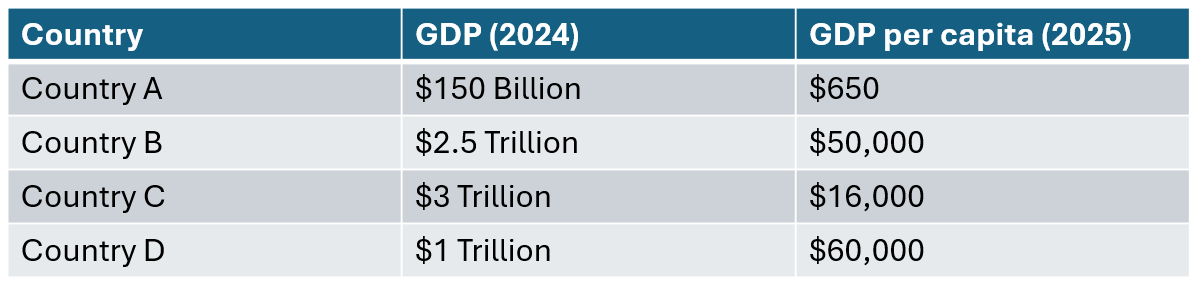
What might explain how Country D can have a lower GDP than Country B, but has a higher GDP per capita?