Log in
Sign up for FREE
arrow_back
Library

Unit 1 Test: Properties of Matter

star
star
star
star
star
Last updated 6 months ago
41 questions
Required
2.5
Required
2.5
Required
2.5
Required
2.5
Required
2.5
Required
2.5
Required
2.5
Required
2.5
Required
2.5
Required
2.5
Required
2.5
Required
2.5
Required
2.5
Required
2.5
Required
2.5
Required
2.5
Required
2.5
Required
2.5
Required
2.5
Required
2.5
Required
2.5
Required
2.5
Required
2.5
Required
2.5
Required
2.5
Required
2.5
Required
2.5
Required
2.5
Required
2.5
5
Question 1
1.

What is a hypothesis?

Question 2
2.

Which statements are true (select 2)

Question 3
3.

The Scientific Method is a series of steps followed to cause problems, including collecting data, ignoring a hypothesis, NEVER testing the hypothesis, and stating conclusions without evidence.

Question 4
4.

Qualitative vs Quantitative Data.  Select the statement that is true.

Question 5
5.

Define accuracy.

Question 6
6.

A child requires a 5 ml dose of medicine each day. How many doses would a  1 L bottle of this medicine contain?

Question 7
7.

Which of the following is an example of a "Base" unit?

Question 8
8.

Molecular motion refers to the movement of molecules, which are the fundamental building blocks of matter. This movement is influenced by temperature, with higher temperatures generally leading to increased molecular motion.

Question 9
9.

In which state of matter is there the most molecular motion?

Required
2.5
Question 10
10.

A student creates diagrams of two models to show magnified views of molecular motion in a solid and a liquid, as shown in the picture.

Answering which question will help the student to decide which sample has more energy?

Question 11
11.

Absolute zero represents a substance's minimum

Required
2.5
Question 13
13.

According to kinetic molecular theory, as the temperature of a confined gas rises, which of the following characteristics of the gas molecules increases?

Required
2.5
Question 14
14.

Which states of matter are most likely represented by each diagram?

Required
2.5
Question 15
15.

Recall the formula to calculate density.
What is the density of an object that has a volume of 600 milliliters (mL)?

Question 16
16.

Read the text about an experiment with bottled soda.

When soda bottles are sealed in a factory, the bottles are all the same temperature with the same pressure of gas inside. A student decides to perform an experiment to determine what changes will result from adjusting the temperatures of two sealed soda bottles. One bottle of soda is heated, while the other is cooled.

Which statement describes a result of the experiment?

Question 17
17.

According to the gas laws..... when the temperature of a substance increases, what will happen to the volume of the substance?

Question 18
18.

Which of the following statements concerning a saturated solution is incorrect?

Question 19
19.

What is true about the relationship between pressure and volume of a gas?

Required
2.5
Question 21
21.

A football is left on the field outside during the winter months, the next morning the football was partially deflated. Using what you know about gas laws, explain what happened to the football.

Question 22
22.

If a gas stays at a constant pressure as the temperature of the gas is decreased, what will happen?

Question 23
23.

A rock is placed in a bucket of water and sinks to the bottom. What can be concluded about the rock's properties relative to the water?

Required
2.5
Question 25
25.

Which of the following statements concerning a saturated solution is incorrect?

Required
2.5
Question 27
27.

Which type of energy is associated with the random motion of the particles in a sample of gas?

Required
2.5
Question 28
28.

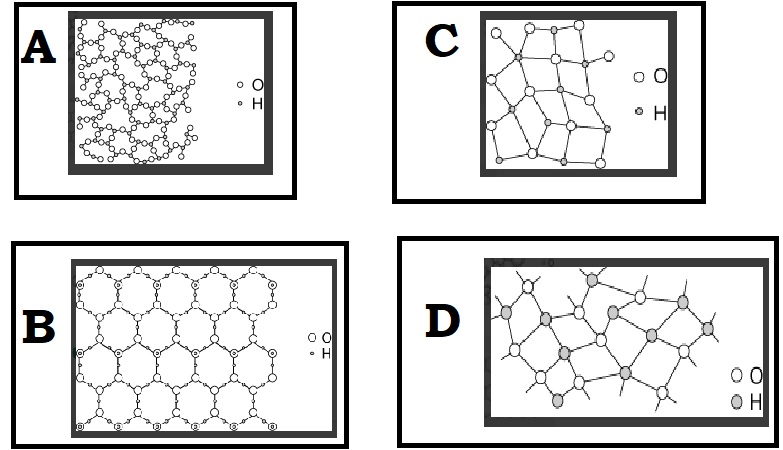
Which image most likely represents the atomic structure of solid ice?

Question 29
29.

Which of the following statements best describes absolute zero?

Question 30
30.

What is true about the relationship between pressure and volume of a gas?

Question 31
31.

A container of gas is kept at constant pressure. Which best explains what will happen to the volume if the temperature of the gas is increased?

Question 32
32.

Which change would cause the volume of a balloon to increase?

Required
2.5
Required
2.5
Required
2.5
Question 35
35.

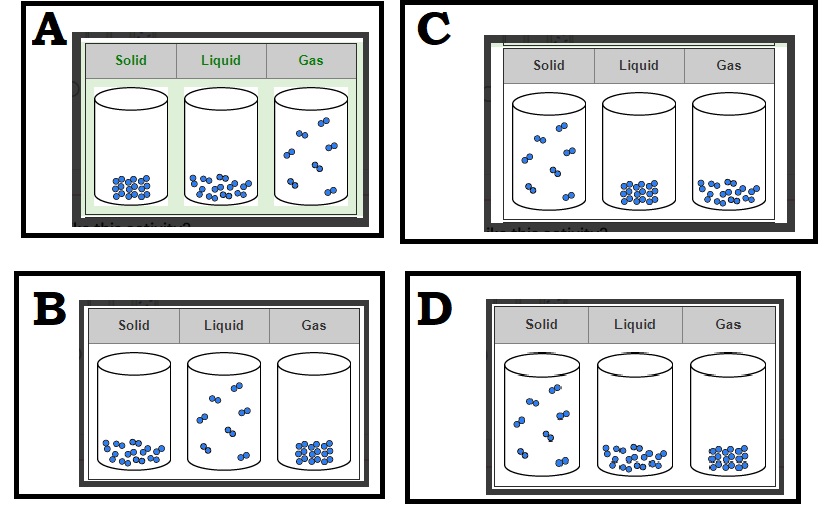
Which image correctly models the molecular arrangements in solids, liquids, and gases?

Question 36
36.

What happens to the molecules of a substance when heat (energy) is removed?

Question 37
37.

What is it called when a substance loses or gains energy to change from one state of matter to another?

Question 38
38.
Question 39
39.

Which of the following would increase the (gas) pressure of a system?

Question 40
40.

As viscosity increases, the _______________________________ also increase.

Question 41
41.

BONUS QUESTION (5pts):

How are you? Any thoughts or concerns? Just tell me anything that you feel like (hey now, be nice) and you get the points.

Question 12
12.

Which options are TRUE for substance W (the blue one)? (You should pick 3 options to be correct).

Question 20
20.

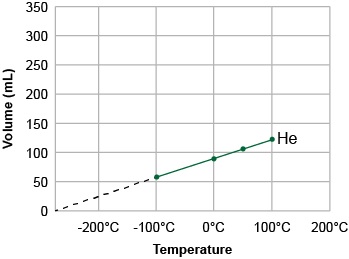
The graph shows how the volume of helium gas changes as the temperature of the gas changes.
The measurements were taken at a constant pressure. What happens as the temperature of helium increases?
Question 24
24.

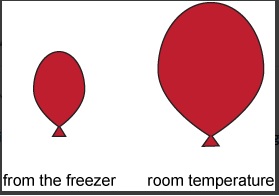
Terry fills two balloons with the same amount of helium gas. She places one of her helium balloons in the freezer. After twenty minutes, she removes the balloon from the freezer and notices that it is smaller than the balloon that stayed at room temperature. Her balloons are shown below.
How does Terry correctly explain the difference in the size her balloons?

Question 26
26.

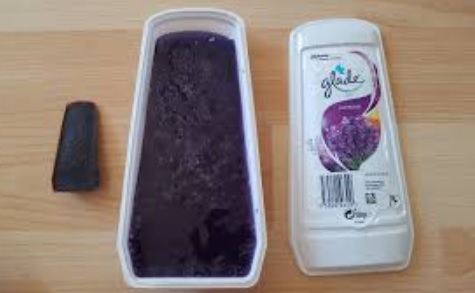
A teacher puts solid adjustable air freshener (as seen above) in his classroom and let's it sit open for a week. At the end of the week the solid is gone, but no liquid was seen. What phase change can explain what occurred?

Question 33
33.

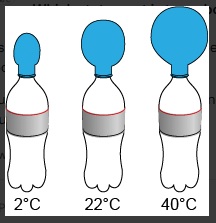
Three identical bottles of soda are used in an experiment. One of the bottles is left at room temperature, another is cooled, and another is heated. Next, the bottles are opened and balloons are placed on top to capture the escaping gas. The temperatures and results are shown.

Which statement is true about the warmest bottle (40'C)?

Question 34
34.

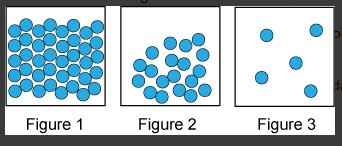
Which statement is most likely true about the intermolecular attractions between the molecules in Figure 3 compared with Figure 1?