Log in
Sign up for FREE
arrow_back
Library

MT 5 Data Analysis 7.MSPA.1-3 Test

star
star
star
star
star
Last updated 9 months ago
15 questions
Bi-Variate Data
Required
1
8.SP.2
Required
1
8.SP.1
Required
1
8.SP.1
1
8.SP.3
Required
1
8.SP.2
Required
1
8.SP.3
Required
1
8.SP.3
1
8.SP.3
Two way frequency tables
Required
1
8.SP.4
Required
1
8.SP.4
Required
1
8.SP.4
Required
1
8.SP.4
Required
3
8.SP.4
1
8.SP.4
1
8.SP.4
Question 1
1.

Question 2
2.

Question 3
3.

Question 4
4.

Shown is a scatter plot and line of best fit, displaying study time per week and grade point average. Predict the GPA for someone who studies 6 hours per week.

Question 5
5.

Question 6
6.

Question 7
7.

Question 8
8.
y = _______ x + _______
Question 9
9.

Question 10
10.

Question 11
11.

Question 12
12.

Question 13
13.
Question 14
14.

From question #13, of those who watched commericial #1, what percent were likely to buy the product?

Question 15
15.

Of those who said they were likely to buy the product, what percent watched Commercial #3?
A
B
C
D
A
B
C
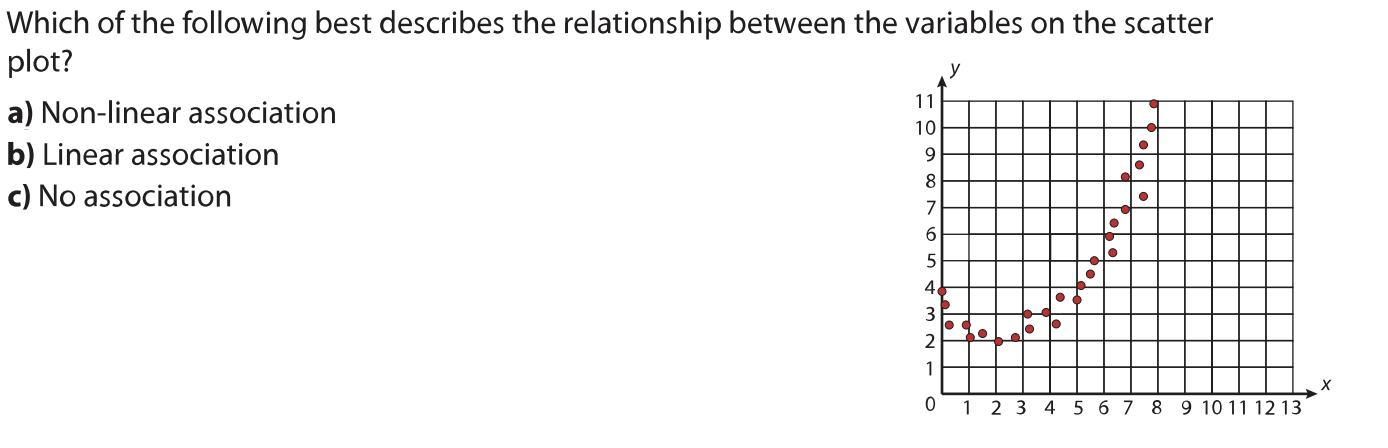
Which scatter plot shows data with negative linear association?
Which scatter plot shows the most appropriate line of best fit for the data?
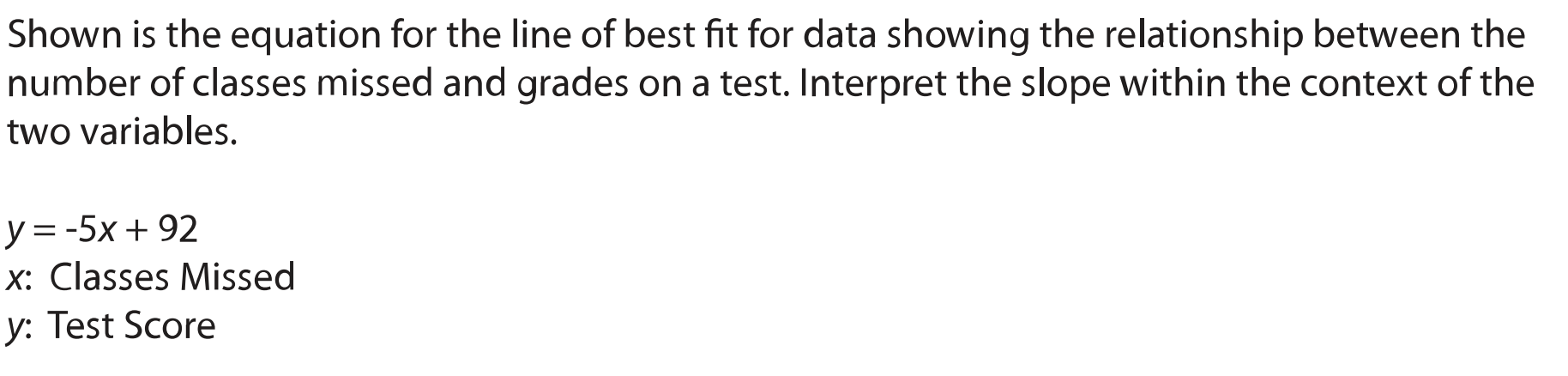
For every additional class missed, a test score decreases by 92 points.
For every additional class missed, a test score decreases by 5 points.
For every additional class missed, a test score decreases by 87 points.
None of these
If a student doesn't miss class, their test score will likely increase by 5 points.
If a student doesn't miss class, they will likely get 92 points on the test.
If a student doesn't miss class, they will likely get 87 points on the test.
If a student doesn't miss class, their test score will likely decrease by 5 points.
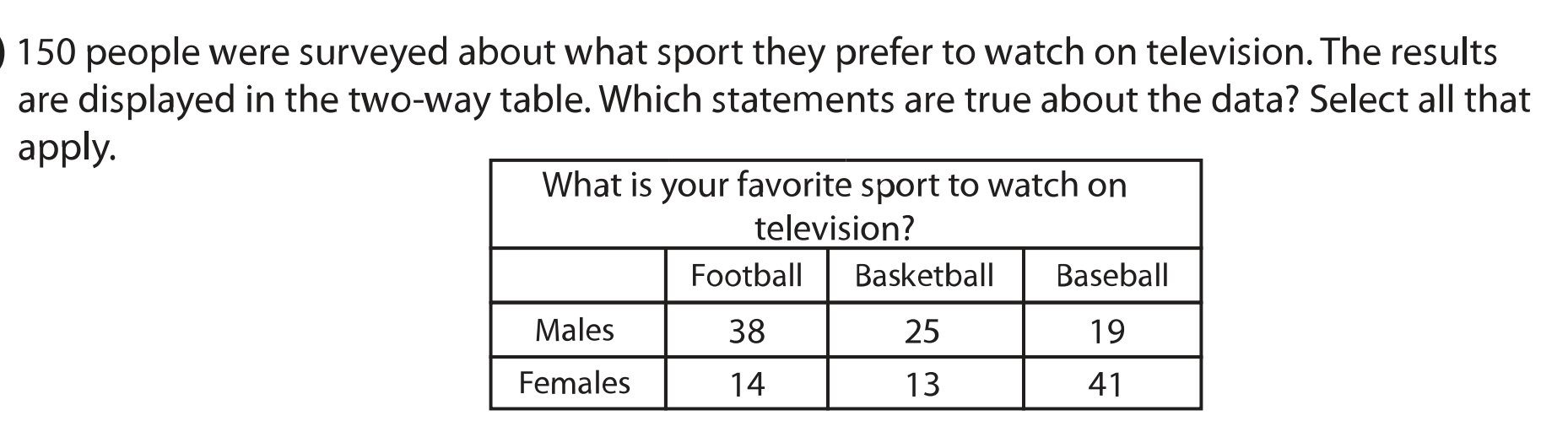
About 46% of males surveyed prefer to watch football.
Approximately 27% of all survey participants aree females who prefer to watch baseball
Of those that prefer watching basketball, 25% are male.
About 68% of survey participants are females.
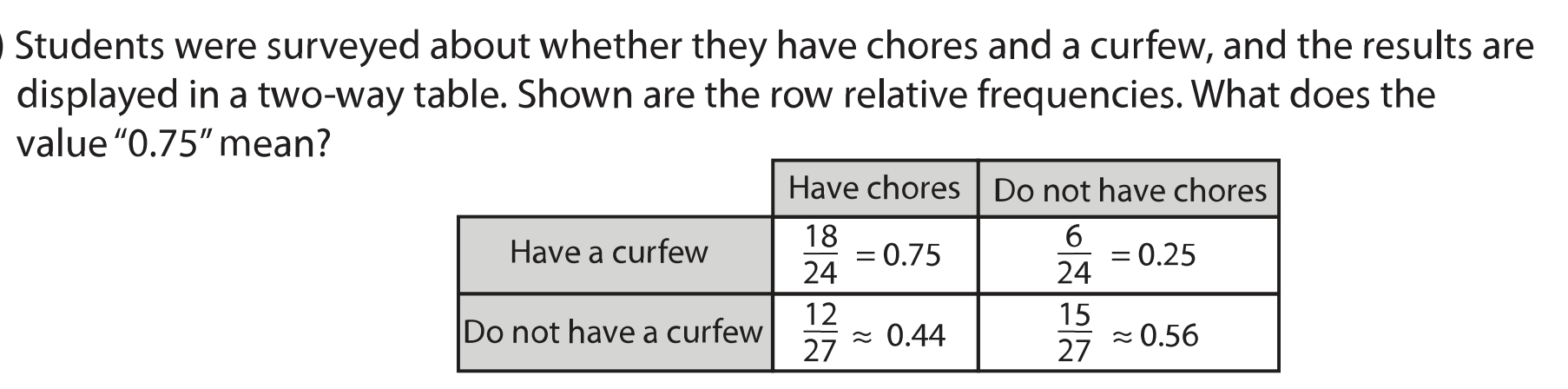
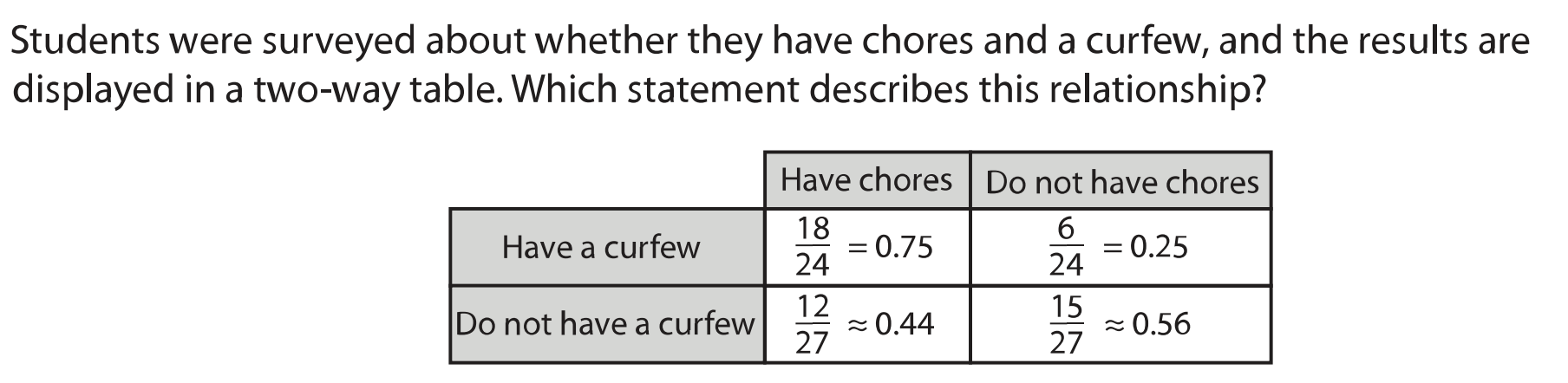
Out of those that do have chores, 75% have a curfew.
Out of those that do not have chores, 75% have a curfew.
Out of those that do have a curfew, 75% have a chores.
Out of those that do not have a curfew, 75% have a chores.
There seems to be an association between having a curfew and having chores. Those that have a curfew are more likely to have chores.
There doesn't see, to be an association between having a curfew and having chores.
There seems to be an association between having a curfew and having chores. Those that have a curfew are less likely to have chores.
none of the above are true