Log in
Sign up for FREE
arrow_back
Library

3.11 How to Invest for Retirement

star
star
star
star
star
Last updated 7 months ago
17 questions
Note from the author:
1
1
1
TEACHER TIP: It is common for people to confuse investment accounts with the types of investments that go into those accounts. You may wish to remind students that when they want to start investing:
  1. They first need to open an investment account (such as a brokerage account, an IRA, or an employer-provided 401k).
  2. Then, they need to select the types of investments that go into those accounts (such as stocks, bonds, index funds, target date funds, etc.)
You can even use the analogy of “investment accounts are like buckets. The various investment types are what go into the buckets.

QUESTION OF THE DAY: How much would I need to save monthly to have $1 million when I retire? 📷5 min

Answer the question on the first slide in the space below. Then, compare your answer to the answer on the second slide. Finally, follow your teacher’s directions on how to answer the follow-up questions on the last slide.
1
Question 1
1.

FINCAP FRIDAY: Saying “OK” to the 401(k) 📷9 min

You may be wondering, “Where do I start if I want to invest for retirement?” A 401(k) is one of the most popular retirement investment accounts. Watch the video to learn about the advantages of a 401(k) and answer the questions. As your teacher progresses through the slides, answer these questions, just writing A, B, C, or D for questions 1 - 5.
5
1

VIDEO: IRA vs. 401(k)

ARTICLE: IRA vs 401(k) 📷9 min

As you learned in the previous FinCap Friday, if your employer doesn’t offer a 401(k), you have other options! Anyone can open a personal retirement account, called an IRA, to get many of the same benefits as a 401(k). Watch the video, read the article, and answer the questions.
1
1
2

VIDEO: What is an IRA? 📷11 min

When opening up an IRA, you’ll have to decide which type of IRA you would like. Watch this video to learn more about the various IRAs. Follow your teacher's directions to answer the questions either in your student activity packet or within the EdPuzzle itself.
1
2
1
1
1
1
2
1
Question 15
15.

Question 16
16.

Question 17
17.

How much would I need to save monthly $_______ for 40 years to have $1 million when I retire?
Question 2
2.
As your teacher progresses through the slides, answer these questions, just writing A, B, C, or D for questions 1 - 5.
Q1:_______
Q2:_______
Q3:_______
Q4:_______
Q5:_______
Question 3
3.

Opening an employer-provided 401(k) or an IRA is just the first step towards investing for retirement. What other action do you need to take? Why?

Question 4
4.

Why might someone want to open an IRA as their retirement account?

Question 5
5.

What is one noticeable difference between an IRA and a 401(k)?

Question 6
6.
According to the article, who should invest in a Roth retirement account? People who have higher/lower_______ income and think they will have higher/lower_______ tax rates now, compared to what they expect to earn later in life.
Question 7
7.

Question 8
8.

Question 9
9.

Question 10
10.

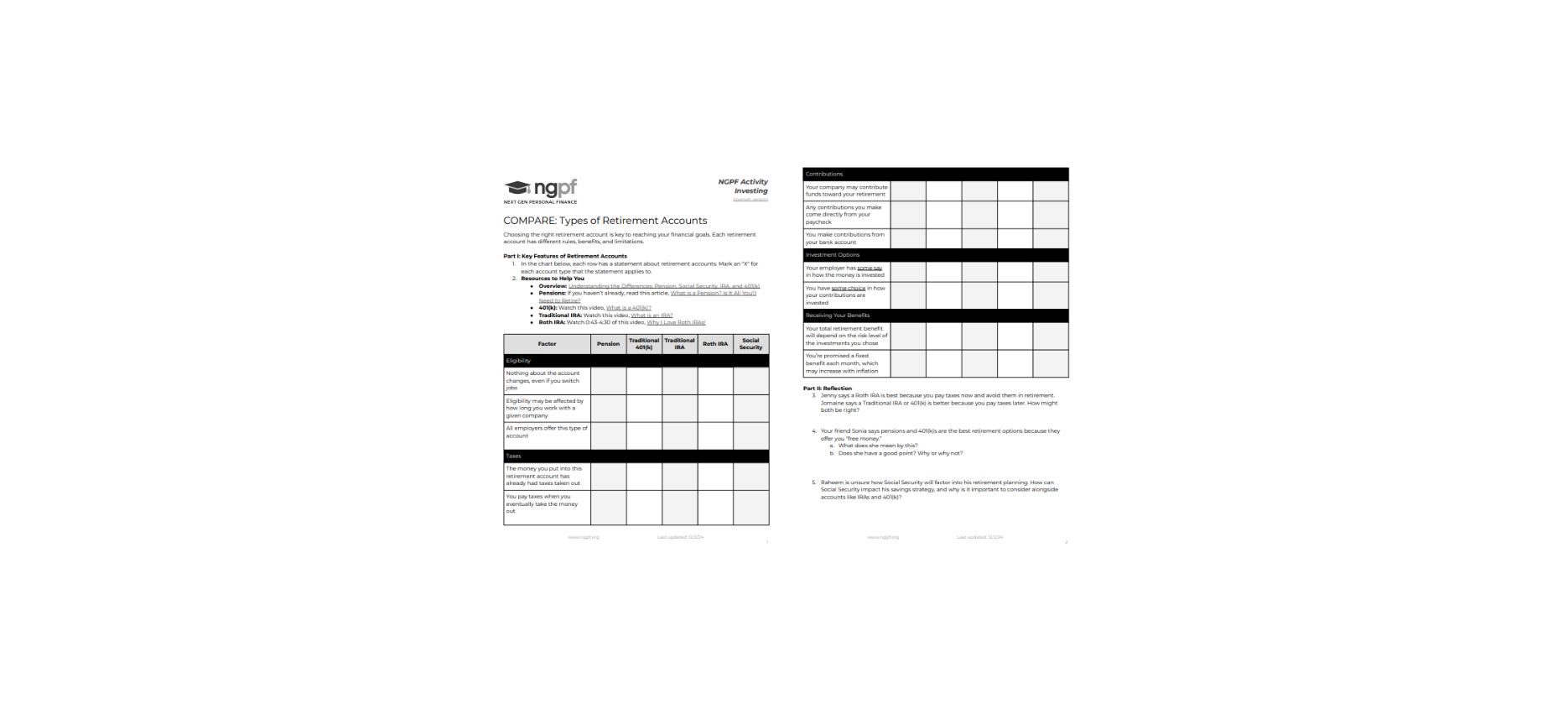
ACTIVITY: COMPARE: Types of Retirement Accounts

Let’s dive deeper into the different types of investment accounts you can have, including pensions, traditional 401(k)s, Traditional IRAs, and Roth IRAs. In this activity, you’ll compare the features of each type of account. Follow the instructions on the worksheet to complete the activity.
COMPARE: Types of Retirement Accounts
Choosing the right retirement account is key to reaching your financial goals. Each retirement account has different rules, benefits, and limitations.
Part I: Key Features of Retirement Accounts
  1. In the chart below, each row has a statement about retirement accounts. Mark an "X" for each account type that the statement applies to.
  2. Resources to Help You
  • Overview: Understanding the Differences: Pension, Social Security, IRA, and 401(k)
  • Pensions: If you haven’t already, read this article, What is a Pension? Is It All You’ll Need to Retire?
  • 401(k): Watch this video, What is a 401(k)?
  • Traditional IRA: Watch this video, What is an IRA?
  • Roth IRA: Watch 0:43-4:30 of this video, Why I Love Roth IRAs!
Question 11
11.

Printed for you. What is ONE thing you learned from this activity?

Question 12
12.

Jenny says a Roth IRA is best because you pay taxes now and avoid them in retirement. Jomaine says a Traditional IRA or 401(k) is better because you pay taxes later. How might both be right?

Question 13
13.

  1. Your friend Sonia says pensions and 401(k)s are the best retirement options because they offer you “free money.”
  2. What does she mean by this?
  3. Does she have a good point? Why or why not?

Question 14
14.

Raheem is unsure how Social Security will factor into his retirement planning. How can Social Security impact his savings strategy, and why is it important to consider alongside accounts like IRAs and 401(k)?

401(k)s and IRAs are both…
Types of investments that you can choose to have in an investment account
Investment accounts that are commonly offered by employers
A type of savings account that generally offers around a 1% rate of return
Investment accounts that you can open to help you invest for retirement
All of the following are advantages of a 401(k), EXCEPT…
You don’t pay taxes on your investments’ growth each year
You can invest your 401(k) into a wider variety of asset types than you can with an IRA
Your employer may match some of your 401(k) contributions
You can contribute more money into a 401(k) than into an IRA
Which type of retirement account is an investment option for ANY young person?
Traditional IRA
Pension
401(k)
Social Security
Select the best definition of an IRA.
An IRA is a tax-advantaged investing tool set up by individuals for retirement savings
An IRA is a retirement plan offered to you by your employer
An IRA is an investment type with a fixed rate of return
An IRA is a retirement savings plan that guarantees a fixed rate of return
Select all of the statements that are a true characteristic of a Traditional IRA. (hint: choose 2 correct answers)
Any money you save into a Traditional IRA is tax deductible
You are taxed on the money in your Traditional IRA when you withdraw it in retirement (it is taxed as ordinary income)
There is no limit on the amount of money you can contribute to a Traditional IRA
You never have to pay taxes when contributing money to a Traditional IRA
Select the TRUE characteristic of a Roth IRA.
There is no limit to the amount you can contribute to a Roth IRA
The Roth IRA has been around longer than the Traditional IRA (the Roth debuted in the 1930s)
The capital gains, interest, & growth of a Roth IRA can be withdrawn tax-free in retirement
You are taxed on the money you withdraw in retirement from your Roth IRA (it is taxed as ordinary income)
True or False: You can only have ONE IRA account, so it is important to weigh the pros and cons of a Traditional vs a Roth IRA and choose wisely!
True
False