Digital Inquiry: Animals Building Homes
star
star
star
star
star
Last updated 7 months ago
11 questions
VIDEO: AMAZING TAPE OF THE CADDISFLY
Click the link to watch the video about how the caddisfly larva protects itself in fast-flowing water.
1
What is a case?
What is a case?
1
What does a case look like? Describe it.
ARTICLE: INCREDIBLE TERMITE MOUND
The Incredible Termite Mound
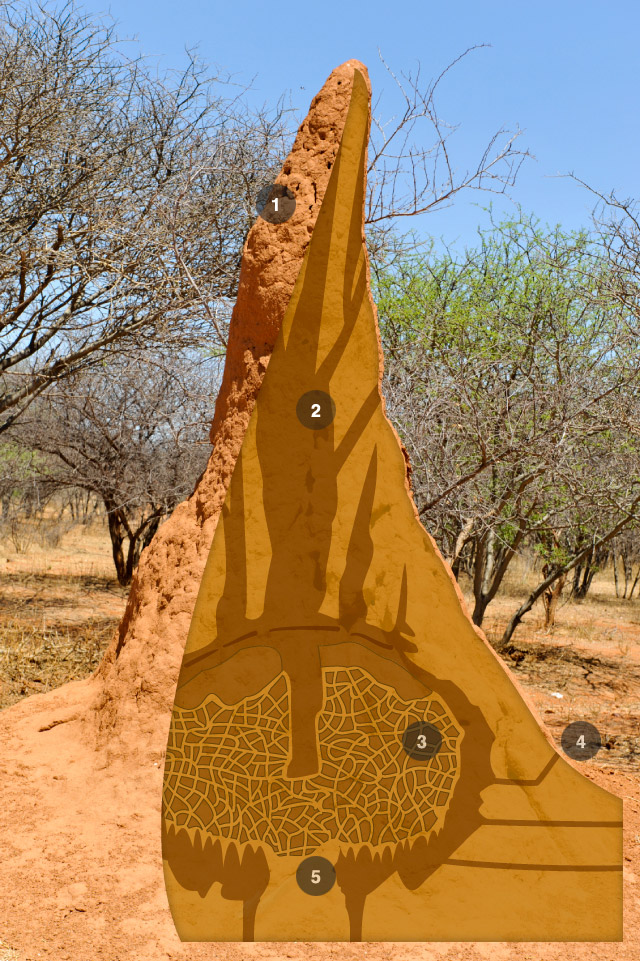
While some termites live in the wood of our homes, others build their own houses, some of the most impressive structures in the animal world. Their mounds are forever-evolving cities, made from the simplest materials. Working independently, without any coordinator or blueprint to reference, they construct temperature-controlled environments that include elaborate ventilation and cooling systems, and specialized chambers that store food, contain fungal gardens, hold eggs, and house the egg-producing queen. As a colony, they are able to create worlds that far exceed their individual capabilities.
1. The mound is constructed out of a mixture of soil, termite saliva and dung. Although the mound appears solid, the structure is incredibly porous. Its walls are filled with tiny holes that allow outside air to enter and permeate the entire structure.
2. The top of the mound consists of a central chimney surrounded by an intricate network of tunnels and passages. Air travels through the porous walls into a series of small tunnels until it reaches the central chimney and rises up. When fresh air mixes with this warm air, the air cools and sinks down into the nest. This ventilation system constantly circulates the air and ensures that oxygen reaches the lower areas of the mound and keeps the nest from overheating.
3. Termites do not live throughout the mound but spend most of their time in a nest located at or below ground level. It’s comprised of numerous galleries separated by thin walls. Workers are constantly repairing areas that require maintenance and adding new tunnels and corridors to the nest.
A city of termites requires a lot of food, and the mound has many storage chambers for wood, the insect’s primary food source. Termites also cultivate fungal gardens, located inside the main nest area. Termites eat this fungus which helps them extract nutrients from the wood they consume. Maintaining the fungal gardens takes precise temperature control, and the remarkable architecture of the mound keeps the temperature almost constant.
The queen and king reside in the royal chamber. The queen’s sole purpose is to produce new termites to help build and protect the nest. Incredibly, the queen can produce thousands of eggs a day and live for up to 45 years, during which time she will grow to the point where she is unable to move. Workers carry her eggs to a special nursery where they are fed on compost until they turn into adults.
4. At the base of the mound are several openings that the termites use to enter and exit the nest. Termites make forays out to collect food at night, when temperatures are cooler.
5. Six feet below ground level is the cellar. It’s the coolest part of the structure. Its ceiling is comprised of a series of thin plates that absorb moisture from the colony above and provide another ingenious cooling mechanism. As the moisture evaporates, the temperature falls, cooling the air around the nest.
1
What are the holes in the mound for?
1
What part of the mound is the coldest?
VIDEO: HOW BEAVERS BUILD DAMS
Click the link above to watch the video.
Beavers are devoted to their work as dam builders and they are born equipped and ready for the job. Leave it to Beavers tells the story of beavers in North America – their history, their near extinction, and their current comeback as modern day eco-heroes. The program airs Wednesday, May 14 at 8 p.m. (ET) on PBS (check local listings). Beavers’ continuously growing, self-sharpening incisors strengthened with iron are the perfect tools of the trade. Not only do they help beavers fell the hundreds of trees they need to dam a river, they also come in handy for meals because beavers are vegetarians that gnaw through bark to eat the sugary layer underneath.
1
What does a beaver dam look like?
1
What is a beaver dam made out of?
TEXT: BAG MOTH CABINS
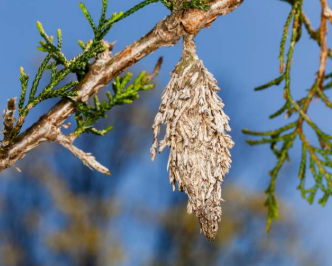
Bagworm moths use their environment to build shelter, feed, grow, and reproduce. They do it all in a silk cocoon covered with plant materials from around them.
As soon as the egg hatches, the larva begins to feed on leaves and build a cocoon. Using silk, the larva constructs a bag and camouflages it with bits of twigs and leaves from the plant its species prefers.
The bagworm moth larva travels in its disguised bag as it feeds, adding to the bag and camouflage as it grows. When ready, the larva attaches the bag to a stem with strong silk. Hidden from predators, the larvae changes into pupa form in its disguised bag.
When it is adult, only the male leaves its bag. The female has no wings. She mates, lays eggs, and dies in the same bag she started building as a larva. Her growing eggs are safe inside until they hatch.
1
What is the Bag Moth shelter made out of?
1
What is the difference between male and female Bag Moths?
VIDEO: OVENBIRD - A NEST MADE OF MUD
Learn how male and female red ovenbirds work together to build nests made out of mud and clay in this video from NATURE: Animal Homes. Their jobs are not finished once the nest is constructed, as they spend just as much time building it as they do defending it!
1
What does an Ovenbird nest look like?
1
Where does the mud come from?
8
Some animals use ______________from their environment to build shelters. The shelters provide protection.
Three insects build interesting structures. Caddisfly larvae live in powerful, shallow ___________. They survive by building a case using ____________and a type of waterproof _________ is creates. Termites build tall mounds made of soil, saliva, and dung. Tiny holes in the structure provide ____________ Bagworm moths use ___________ to create a disguise they use in their pupa form.
Beavers work together to change their environment. They build _________using logs they cut with their teeth.
Birds are famous for building nests. Ovenbirds build a unique enclosed nest with ________.
Other Answer Choices:
pebbles
airflow
tape
waters
mud
dams
materials
sticks