Digital Inquiry - Sharks

Last updated 7 months ago
12 questions

VIDEO: SHARKS UNDER THREAT


Click the link above to watch the video about sharks.

Sharks often take on the role of the villain in pop culture, but they play a much more critical (and less scary) role in ocean ecosystems around the world. Like many species, these misunderstood predators are under constant threat due to human activities like fishing. Join conservationist and National Geographic Explorer Jess Cramp as she works to protect these amazing creatures and restore their reputation.
1

How do humans affect sharks?

1

What happens when sharks are removed from an ecosystem?

ARTICLE: MARINE FOOD CHAIN


Sharks are Level 4: Top Predators. As you read the article, think about how energy moves from the Sun to producers and consumers before reaching sharks. Click the link to read the article.

Marine Food Chain

The marine ecosystem is made up of a complicated series interconnected energy producers—like plants and photoplankton—and consumers—from plant-eaters to meat-eaters, both great and small.

There are around 300,000 known marine, or ocean, species. A species is a particular kind of plant or animal. Together, these different species make up about 15 percent of the planet's plants and animals.

Most marine species are tied together through the food web. A food web is a system of interconnected food chains. A food chain is a top-to-bottom set of animals and plants. They are linked to each other because those on top eat those below.


Level One: Photoautotrophs

The bottom level of the ocean's food chain is made up of one-celled organisms called phytoplankton. These tiny organisms are microscopic. They are so small they cannot be seen without a microscope.

Billions of phytoplankton live in the upper part of the ocean. They take in the sun's light. Through photosynthesis, they turn the sun's light energy into chemical energy. This chemical energy allows them to survive and grow.

Together, these tiny organisms play a large role. They are the main producers of the carbon all ocean animals need to survive. They also produce more than half of the oxygen we breathe on Earth.


Level Two: Herbivores

The next level of the marine food chain is made up of plant-eaters, or herbivores. Many are microscopic animals known as zooplankton. They drift across the ocean's surface. As they drift, they graze on whatever plants they come across.

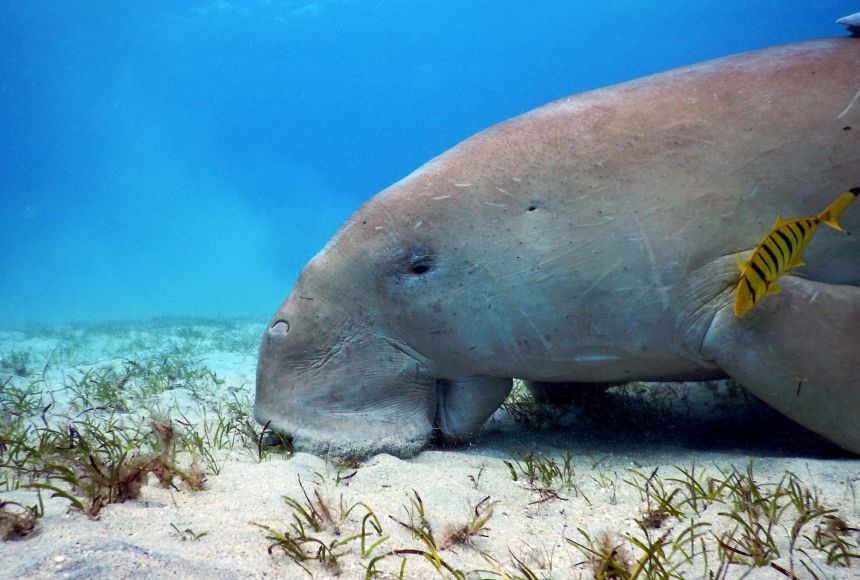
Many herbivores are big enough for us to see. They come in a huge range of sizes, though. There are smaller ones, such as surgeonfish and parrotfish, and bigger ones, like green turtles and manatees.

Together, herbivores eat up a huge amount of plant life. However, many of them are eaten in turn. They become food for the carnivorous, or flesh-eating, animals. Carnivores make up the food chain's top two levels.


Level Three: Carnivores

The third level of the food chain consists of a large group of small carnivores. It includes fish, like sardines, herring and menhaden. Such smaller fish eat a great amount of zooplankton. However, they themselves are often eaten.

There is one simple fact of ocean life. Big fish eat smaller fish.


Level Four: Top Predators

Large predators sit at the top of the marine food chain. They are a varied group. Some are finned animals, such as sharks, tuna, and dolphins. Others are feathered animals, like pelicans and penguins. Yet others are animals with flippers, like seals and walruses.

Most top predators are large, fast and very good hunters. They also have longer lifespans. Usually, they reproduce slowly. Females of these species do not give birth that often.

Many of the marine food chain's top predators are eaten too. They are hunted by humans, the most deadly of all hunters. Overfishing by humans can greatly shrink top predator populations. Because such animals reproduce slowly, it can take years for their populations to recover.

The loss of top predator species can create serious problems. These problems ripple through the entire food web. For example, populations of smaller animals that top predators normally feed on can become too large. These smaller animals might then nearly wipe out populations of even smaller animals. Or, they might eat too much plant life. Then, animals that live on plants no longer have enough food.


Alternative Food Chains

The main marine food web is based on sunlight and plants. It includes many of the ocean's species. However, it does not include all of them. There are other, separate deep-ocean ecosystems. These are fueled by chemical energy. This energy enters the ocean through hydrothermal vents. Hydrothermal vents are openings in the ocean floor. They release heated minerals from deep within Earth, into the ocean.
1

What makes sharks vulnerable to extinction?
1

How can the loss of a top predator species affect the food web?

VIDEO: SHARKS & SHORELINES


Research into tagging ocean predators, like lemon sharks, has helped scientists better understand coastal ecosystems. Tracking the location of these marine animals has shown top predators returning to safer mangrove ecosystems to give birth. By frequenting these coastal waters, sharks help limit grazing in the sea-grass ecosystem and improve the overall health of the environment.
1

How do lemon sharks affect the mangrove ecosystem?

1

How do lemon sharks help defend against hurricanes?

TEXT: SHARKS, Humans, & Rays


Shark species have declined, some 75% or even 90%. How do you think this effects the species that they eat?


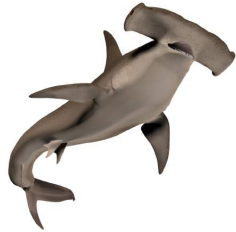
Surprisingly, its not good news for the sharks’ prey. Take hammerhead sharks in Australian waters for an example. Hammerhead populations have declined up to 80% from commercial fishing and government shark control programs to protect swimmers at beaches.

Hammerheads prey mainly on stingrays and smaller sharks. Fewer stingrays were eaten by the sharks, so stingrays increased in numbers. Stingrays have very strong jaws which can crush hard shells of oysters and clams. Farmers who grow oysters in shallow water off Queensland noticed that stingrays were destroying their oyster beds. In response, many stingrays were killed. Now stingrays are also considered in danger of disappearing in the area.

When humans change the environment by removing one species, it can cause problems for other species. Every part of a food web is important to the whole environment.
1

What happened to stingrays when the Australia hammerhead shark population declined?

Sharks and Their Role in Food Webs and Food Chains

Introduction to Sharks

Sharks are fascinating creatures that have been around for over 400 million years. They come in various shapes and sizes, from the tiny dwarf lantern shark to the enormous whale shark. Sharks are known for their sharp teeth, powerful jaws, and incredible swimming abilities. But did you know that sharks play a crucial role in the ocean's food webs and food chains?

What is a Food Chain?

A food chain is a sequence of organisms where each one is eaten by the next member in the chain. It starts with producers, like plants and algae, which make their own food using sunlight. Then come the consumers, which eat the producers. There are different levels of consumers:
  • Primary consumers: These are usually herbivores that eat plants.
  • Secondary consumers: These are carnivores that eat herbivores.
  • Tertiary consumers: These are top predators that eat other carnivores.

What is a Food Web?

A food web is a more complex network of food chains that are interconnected. It shows how different organisms are related through what they eat. In a food web, one organism might be part of multiple food chains.

Sharks in Food Chains and Food Webs

Sharks are often top predators in their ecosystems. This means they are at the top of the food chain. They eat a variety of prey, including fish, seals, and even other sharks. By doing so, sharks help keep the populations of their prey in check. This prevents any one species from becoming too abundant and disrupting the balance of the ecosystem.

Importance of Sharks

Sharks play a vital role in maintaining the health of the ocean. Here are some reasons why sharks are important:
  1. Population Control: By preying on weaker or sick animals, sharks help keep the populations of other species healthy.
  2. Biodiversity: Sharks contribute to the diversity of marine life by controlling the populations of various species.
  3. Ecosystem Balance: Sharks help maintain the balance of marine ecosystems, ensuring that no single species dominates.

Threats to Sharks

Unfortunately, sharks face many threats, including overfishing, habitat loss, and pollution. Many shark species are now endangered. It's important to protect sharks to ensure the health of our oceans.

Conclusion

Sharks are more than just fearsome predators; they are essential to the health of marine ecosystems. By understanding their role in food webs and food chains, we can appreciate the importance of conserving these incredible creatures.
1

What is a food chain?

1

What role do sharks often play in food chains?

1

How do sharks help maintain the health of marine ecosystems?

1

Why is it important to protect sharks?

9
There are many species of sharks. Sharks are ________ predators in marine ecosystems. They are _______________ that ____________fish, stingrays, seals, and many other ocean animals.

If lemon sharks were removed from the mangrove ecosystem, the population of
herbivores would likely _____________. They could overeat the needed _______________ in the mangrove ecosystem.

In Australia, there was a _____________ in the population of hammerhead sharks. As a result, the stingray population increased. Stingrays ate more and more oysters. Eventually,
humans killed stingrays because they were destroying their oyster beds.

The greatest threat to shark populations is __________behavior. Destruction of habitat and ________________ cause a decline in the number of sharks.

If there were no sharks, marine ecosystems would not be _____________.
Other Answer Choices:
carnivores
balanced
overfishing
vegetation
consume
decrease
human
top
increase