Module 1: Smart Starts (Days 1-5)
This is a game based learning assesment on Financial Literacy.
Welcome to Money Moves: Survive and Thrive!
In this simulation, you will step into the shoes of a college student/young professional trying to navigate the world of personal finance over 30 virtual days.
Each day will present you with realistic situations and choices. Your goal is to make smart money moves to end the month with a positive balance, build savings, and develop good financial habits.
Let's begin your financial journey!
Module 1: Smart Starts (Days 1-5)
Day 1: The Coffee Conundrum (Understanding Opportunity Cost)
It's Monday morning, and you're deciding on your coffee routine for the week (5 workdays). A homemade coffee costs ₹30 per day, while buying from a cafe costs ₹120 per day. What is the opportunity cost of choosing cafe coffee for the entire week?
Day 2: The Impulse Buy (Wants vs. Needs)
Drag each item below into the 'Want' or 'Need' category as you start planning your monthly expenses.
Eating out multiple times a week
Groceries
Transportation to work/college
Rent
High-speed internet
Designer clothes
Streaming service subscription (one)
Latest smartphone
Need
Want
Day 3: Tracking Your Spending (Building Awareness)
Imagine you tracked your spending for the last 24 hours and these are some of the things you spent money on. Drag each item into the category you think you were MOST aware of spending on versus the category you were LEAST aware of spending on.
A small online purchase you didn't plan
Lunch
A spontaneous coffee
Snacks while studying/working
Transportation fare
Subscription renewal (e.g., for an app)
Things I Was Likely VERY Aware Of Spending On
Things I Was Likely LESS Aware Of Spending On
Day 4: Setting a Small Financial Goal (Motivation)
To build good saving habits, it's often helpful to start with a small, achievable financial goal. Which of the following is the MOST effective SMART goal (Specific, Measurable, Achievable, Relevant, Time-bound) to start with for the next month?
Day 5: The Power of "No" (Resisting Unnecessary Spending)
Your friend enthusiastically invites you to a movie this evening. You have already spent a bit more than you planned this week, and going to the movie will put you over your mini-budget for entertainment. You're deciding whether or not to go to the movie with your friend.
Rank the following internal factors in order of how MUCH they should influence your decision, from MOST influential to LEAST influential. (Drag the options to reorder them)
Your pre-set entertainment budget for the week.
Your long-term financial goals (e.g., saving for something important).
The strength of your friendship.
Your fear of missing out (FOMO).
Module 2: The Credit Card Crunch (Days 6-10)
Day 6: The Student Credit Card Offer (Understanding Credit)
A representative at your college is offering a student credit card with a ₹1,000 credit limit and a 18% annual percentage rate (APR). They highlight the convenience and the potential to build your credit history. What is the MOST important factor you should consider before applying for this credit card?
Day 7: The Laptop Emergency (EMI vs. Saving)
Your old laptop suddenly crashes, and you need one urgently for your studies/work. A new laptop costs ₹30,000. You have ₹10,000 in savings. You're offered an EMI (Equated Monthly Installment) option with a 12% annual interest rate over 12 months. What is the MOST financially sound first step in this situation?
Day 8: Understanding Your Credit Score (Knowledge Check)
Which of the following factors typically has the MOST significant impact on your credit score?
Day 9: The Interest Trap (Calculation and Awareness)
You have a credit card bill of ₹5,000 with a 20% annual interest rate. If you only pay the minimum due (let's say ₹250) each month and don't make any new charges, approximately how much interest will you accrue in the first month?
Day 10: Avoiding Unnecessary Debt (Decision Making)
Your friend is upgrading to the latest smartphone and offers you their perfectly functional old phone for ₹5,000. You are tempted, but your current phone still works fine for your needs. You don't have ₹5,000 readily available and would need to use your credit card to buy it. What is the MOST financially prudent action in this situation?
Module 3: The Investment Pitch (Days 11-15)
Day 11: The Friend's SIP Pitch (Introduction to SIPs)
Your friend excitedly tells you about SIPs (Systematic Investment Plans) in mutual funds. They explain that it's a way to invest a fixed amount regularly, like ₹500 per month, in the stock market. What is the PRIMARY benefit of investing through a SIP, according to standard financial advice?
Day 12: The Crypto Recommendation (Understanding Risk vs. Reward)
Another friend strongly advises you to invest in a new cryptocurrency, claiming it's the 'next big thing' and could give you massive returns very quickly. What is the MOST important question you should ask yourself before investing in such a volatile asset?
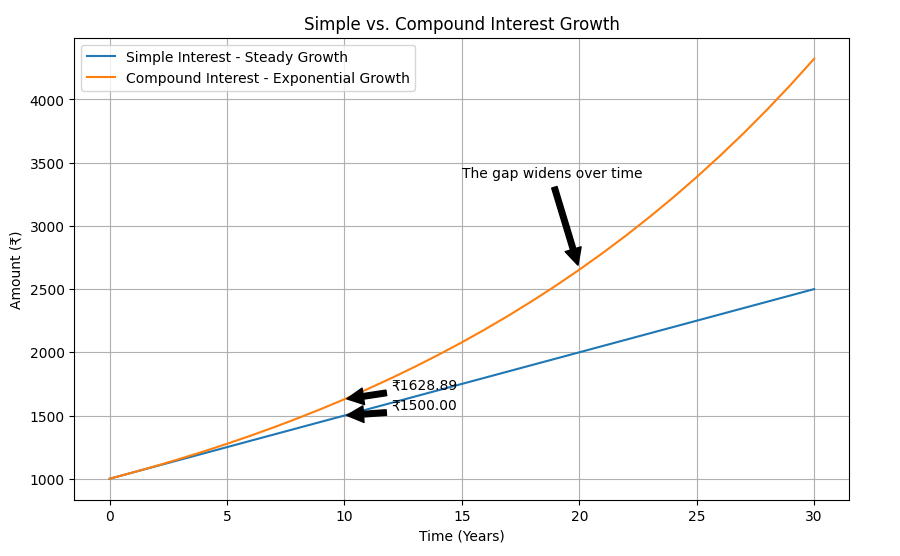
Day 13: Simple vs. Compound Growth (Visual Introduction)
The graph shows the growth of ₹1,000 invested over time with simple interest versus compound interest. Which of the following statements BEST describes the key difference illustrated by the graph?
Day 14: Starting Small (Overcoming Inertia)
Match the following small, actionable first steps to their primary benefit in overcoming the feeling of being overwhelmed by investing.
| Draggable item | arrow_right_alt | Corresponding Item |
|---|---|---|
Setting aside a small, fixed amount for potential investment each month (e.g., ₹100). | arrow_right_alt | Helps demystify complex concepts and build basic knowledge. |
Talking to a trusted friend or family member who has some investment experience. | arrow_right_alt | Creates a tangible starting point and builds the habit of saving for investment. |
Reading a beginner's guide to mutual funds. | arrow_right_alt | Provides a relatable perspective and can answer initial basic questions. |
Day 15: Risk Tolerance Check (Self-Assessment)
Imagine you invest ₹1,000 in a mutual fund, and after one year, its value drops to ₹800 due to market fluctuations. Which of the following emotions would you MOST likely feel?"
Module 4: Peer Pressure vs. Money Goals (Days 16-20)
Day 16: The Weekend Getaway (Resisting FOMO)
Your friends are planning an impromptu weekend getaway to a nearby resort. The cost per person is ₹3,000, including travel and accommodation. You've been diligently saving ₹500 per week for a new laptop you need for your studies, and this trip would significantly derail your progress. You're deciding whether or not to join the weekend getaway, Rank the following factors in order of how MUCH they should influence your decision, from MOST influential to LEAST influential. (Drag the options to reorder them)
Your desire to spend time with your friends.
Your urgency in needing the new laptop for your studies.
The progress you've already made towards your laptop savings goal.
Your fear of being excluded from the group.
Day 17: The Trendy Gadget (Wants vs. Long-Term Savings)
Everyone in your social circle seems to have bought the newest 'TechSpark X' gadget, which costs ₹8,000. You feel a strong urge to fit in and not be left out. However, you are also saving for a long-term goal – a trip abroad that will cost around ₹50,000. Buying the gadget would take a significant chunk out of your current savings. What is the MOST financially responsible perspective to adopt in this situation?
Day 18: The "Treat Yourself" Culture (Mindful Spending)
You're tempted to 'treat yourself' to an expensive item. Drag each of the following thoughts into the 'Mindful Spending Thought' or 'Impulsive Spending Thought' category.
Does this fit into my budget for discretionary spending?
Will this purchase still bring me joy in a week or a month?
I deserve this! I don't need to think about the cost right now.
Is there a less expensive alternative that would satisfy the same need/want?
Everyone else is buying something similar; I should too.
Mindful Spending Thought
Impulsive Spending Thought
Day 19: The Group Outing Budget (Setting Boundaries)
Your friends are planning a group outing to a fancy restaurant. The estimated cost per person is significantly higher than what you usually spend on a meal. You want to socialize but are also trying to stick to your food budget. What is the MOST assertive yet respectful way to handle this situation?
Day 20: Reflecting on Wants vs. Needs (Reinforcement)
Over the past few days, you've been faced with various spending temptations. Drag each of the following scenarios into the category that BEST describes the primary driver behind the urge to spend.
Your phone screen cracked, making it difficult to use for work/study.
Celebrating a promotion with an expensive dinner.
Wanting the latest fashion trend to feel more confident.
Feeling left out because everyone has a new gadget.
Your old shoes have holes, and you need a new pair for walking.
Driven by Peer Pressure/Social Needs
Driven by Genuine Need/Personal Goal
Module 5: Danger Zone (Days 21-25)
Day 21: The "You've Won!" Scam (Identifying Red Flags)
You receive this message claiming you've won a significant amount. Which of the following is the BIGGEST red flag that this might be a scam?
Day 22: The Fake Investment Opportunity (Spotting High-Pressure Tactics)
Match the following phrases you might hear with whether they are TYPICAL of a legitimate investment opportunity or a POTENTIAL scam.
Guaranteed returns of 20% per month with zero risk!
We are a regulated financial institution with a proven track record.
This is a once-in-a-lifetime opportunity you can't afford to miss!
Limited-time offer! You must invest within 24 hours to get these guaranteed high returns!
Take your time to review our documents and consult with a financial advisor.
Potential Scam
Legitimate Investment
Day 23: Protecting Your Digital Wallet (Cybersecurity Basics)
Which of the following are BEST practices for protecting your digital wallet (e.g., UPI apps, mobile banking) and preventing unauthorized access? (Select all that apply)
Day 24: Recognizing Phishing Attempts (Scenario Analysis)
You receive an email that looks like it's from your bank, stating that there was suspicious activity on your account and you need to click a link to verify your details immediately. What is the SAFEST course of action?
Day 25: Protecting Yourself from UPI Fraud (Knowledge Application)
Match the following UPI safety tips with their correct explanation.
| Draggable item | arrow_right_alt | Corresponding Item |
|---|---|---|
Enable transaction limits in your UPI app. | arrow_right_alt | Your PIN is only required when you are sending money, not receiving it. |
Never enter your UPI PIN when receiving money. | arrow_right_alt | This helps prevent accidental transfers to the wrong person. |
Always check the recipient's UPI ID carefully before sending money. | arrow_right_alt | This can limit potential losses if your account is compromised. |
Module 6: Real-life Twists (Days 26-30)
Day 26: The Unexpected Medical Bill (Emergency Fund)
On Day 26, you suddenly fall ill and need to visit a doctor. The consultation and basic tests cost ₹2,500, which was completely unexpected. How should you ideally cover this expense without derailing your other financial goals?
Day 27: The Surprise Bonus (Splurge vs. Invest)
You receive a surprise bonus of ₹5,000 from a part-time job! Rank the following options in the order of their MOST to LEAST financially sound use in this situation. (Drag the options to reorder them)
Treat yourself to a nice dinner and a movie with friends.
Invest the entire amount in a low-cost index fund.
Splurge on a new gadget you've been wanting.
Put a significant portion into your savings account or towards your emergency fund.
Day 28: Peer Pressure Revisited (Making Independent Choices)
Your friends are all planning to buy tickets to a very expensive concert next month. You're interested in going, but the ticket price would eat up a large chunk of your entertainment budget for the entire month. They are pressuring you to buy a ticket, saying 'You only live once!' What is the MOST financially responsible response that acknowledges your friends while respecting your budget?
Day 29: The Final Stretch - Emergency Fund Check (Knowledge Recall)
As you approach the end of the 30 days, you reflect on the importance of an emergency fund. Ideally, how many months' worth of essential living expenses should a well-established emergency fund cover?
Day 30: Looking Ahead - Building Your Financial Future (Reflection/Action Planning)
Now that you've navigated 30 virtual days of financial decisions, rank the following financial habits in order of their importance for building long-term financial security, from MOST important to LEAST important. (Drag the options to reorder them)
Consistently tracking your income and expenses.
Saving and investing regularly.
Avoiding high-interest debt.
Keeping up with the latest trends and gadgets.
--- Congratulations, Financial Fortress Builder! ---
You've successfully navigated 30 days of financial decisions in Money Moves: Survive and Thrive!
Remember, building financial security takes time and consistent effort. Keep learning, keep practicing, and keep making those smart money moves!