Read the questions and fill out the short answer questions in addition to answering the multipe choice questions.
Read Each Document (Document A-G) and answer the questions below.
Some questions are multiple choice.
Some questions are short answers that are to be written in complete sentences.
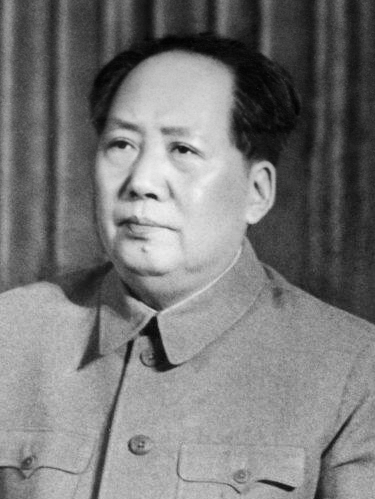
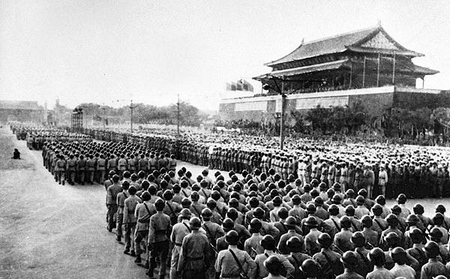
Is Mao Zedong convincing in his speech that he and his followers are in the right? Why or why not?
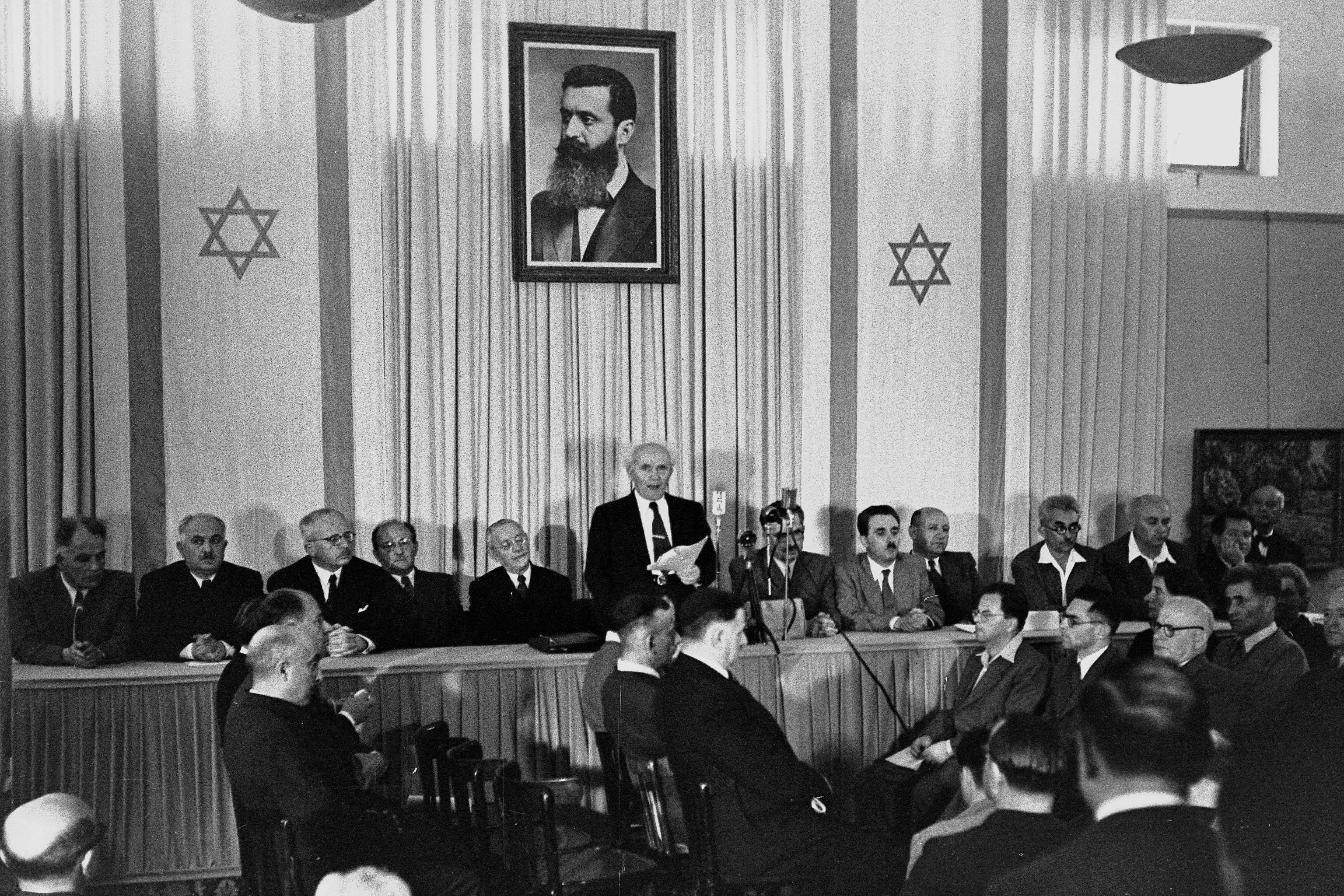
Declaration of Israel's Independence, 1948
A Jewish state is established in Palestine.
The land of Israel was the birthplace of the Jewish people. Here their spiritual, religious and national identity was formed. Here they achieved independence and created a culture of national and universal significance. Here they wrote and gave the Bible to the world.
Exiled from Palestine, the Jewish people remained faithful to it in all the countries of their dispersion, never ceasing to pray and hope for their return and the restoration of their national freedom.
Impelled by this historic association, Jews strove throughout the centuries to go back to the land of their fathers and regain their statehood. In recent decades they returned in masses. They reclaimed the wilderness, revived their language, built cities and villages and established a vigorous and ever-growing community with its own economic and cultural life.
They sought peace yet were ever prepared to defend themselves. They brought the blessing of progress to all inhabitants of the country.
In the year 1897 the First Zionist Congress, inspired by Theodor Herzl's vision of the Jewish State, proclaimed the right of the Jewish people to national revival in their own country.
This right was acknowledged by the Balfour Declaration of November 2, 1917, and re-affirmed by the Mandate of the League of Nations, which gave explicit international recognition to the historic connection of the Jewish people with Palestine and their right to reconstitute their National Home.
The Nazi holocaust, which engulfed millions of Jews in Europe, proved anew the urgency of the re-establishment of the Jewish state, which would solve the problem of Jewish homelessness by opening the gates to all Jews and lifting the Jewish people to equality in the family of nations.
The survivors of the European catastrophe, as well as Jews from other lands, proclaiming their right to a life of dignity, freedom and labor, and undeterred by hazards, hardships and obstacles, have tried unceasingly to enter Palestine.
In the Second World War the Jewish people in Palestine made a full contribution in the struggle of the freedom-loving nations against the Nazi evil. The sacrifices of their soldiers and the efforts of their workers gained them title to rank with the peoples who founded the United Nations.
On November 29, 1947, the General Assembly of the United Nations adopted a Resolution for the establishment of an independent Jewish State in Palestine, and called upon the inhabitants of the country to take such steps as may be necessary on their part to put the plan into effect.
This recognition by the United Nations of the right of the Jewish people to establish their Independent State may not be revoked. It is, moreover, the self-evident right of the Jewish people to be a nation, as all other nations, in its own Sovereign State.
ACCORDINGLY, WE, the members of the National Council, representing the Jewish people in Palestine and the Zionist movement of the world, met together in solemn assembly today, the day of the termination of the British mandate for Palestine, by virtue of the natural and historic right of the Jewish and of the Resolution of the General Assembly of the United Nations,
HEREBY PROCLAIM the establishment of the Jewish State in Palestine, to be called ISRAEL.
WE HEREBY DECLARE that as from the termination of the Mandate at midnight, this night of the 14th and 15th May, 1948, and until the setting up of the duly elected bodies of the State in accordance with a Constitution, to be drawn up by a Constituent Assembly not later than the first day of October, 1948, the present National Council shall act as the provisional administration, shall constitute the Provisional Government of the State of Israel.
THE STATE OF ISRAEL will be open to the immigration of Jews from all countries of their dispersion; will promote the development of the country for the benefit of all its inhabitants; will be based on the precepts of liberty, justice and peace taught by the Hebrew Prophets; will uphold the full social and political equality of all its citizens, without distinction of race, creed or sex; will guarantee full freedom of conscience, worship, education and culture; will safeguard the sanctity and inviolability of the shrines and Holy Places of all religions; and will dedicate itself to the principles of the Charter of the United Nations.
THE STATE OF ISRAEL will be ready to cooperate with the organs and representatives of the United Nations in the implementation of the Resolution of the Assembly of November 29, 1947, and will take steps to bring about the Economic Union over the whole of Palestine.
We appeal to the United Nations to assist the Jewish people in the building of its State and to admit Israel into the family of nations.
In the midst of wanton aggression, we yet call upon the Arab inhabitants of the State of Israel to return to the ways of peace and play their part in the development of the State, with full and equal citizenship and due representation in its bodies and institutions -- provisional or permanent.
We offer peace and unity to all the neighboring states and their peoples, and invite them to cooperate with the independent Jewish nation for the common good of all.
Our call goes out to the Jewish people all over the world to rally to our side in the task of immigration and development and to stand by us in the great struggle for the fulfillment of the dream of generations -- the redemption of Israel.
With trust in Almighty God, we set our hand to this Declaration, at this Session of the Provisional State Council, in the city of Tel Aviv, on this Sabbath eve, the fifth of Iyar, 5708, the fourteenth day of May, 1948.
Source: https://www.pbs.org/wgbh/americanexperience/features/truman-israel/
Why do the Jewish people believe that this land belongs to them?
According to the Declaration, what did the Jewish people do while in exile from Palestine?
According to the Declaration of Independence, what commitment does the State of Israel make regarding its citizens?
In 1947, what organization granted the right to Jewish people to create their own Sovereign, independent nation?
According to the Declaration, what action did the General Assembly of the United Nations take on November 29, 1947?
According to the Declaration, what did the Jewish people contribute to during the Second World War?
According to the Declaration, what inspired the First Zionist Congress in 1897?
According to the Declaration, what did the Nazi holocaust demonstrate?
According to the Declaration, what does the State of Israel offer to the Arab inhabitants of the State?
What groups of people does the State of Israel plan to protect? Why do they plan to protect them and how do they plan to protect them?
Israeli-Palestinian Conflict
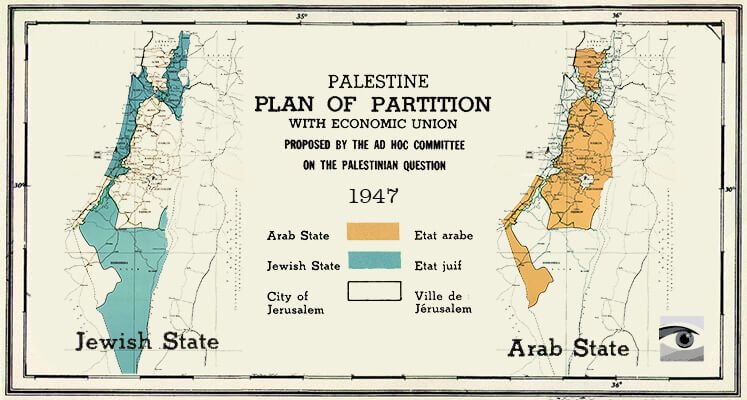
The Israeli-Palestinian conflict dates back to the end of the nineteenth century. In 1947, the United Nations adopted Resolution 181, known as the Partition Plan, which sought to divide the British Mandate of Palestine into Arab and Jewish states. On May 14, 1948, the State of Israel was created, sparking the first Arab-Israeli War. The war ended in 1949 with Israel’s victory, but 750,000 Palestinians were displaced, and the territory was divided into 3 parts: the State of Israel, the West Bank (of the Jordan River), and the Gaza Strip.
Over the following years, tensions rose in the region, particularly between Israel and Egypt, Jordan, and Syria. Following the 1956 Suez Crisis and Israel’s invasion of the Sinai Peninsula, Egypt, Jordan, and Syria signed mutual defense pacts in anticipation of a possible mobilization of Israeli troops. In June 1967, following a series of maneuvers by Egyptian President Abdel Gamal Nasser, Israel preemptively attacked Egyptian and Syrian air forces, starting the Six-Day War. After the war, Israel gained territorial control over the Sinai Peninsula and Gaza Strip from Egypt; the West Bank and East Jerusalem from Jordan; and the Golan Heights from Syria.
Six years later, in what is referred to as the Yom Kippur War or the October War, Egypt and Syria launched a surprise two-front attack on Israel to regain their lost territory; the conflict did not result in significant gains for Egypt, Israel, or Syria, but Egyptian President Anwar al-Sadat declared the war a victory for Egypt as it allowed Egypt and Syria to negotiate over previously ceded territory. Finally, in 1979, following a series of cease-fires and peace negotiations, representatives from Egypt and Israel signed the Camp David Accords, a peace treaty that ended the thirty-year conflict between Egypt and Israel.
Even though the Camp David Accords improved relations between Israel and its neighbors, the question of Palestinian self-determination and self-governance remained unresolved. In 1987, hundreds of thousands of Palestinians living in the West Bank and Gaza Strip rose up against the Israeli government in what is known as the first intifada. The 1993 Oslo I Accords mediated the conflict, setting up a framework for the Palestinians to govern themselves in the West Bank and Gaza, and enabled mutual recognition between the newly established Palestinian Authority and Israel’s government. In 1995, the Oslo II Accords expanded on the first agreement, adding provisions that mandated the complete withdrawal of Israel from 6 cities and 450 towns in the West Bank.
What was the main goal of the United Nations Resolution 181, also known as the Partition Plan, in 1947, as mentioned in the text?
According to the text, what territories did Israel gain control over after the Six-Day War in 1967?
What was the primary outcome of the Oslo I Accords in 1993, as stated in the text?
What was the result of the first Arab-Israeli War that started after the creation of Israel, according to the text?
According to the text, what was significant about the Camp David Accords signed in 1979?
Why might there be tension between the Israelis and the Palestinians?
Apartheid
What is Apartheid?
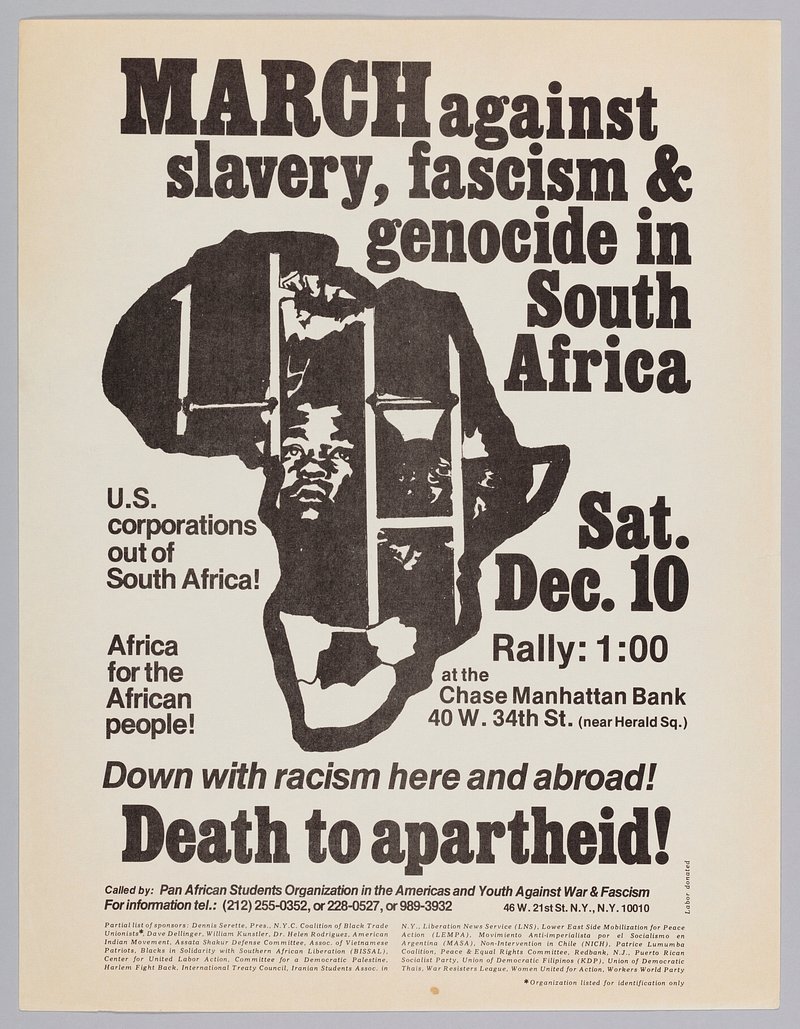
Back in the 1980s, one issue brought the world together as few had done before. Activists from every corner of the Earth, inspired by the actions of black South Africans, demanded an end to an unjust system known as apartheid. Apartheid is an Afrikaans word meaning "apartness." It was a policy of legal discrimination and segregation directed at the black majority in South Africa.
The oppression of black African communities, even within Africa, was nothing new. European colonial governments had placed restrictions on almost every aspect of their lives, from marriage to employment to housing. In South Africa in particular, the white minority had used their colonial authority and weaponry to control the majority population as early as the eighteenth century. Under British rule, they had passed a series of laws that gradually brought most of the land of South Africa under their control, and forced the indigenous people to become poorly paid laborers.
But after WWII, independence was in the air. Britain, France, and other European colonial powers were weakened from the devastating war against Germany. At the same time, countries all over the world that had been colonized and exploited for decades now wanted their freedom. Between 1946 and 1970, over 60 countries declared their independence from foreign rule. Of those, 44 were in Africa! It was good timing. This passionate movement toward decolonization and self-determination was happening along with a global spirit of cooperation that emerged from the devastating effects of WWII. Many parts of the world were coming together in calls for freedom and justice. The South African black majority, inspired by these calls and fed up with discriminatory laws, demanded equality. Of course, the powerful rarely give up anything without a fight, and the white majority in South Africa were no exception. In 1948 the National Party became the ruling political party in South Africa. Frightened by increasing black activism and fueled by racism, they passed a series of laws to make the oppression of black South Africans perfectly legal. This discriminatory legal system was called apartheid. Some of these laws included:
Classifying all South Africans into racial categories: "white," "black," and "colored" (mixed race).
Making it illegal for people to marry across those categories, or even to have sexual relations.
Mandating segregation (separation of races) in schools and all public facilities.
Moving all black South Africans into small areas referred to as "homelands" or Bantustans. In total, 30 million black South Africans—over 70 percent of the population—were moved onto 13 percent of South Africa's land.
Restricting freedom of movement, requiring black South Africans to always carry a "pass book" showing their assigned race and "homeland." Being outside of one's "homeland" was cause for arrest.
Forbidding black South Africans from owning land outside of the Bantustans.
Forbidding black labor unions from striking.
Making it illegal to protest, or to gather in groups large enough to start a protest.
Denying black people the right to vote, except for local authorities in their Bantustans.
Historians have noted how similar these laws were to the Jim Crow laws in the American South from the 1870s through the 1960s. The Jim Crow laws forced segregation, second-class status, and political disenfranchisement (taking away the right to vote) on African Americans. Apartheid did the same thing, but to a black majority within South Africa. As the Civil Rights Movement gained momentum in the U.S., the federal government slowly began to dismantle these legal restrictions. But about the same time, South Africa's national government was writing inequality and injustice deeper into the law of the land.
The Anti-Apartheid Movement
The anti-apartheid movement in South Africa was fought on many fronts. Political parties were formed such as the African National Congress (ANC), the South African Communist Party (SACP), the South African Indian Congress, and the South African Congress of Democrats. In the 1950s, most of these parties formed a multi-racial alliance against apartheid.
For many years these groups used nonviolent activism. But as National Party laws became more racist and restrictive, the opposition groups called for stronger action. They organized strikes, boycotts of white businesses, and protests of all kinds. In 1955 they issued the Freedom Charter. This document called for an end to apartheid and new freedom and opportunity for black South Africans. It stated that all people were entitled to an education and a decent job. Also, since many influential leaders had embraced the idea of African socialism, the Freedom Charter called for worker control of industry and a sharing of all the nation's land and wealth.
The Freedom Charter was controversial. Some black activists disliked the references to all people having rights, wanting it to focus exclusively on the rights and freedoms of black Africans. Others were uncomfortable with the charter's socialist language. They feared that any link to socialist or communist ideas would discredit the entire anti-apartheid movement. And that's pretty much what happened. The white minority government sounded the alarm that all activism—protests, strikes, and boycotts—was communist-inspired. Remember that this was taking place during the 1950s and 1960s, when many were panicked about the spread of communism. The U.S. and U.S.S.R. were in the midst of the Cold War. Governments, as well as some dictators, were using the excuse of "fighting communism" to crush rebellions of workers who rose up to battle poverty and injustice. It was easy for the National Party to do the same. They claimed that their brutal tactics against black activists were simply attempts to stop a communist takeover. And brutal they were. As opposition to apartheid gained momentum across the country, the government unleashed the power of their well-armed police and military. In 1960 police opened fire on peaceful protesters in the township of Sharpeville, killing 69 people. Shortly after these killings in 1962, Nelson Mandela, a lawyer and president of the ANC, was imprisoned along with other leaders of the opposition movement. At his trial, Mandela inspired future generations of activists with his three-hour "I Am Prepared to Die" speech in court. While Mandela would spend 27 years in prison, both he and others continued the fight against apartheid. In 1976, in the township of Soweto, thousands of students took to the streets to protest new educational restrictions. The police responded with tear gas and gunfire, which resulted in the deaths of over 100 schoolchildren.
These and other actions were creating the type of inspirational figures that authoritarian leaders fear. Stephen Biko was a leader of the South African Black Consciousness Movement (BCM), which shared ideas about black pride and empowerment with people of color around the world. In the same way that the American Civil Rights Movement inspired anti-apartheid struggles, African American groups like the Black Panther Party were motivating the BCM from many thousands of miles away. The term "Black is Beautiful" may have originated in America, but it was Biko who used it to inspire a generation of young black Africans. When he was jailed and beaten to death in Port Elizabeth, 20,000 people attended his funeral and he became a beloved martyr of the movement.
A Global Response
Nelson Mandela was also beloved. His decades-long imprisonment became a symbol of the ongoing repression by the South African government. The resistance to apartheid by youth in Soweto and elsewhere was discussed all over the world. It broadened the anti-apartheid movement into a powerful international network. As more people became aware of the horrors of apartheid, the international community began to act. In the 1970s and 1980s, South African teams were banned from participating in the Olympics, FIFA World Cup, and the Rugby World Cup, among others. Activist groups, in particular university students in America and Europe, began asking their schools to "divest" from South Africa. Divestment is basically the opposite of investment, so this movement called for companies to stop doing business in South Africa and for individuals to boycott any companies that refused. This became a major focus of the movement within the United States, with students on campuses nationwide staging demonstrations. Their message: Americans must sever ties to anyone conducting business in South Africa.
Inspired by the continued struggle of the black community in South Africa, people around the world became determined to bring about change in South Africa. The frequent television reports of black South Africans taking to the streets and being met with brutal government retaliation helped to keep attention on the situation. In many countries, schools, churches, city councils, union halls, and corporations were all demanding an end to apartheid. Some leaders, like President Ronald Reagan in the United States and Prime Minister Margaret Thatcher in the United Kingdom, resisted these calls. They claimed that the black activists supported communism. But the international movement managed to overcome their objections.
South Africans felt supported and encouraged, and their political power grew while the South African government became financially and politically more isolated. Finally, in 1990, the world watched as the new president of the National Party, F. W. de Klerk, released Nelson Mandela and other political prisoners. The party began to overturn segregationist laws and recognized the ANC as a legitimate political party. Within four years, Mandela became president of the country. Though the new majority government faced many challenges, it was a new day in South Africa. Apartheid was over.
The country continues to grapple with the problems faced by many nations: economic development, poverty, crime, access to education, and discrimination. But its ability to end the policies of apartheid are still an example of how people can come together to overcome years of mistreatment and work to create a just society. It has also shown how the fight for equality in one nation can move to a global stage and gain support. Had the activists in South Africa not been able to bring on board global support, would apartheid still be the law of the land in South Africa?
According to the text, what was one of the first actions taken by the National Party in 1948 to enforce apartheid
Based on the text, what was the purpose of the "pass book" that black South Africans were required to carry?
According to the text, what was the significance of Nelson Mandela's imprisonment in the fight against apartheid?
According to the text, what event directly led to Nelson Mandela's imprisonment?
According to the text, what was the Freedom Charter?
According to the text, what claim did the White minority government use to justify their brutal actions against Black activists?
According to the text, what role did the international community play in the fight against apartheid?
This article highlights the communities and networks that resisted apartheid. Can you explain any ways that global and local production and distribution were helpful in ending the system?
The end of apartheid was a group effort. What changes in community within South Africa helped end apartheid? What actions of global "networks" helped end the racist system? Why is it useful to view this important change through both?
FOREIGN RELATIONS OF THE UNITED STATES: DIPLOMATIC PAPERS, 1942, GENERAL; THE BRITISH COMMONWEALTH; THE FAR EAST, VOLUME I
Mr. Mohandas K. Gandhi to President Roosevelt
Sevagram, via Wardha (India), 1 July, 1942.
Dear Friend: I twice missed coming to your great country. I have the privilege of having numerous friends there both known and unknown to me. Many of my countrymen have received and are still receiving higher education in America. I know too that several have taken shelter there. I have profited greatly by the writings of Thoreau and Emerson. I say this to tell you how much I am connected with your country. Of Great Britain I need say nothing beyond mentioning that in spite of my intense dislike of British Rule, I have numerous personal friends in England whom I love as dearly as my own people. I had my legal education there. I have therefore nothing but good wishes for your country and Great Britain. You will therefore accept my word that my present proposal, that the British should unreservedly and without reference to the wishes of the people of India immediately withdraw their rule, is prompted by the friendliest intention. I would like to turn into good will the ill will which, whatever may be said to the contrary, exists in India towards Great Britain and thus enable the millions of India to play their part in the present war.
My personal position is clear. I hate all war. If, therefore, I could persuade my countrymen, they would make a most effective and decisive contribution in favour of an honourable peace. But I know that all of us have not a living faith in non-violence. Under foreign rule however we can make no effective contribution of any kind in this war, except as helots.
The policy of the Indian National Congress, largely guided by me, has been one of non-embarrassment to Britain, consistently with the honourable working of the Congress, admittedly the largest political organisation, of the longest standing in India. The British policy as exposed by the Cripps mission and rejected by almost all parties has opened our eyes and has driven me to the proposal I have made. I hold that the full acceptance of my proposal and that alone can put the Allied cause on an unassailable basis. I venture to think that the Allied declaration that the Allies are fighting to make the world safe for freedom of the individual and for democracy sounds hollow, so long as India and, for that matter, Africa are exploited by Great
Britain, and America has the Negro problem in her own home. But in order to avoid all complications, in my proposal I have confined myself only to India. If India becomes free, the rest must follow, if it does not happen simultaneously.
In order to make my proposal fool-proof I have suggested that, if the Allies think it necessary, they may keep their troops, at their own expense in India, not for keeping internal order but for preventing Japanese aggression and defending China. So far as India is concerned, she must become free even as America and Great Britain are. The Allied troops will remain in India during the war under treaty with the Free India Government that may be formed by the people of India without any outside interference, direct or indirect.
It is on behalf of this proposal that I write this to enlist your active sympathy.
I hope that it would commend itself to you.
Mr. Louis Fischer is carrying this letter to you.
If there is any obscurity in my letter, you have but to send me word and I shall try to clear it.
I hope finally that you will not resent this letter as an intrusion but take it as an approach from a friend and well wisher of the Allies.
I remain,
Yours sincerely,
M. K. Gandhi
According to Gandhi's letter, what is his main proposal to President Roosevelt?
According to Gandhi, what condition would allow India to make an effective contribution to the war effort?
According to Gandhi, what should happen to Allied troops currently stationed in India if India gains independence?
In his letter, what reason does Gandhi give for disliking British rule in India?
What does Gandhi say about his personal feelings towards Great Britain and its people?
According to Gandhi, what specific problem does America have that undermines the Allied cause?
Who is delivering Gandhi's letter to President Roosevelt?
According to Gandhi, what does the Indian National Congress policy consist of?
Gandhi argues that the Allied powers' claim to be fighting for freedom and democracy sounds hollow while India and Africa are exploited. Think about a time when you observed a contradiction between someone's words and their actions. What was the impact of that contradiction, and how did it make you feel?
Why was British India Partitioned in 1947?
Considering the role of Muhammad Ali Jinnah
‘The Long Partition’
In August 1947 British India was partitioned, ending three hundred years of colonial rule with the creation of two independent nations: India and Pakistan (comprising West and East Pakistan, present-day Bangladesh). From the tumultuous and tragic set of events that encompass this ‘Great’ and ‘Long’ Partition, much is set in stone: partition caused the ‘greatest mass movement of humanity in history’.
Twelve million refugees moved across new national borders drawn up by the British barrister Sir Cyril Radcliffe (who had famously never travelled further east than Paris before being tasked with drawing up the lines of partition). Crudely, this was a division based upon religious affiliation, with the creation of a Muslim majority in West and East Pakistan and a Hindu majority in India. Between 500,000 and 2 million souls perished as a result of the ensuing upheaval and violence. 80,000 women were abducted. India and Pakistan have since fought three wars over disputed boundaries in Kashmir (1947, 1965, and 1999).
In the long term, Partition has meant an ‘enduring rivalry’ between two nuclear-armed nations and continues to define the tone and character of Indian and Pakistani politics to this day. This resource takes just one approach to investigating Partition by analysing the role of a key individual at the heart of the high politics of Partition.
Historiography: At A Glance
Most scholars today emphasise that Partition was neither an inescapable consequence of irreconcilable differences between Muslim and Hindu populations, nor an inevitable political manoeuvre by the British following decades of ‘divide and rule’. Rather, a complex interplay of factors, including rising communal tensions in the 1930s, political choices made by elites at both national and provincial levels, the impact of the Second World War and the widespread breakdown of law and order following the ‘Great Calcutta Killing’ in 1946 are important to consider as factors. As a caveat, much work that dwells upon the role of individuals as key stimuli to change is rather dated (or has at least been greatly revised and added to in recent decades). Caricatures do however still loom large in the literature, with accounts that present Nehru as a handsome, warm personality close to the “Hollywood version of a British prince”, the Last Viceroy, Lord Mountbatten standing in opposition to that of Mohammad Ali Jinnah, who is often defined as a cold, calculating presence. That the Congress Party politician Sarojini Naidu joked she needed a fur coat when in his presence is testament to this enduring characterisation. Nehru thought that Jinnah represented “an obvious example of the utter lack of the civilised mind,” whilst Gandhi called him a “maniac” and “an evil genius.”
The Role of Muhammad Ali Jinnah
This resource invites us to consider how a secular, whisky-drinking, clean-shaven dandy with a penchant for Savile Row suits who rarely prayed at the mosque became seen as the ultimate champion of Muslim minority rights in India and who is today revered in Pakistan as the Quaid-i-Azam [Great Leader], whilst being widely reviled to this day by Indian nationalists as a harbinger of division and violence. He has been seen as the symbolic figure behind the two nation theory: an ideology that stressed religion, rather than language or ethnicity as the primary unifying characteristic to define populations in British India, meaning the necessity for the creation of two distinct nations at the end of empire. Ultimately however, Jinnah is perhaps Partition’s most contested and misunderstood character.
Born in 1876, Jinnah was educated at the Christian Missionary Society High School in Karachi before being sent to London in 1893 by his father to join Graham's Shipping Company before he entered Lincoln's Inn to study law (becoming the youngest Indian at that time to pass the bar in the process). In London, Jinnah discovered nationalist politics, assisting Dadabhai Naoroji, the first Indian Member of Parliament before returning to practise law in Bombay (at that time the only Muslim barrister in the city) which earned him considerable wealth and status. He joined the (mainly Hindu) Indian National Congress and the Muslim League, urging cooperation between the two organisations, describing the potential threat of Hindu domination of India as “a bogey, put before you by your enemies to frighten you... from cooperation and unity, which are essential for the establishment of self-government.” In 1916, Jinnah succeeded in urging the two organisations to present the British a common set of demands called the Lucknow Pact.
Gandhi's emergence as a key political figure in the 1920s meant the marginalisation of Jinnah within Indian politics. Deeply resenting the ways Gandhi brought a spiritual sensibility to the political mainstream, Jinnah was booed off stage at a Congress Party meeting in December 1920 when insisting on calling his rival ‘Mr. Gandhi’, rather than referring to his spiritual title, Mahatma [Great Soul]. A mutual dislike continued to grow: by the 1940s their relationship had grown so poisonous that they could barely be persuaded to sit in the same room. By this time, Jinnah had become the leading figure in a Muslim League that was advocating a separate homeland for the Muslim minority in India, a position he’d opposed earlier in his career, claiming that the option of Partition was simply “a bargaining chip.”
"India divided or India destroyed"
In his address, Jinnah emphasises that the Muslim League was the sole organization committed to voicing the concerns of Muslims in India, arguing that they’d been betrayed after the 1937 elections with Muslim interests inadequately catered for. A divorce from Congress was advocated, with fears that the Constituent Assembly, much like independent India’s political life would be dominated by Hindus. Furthermore, since Muslims would have a key part to play in the political life of an independent India, they too must also have a role in decisions made with regard to independence, whilst also stressing that Hindus and Muslims constituted different nationalities: this is the two-nation theory.
With Gandhi and Nehru spearheading the ‘Quit India Movement’ during the chaos of the Second World War, both ending up in prison, Jinnah was able to define himself as a key British ally amidst the chaos, earning sympathies and consolidating opinion behind him as the best protector of Muslim interests against a Hindu dominance. In 1945-6 the Muslim League succeeded in general elections, widely becoming recognised as a ‘third political force’ in India alongside Congress and the British. With tensions increasingly heightened over the 1940s by regional political leaders, such as H. S. Suhrawardy, Muslim League Chief in Bengal, who provoked rioting against the Hindu populace in Calcutta, civil disturbances continued to rise. With the British administration feeling increasingly unable to manage what seemed an steadily worsening political situation, the then British Prime Minister, Clement Attlee, announced before Parliament that British rule would end in India “a date not later than June, 1948.” This was ultimately brought forward by a year by the British administration.
Partition was even by the late 1940s just one in a number of potential political outcomes. The notion of dividing the Indian subcontinent into Hindu-majority and Muslim-majority areas as is now characterised as the brainchild of Jinnah’s Muslim League went through various stages of evolution. Jinnah was most in favour of federation, given that Muslims were scattered right across the country. Nehru proved steadfast however in advocating a centralised and unified Indian state.
In the end, Nehru got a centralised Indian state, but not a unified one. Jinnah is often cast as the victor in Partition, achieving his goal of an independent Pakistan, yet he complained bitterly before his death in 1948 that the final settlement was "moth-eaten" and incomplete.
https://www.history.ox.ac.uk/why-was-british-india-partitioned-in-1947-considering-the-role-of-muhammad-ali-0
According to the text, what was the main basis for the division of British India during the Partition of 1947?
According to the text, what was Jinnah's initial view on the idea of partitioning India?
According to the text, what was Prime Minister Clement Attlee's announcement regarding British rule in India?
What was the impact of Gandhi's emergence on Jinnah's role in Indian politics, according to the text?
According to the text, what was one of the main arguments Jinnah used to advocate for a separate homeland for Muslims?
According to the text, what was Jinnah's profession before entering politics?
According to the text, what was Jinnah's view on the two-nation theory?
According to the text, what was one of the reasons the British decided to end their rule in India sooner than initially planned?
Why is Muhammad Ali Jinnah such a maligned figure in the yes of Indian Nationalists?
Chinese Communist Revolution
By Eman M. Elshaikh
China was never really colonized, but an anti-colonial vision drove much of its history in the twentieth century. Let's look at their unique route through empire, nationalism, communism and economic success.
Carving Up the Melon
In the early 1900s, there was one image that kept popping up in Chinese newspapers and magazines: the melon. No, it wasn't a diet craze. The melon was China. It was a time when foreign influences were exploiting China's weak state more and more. That created an anxiety that China was being "carved up like a melon" by greedy imperialists.
Anxiety about imperialism is understandable. But China has a complicated relationship with imperialism. For much of its history, China was an empire itself. In the nineteenth century, however, it struggled against foreign imperialism. Decades of unequal treaties with Western nations and rising Japanese power meant that China had lost control of key ports, cities, and spheres of influence. The government was also forced to borrow money from foreign banks. Although in most cases not technically colonies, large regions of China were in reality under foreign control.
This situation was a large part of the reason why, in 1911, rebels started the Xinhai Revolution, overthrowing China's last imperial dynasty. The actual trigger came when the government gave control of China's railways to foreign companies. The revolt overthrew the six-year-old Emperor Puyi, and in 1912 opposition leaders established a Chinese republic.
Nationalists vs. Communists (except during WWII)
After declaring a republican government, the new nationalist party, called the Guomindang (GMD), tried to rebuild the country. Under the leadership of the first president, Sun Zhongshan, they set about modernizing and unifying the country. But they struggled to maintain unity, and in reality warlords ran the different regions of China. In 1921, revolutionaries inspired by socialist anti-imperialist ideas formed the Communist Party of China (CCP).
At first, the Communists allied with the GMD against the warlords, but it didn't last long. By 1927, shortly after Sun Zhongshan's death, things fell apart. The GMD became willing to ally with any warlords or landlords, no matter how they treated the peasants, as long as they agreed to fight the Communists. In the meantime, the Communists encouraged peasants to overthrow their landlords.
Between 1927 and 1937, Communists tried to gain power for themselves, with the nationalists suppressing them. Meanwhile, another danger was looming. While the Chinese had ended their own imperial government, outside empires were still a threat. At the end of the First World War, the Treaty of Versailles had recognized some Japanese claims in China as a reward for Japan fighting alongside the victorious powers. By the 1920s, Japanese armies were pushing into Manchuria in northeast China. After 1937, China was officially at war with Japan. Reunited once again against imperialists, the GMD and CCP fought the Japanese invaders. Fast forward to the end of WWII, and the Japanese were forced to surrender in China (as elsewhere), but only to the GMD. Their alliance of convenience ended, and for three years, 1946-1949, China was divided in a brutal civil war between the nationalists and the Communists. The Communists were the underdogs for many reasons, including US support for the GMT Nevertheless, they nevertheless emerged victorious in 1949. The Communist leader, Mao Zedong, declared a new socialist nation: The People's Republic of China (PRC). The nationalists and their leaders—about two million people— retreated to the island of Taiwan and established a rival Chinese nation, the Republic of China (ROC).
Rise of the Communist Party of China
So, the Communists had their revolution in China, only it took twenty-eight years for them to hold power. But better late than never. They had won a great deal of support among the common people, especially peasants, who were glad to escape from the control of wealthy landlords and corrupt warlords. And they were seen as anti-imperialist heroes for their efforts against the Japanese. The PRC, led by Mao Zedong, embarked on the huge task of building a socialist state. Chairman Mao (as he was known) had a plan to lower rent, redistribute land, energize industry, and uphold women's rights. But that required him to restructure society completely—an uphill battle, and a violent one. In the early 1950's, the PRC began its land reform process, mobilizing hundreds of thousands of poor peasants to liberate land from wealthy landlords and redistribute their resources. The landlords were subject to humiliation and violence. The struggle led to hundreds of thousands, possibly millions, of deaths. The process, as Mao admitted, was "not a dinner party."
Mao Zedong is reported to have said that "women hold up half the sky" and should be treated equally. During the early PRC days, he was true to his word. Marriage and land reforms gave women more rights, and women were encouraged to enter the work force—though there was a temporary reversal when urban women were encouraged to be good socialist housewives.
Following in Soviet footsteps and with Soviet support, the PRC also set out to centralize its industries, using five- year plans to set the pace of development. Focused on heavy industry, this commitment to industrializing continued with the Great Leap Forward. The what? Glad you asked…
The Great Leap Forward
So, you know how on TV, when someone is doing something dangerous—and usually awesome—they say: don't try this at home! Well, the Chinese government gave the opposite advice, when it came to making steel. People were encouraged to build furnaces in their communities to make steel, in order to help China grow its industries. That's because China had been the biggest manufacturing center in the world before about 1750, but now they were way behind other parts of the world in industrial production. To catch up, they figured, why limit factory work to factories?
Homemade steel wasn't the best idea ever, but it was part of new initiatives launched during the Great Leap Forward campaign. Mao introduced the campaign in the late 1950s to industrialize the countryside, usually with small-scale factories and workshops. The campaign also called for educational reforms and the use of people's communes, where people lived and worked collectively.
Though stay-at-home steel-making didn't pan out, other things did. Infrastructure, like railroads, bridges, canals, reservoirs, mines, power stations, and irrigation systems, were built and modernized. However, agricultural output was pretty bad. There was a period of bad weather, plus a lot of the grain that people managed to grow was exported to the Soviet Union to pay for industrial equipment. As a result, China experienced catastrophic famines that killed tens of millions of people.
The Cultural Revolution
Now if you're thinking: another revolution? Didn't China have two already?—don't worry. This wasn't that kind of revolution. It was another one of Mao's initiatives introduced in the mid-1960s: The Great Proletarian Cultural Revolution. The Great Leap Forward hadn't worked, and the economy was slow. Mao thought perhaps capitalism was still the culprit, so he started a social movement to weed it out of Chinese society.
He organized the "Red Guards," a militarized group of mostly teenagers. The goal was to destroy the "Four Olds" of pre-Communist China: Old Customs, Old Culture, Old Habits, and Old Ideas. Much of China's cultural heritage was destroyed, as it was—said the campaign—associated with capitalist, feudal, or backwards ways of thinking. That included religion, and this was especially tough on religious minorities. Also, those young people in the Red Guard who suddenly had so much power were an unruly bunch, and central authorities did not really have control of them.
During the Cultural Revolution, Mao and the PRC claimed to have achieved the goal of giving women equal rights, with Mao declaring, "The times have changed; men and women are the same." Women sported short hairstyles, wore army clothing, and worked alongside men. Despite this declaration, women continued to experience discrimination and abuse, but it was harder for them to speak up when Mao's message was that the battle for equality had already been won.
In the end, the Cultural Revolution caused a lot of problems. Schools suffered as students denounced their teachers as "bourgeois intellectuals"—but don't try that with your teachers. Many industries came to a halt as experts were driven off by the Red Guards. Even the Chinese Communist Party later called the policies "a great catastrophe", and many leaders believed it was really just Mao's way of eliminating his rivals within the party.
China and the World
After the Cultural Revolution, however, things began to stabilize. Despite some disastrous policies, between 1949 and Mao's death in 1976, China's economy vastly improved. Its residents during this time became on average wealthier, more educated, and healthier. China was also becoming a more powerful regional and global actor once again—just in time for decolonization.
Anti-imperialism had been a huge part of Chinese nationalism for most of the century, and China committed to fighting imperialist powers abroad. But the face of imperialism had changed since WWII, with the United States and the Soviet Union vying for control. And though the PRC was on good terms with the Soviets initially, the relationship had soured, and China was more or less on its own by the 1960s. It joined the Non-Aligned Nations—who were committed to not taking sides in the US - Soviet Union rivalry—and practiced a policy of overall opposition to imperialism and colonialism.
Equipped with nuclear power after 1967, China emerged as the most powerful of these non-aligned nations. With a growing economy and a strong military, it became a powerful world actor. In fact, it was the PRC and not the Soviet Union that was the main socialist backer of Communists in the Korean and Vietnam Wars for a while. As its economy and power grew, China effectively became the third-strongest global power. And for a long time, it sponsored decolonization in many places. Ultimately, this powerful nation enacted policies that others claimed were Chinese imperialism—like taking over Tibet and trying to culturally change Muslim citizens in the south-west of China. Some might question, therefore, whether late twentieth-century China was becoming an empire once again.
According to the text, what event triggered the Xinhai Revolution in 1911?
What was the main goal of the 'Great Leap Forward' campaign introduced by Mao Zedong?
According to the text, what was the main objective of the Red Guards during the Cultural Revolution?
What event led to the end of the alliance between the Guomindang (GMD) and the Communist Party of China (CCP), according to the text?
According to the text, what was the main focus of the five-year plans implemented by the People's Republic of China (PRC)?
According to the text, what was China's role in the global political landscape after acquiring nuclear power in 1967?
China was a communist power. Was it a Soviet ally during the Cold War?
According to the text, what was one of the main reasons the Communist Party gained support among the common people?
What were the main policies of the communists under Chairman Mao, once he came to power?
THE CHINESE PEOPLE HAVE STOOD UP! September 21, 1949
[Opening address by Mao Zedong, Chairman of the Chinese Communist Party, at the First Plenary Session of the Chinese People's Political Consultative Conference.]
Fellow Delegates,
The Political Consultative Conference so eagerly awaited by the whole nation is herewith inaugurated. Our conference is composed of more than six hundred delegates, representing all the democratic parties and people's organizations of China, the People's Liberation Army, the various regions and nationalities of the country and the overseas Chinese. This shows that ours is a conference embodying the great unity of the people of the whole country.
It is because we have defeated the reactionary Kuomintang government backed by U.S. imperialism that this great unity of the whole people has been achieved. In a little more than three years the heroic Chinese People's Liberation Army, an army such as the world has seldom seen, crushed all the offensives launched by the several million troops of the U.S.-supported reactionary Kuomintang government and turned to the counter-offensive and the offensive. At present the field armies of the People's Liberation Army, several million strong, have pushed the war to areas near Taiwan, Kwangtung, Kwangsi, Kweichow, Szechuan and Sinkiang, and the great majority of the Chinese people have won liberation. In a little more than three years the people of the whole country have closed their ranks, rallied to support the People's Liberation Army, fought the enemy and won basic victory. And it is on this foundation that the present People's Political Consultative Conference is convened.
Our conference is called the Political Consultative Conference because some three years ago we held a Political Consultative Conference with Chiang Kai-shek's Kuomintang.[1] The results of that conference were sabotaged by Chiang Kai-shek's Kuomintang and its accomplices; nevertheless the conference left an indelible impression on the people. It showed that nothing in the interest of the people could be accomplished together with Chiang Kai-shek's Kuomintang, the running dog of imperialism, and its accomplices. Even when resolutions were reluctantly adopted, it was of no avail, for as soon as the time was ripe, they tore them up and started a ruthless war against the people. The only gain from that conference was the profound lesson it taught the people that there is absolutely no room for compromise with Chiang Kai-shek's Kuomintang, the running dog of imperialism, and its accomplices -- overthrow these enemies or be oppressed and slaughtered by them, either one or the other, there is no other choice. In a little more than three years the Chinese people, led by the Chinese Communist Party, have quickly awakened and organized themselves into a nation-wide united front against imperialism, feudalism, bureaucrat-capitalism and their general representative, the reactionary Kuomintang government, supported the People's War of Liberation, basically defeated the reactionary Kuomintang government, overthrown the rule of imperialism in China and restored the Political Consultative Conference.
The present Chinese People's Political Consultative Conference is convened on an entirely new foundation; it is representative of the people of the whole country and enjoys their trust and support. Therefore, the conference proclaims that it will exercise the functions and powers of a National People's Congress. In accordance with its agenda, the conference will enact the Organic Law of the Chinese People's Political Consultative Conference, the Organic Law of the Central People's Government of the People's Republic of China and the Common Programme of the Chinese People's Political Consultative Conference; it will elect the National Committee of the Chinese People's Political Consultative Conference and the Central People's Government Council of the People's Republic of China; it will adopt the national flag and national emblem of the People's Republic of China; and it will decide on the seat of the capital of the People's Republic of China and adopt the chronological system in use in most countries of the world.
Fellow Delegates, we are all convinced that our work will go down in the history of mankind, demonstrating that the Chinese people, comprising one quarter of humanity, have now stood up. The Chinese have always been a great, courageous and industrious nation; it is only in modern times that they have fallen behind. And that was due entirely to oppression and exploitation by foreign imperialism and domestic reactionary governments. For over a century our forefathers never stopped waging unyielding struggles against domestic and foreign oppressors, including the Revolution of 1911 led by Dr. Sun Yat-sen, our great forerunner in the Chinese revolution. Our forefathers enjoined us to carry out their unfulfilled will. And we have acted accordingly. We have closed our ranks and defeated both domestic and foreign oppressors through the People's War of Liberation and the great people's revolution, and now we are proclaiming the founding of the People's Republic of China. From now on our nation will belong to the community of the peace-loving and freedom-loving nations of the world and work courageously and industriously to foster its own civilization and well-being and at the same time to promote world peace and freedom. Ours will no longer be a nation subject to insult and humiliation. We have stood up. Our revolution has won the sympathy and acclaim of the people of all countries. We have friends all over the world.
Our revolutionary work is not completed, the People's War of Liberation and the people's revolutionary movement are still forging ahead and we must keep up our efforts. The imperialists and the domestic reactionaries will certainly not take their defeat lying down; they will fight to the last ditch. After there is peace and order throughout the country, they are sure to engage in sabotage and create disturbances by one means or another and every day and every minute they will try to stage a come-back. This is inevitable and beyond all doubt, and under no circumstances must we relax our vigilance.
Our state system, the people's democratic dictatorship, is a powerful weapon for safeguarding the fruits of victory of the people's revolution and for thwarting the plots of domestic and foreign enemies for restoration, and this weapon we must firmly grasp. Internationally, we must unite with all peace-loving and freedom-loving countries and peoples, and first of all with the Soviet Union and the New Democracies, so that we shall not stand alone in our struggle to safeguard these fruits of victory and to thwart the plots of domestic and foreign enemies for restoration. As long as we persist in the people's democratic dictatorship and unite with our foreign friends, we shall always be victorious.
The people's democratic dictatorship and solidarity with our foreign friends will enable us to accomplish our work of construction rapidly. We are already confronted with the task of nation-wide economic construction. We have very favourable conditions: a population of 475 million people and a territory of 9,600,000 square kilometres. There are indeed difficulties ahead, and a great many too. But we firmly believe that by heroic struggle the people of the country will surmount them all. The Chinese people have rich experience in overcoming difficulties. If our forefathers, and we also, could weather long years of extreme difficulty and defeat powerful domestic and foreign reactionaries, why can't we now, after victory, build a prosperous and flourishing country? As long as we keep to our style of plain living and hard struggle, as long as we stand united and as long as we persist in the people's democratic dictatorship and unite with our foreign friends, we shall be able to win speedy victory on the economic front.
An upsurge in economic construction is bound to be followed by an upsurge of construction in the cultural sphere. The era in which the Chinese people were regarded as uncivilized is now ended. We shall emerge in the world as a nation with an advanced culture.
Our national defence will be consolidated and no imperialists will ever again be allowed to invade our land. Our people's armed forces must be maintained and developed with the heroic and steeled People's Liberation Army as the foundation. We will have not only a powerful army but also a powerful air force and a powerful navy.
Let the domestic and foreign reactionaries tremble before us! Let them say we are no good at this and no good at that. By our own indomitable efforts we the Chinese people will unswervingly reach our goal.
The heroes of the people who laid down their lives in the People's War of Liberation and the people's revolution shall live forever in our memory!
Hail the victory of the People's War of Liberation and the people's revolution!
Hail the founding of the People's Republic of China!
Hail the triumph of the Chinese People's Political Consultative Conference!
According to Mao Zedong, what was a major reason why the Chinese people had fallen behind in modern times?
What does Mao Zedong state is the purpose of the 'people's democratic dictatorship'?
According to Mao Zedong, what specific actions will the Chinese People's Political Consultative Conference take?
According to Mao Zedong, what was the result of the previous Political Consultative Conference with Chiang Kai-shek's Kuomintang?
What does Mao Zedong say the Chinese people will do to ensure their safety and success?
According to Mao Zedong, what specific group does he say helped the Chinese people quickly awaken and organize?
According to Mao, what will China become after the revolution?