Ɛhia
1
Ɛhia
2
Review the passage. Then, select TWO details that best suggest that Scout is persistent and bold.
Review the passage. Then, select TWO details that best suggest that Scout is persistent and bold.
Ɛhia
1
Ɛhia
1
Review the passage. Then, select TWO details that best suggest that Scout is persistent and bold.
The trial of the Scottsboro Boys inspired much of Harper Lee's To Kill a Mockingbird. Compare and contrast these two trials.
Order of Paragraphs:
Paragraph #1: Summary of both trials
Paragraph #2: Similarities between the trials
Paragraph #3: Differences between the two trials
Paragraph #4: Conclusion
Be sure to include examples from the texts and texual evidence in paragraphs #2 & #3.
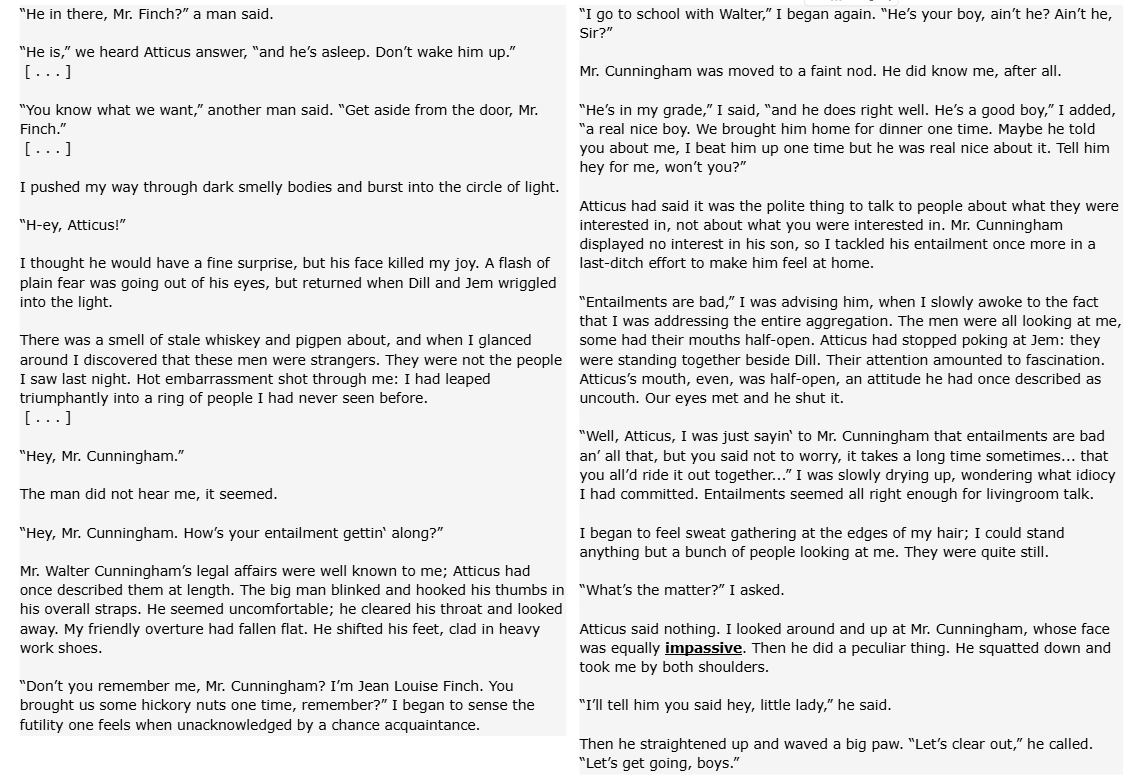
Read the following passage. In this excerpt, a violent mob arrives at the town jail to kill Tom Robinson. Tom's lawyer, Atticus Finch, stands in the mob's way. Scout, Atticus's daughter and the novel's narrator, watches nearby as the scene begins.
Which of the following describes Scout's behavior toward Mr. Cunningham?
“He in there, Mr. Finch?” a man said.
“He is,” we heard Atticus answer, “and he’s asleep. Don’t wake him up.”
[ . . . ]
“You know what we want,” another man said. “Get aside from the door, Mr. Finch.”
[ . . . ]
I pushed my way through dark smelly bodies and burst into the circle of light.
“H-ey, Atticus!”
There was a smell of stale whiskey and pigpen about, and when I glanced around I discovered that these men were strangers. They were not the people I saw last night. Hot embarrassment shot through me: I had leaped triumphantly into a ring of people I had never seen before.
[ . . . ]
“Hey, Mr. Cunningham.”
The man did not hear me, it seemed.
“Hey, Mr. Cunningham. How’s your entailment gettin‘ along?”
Mr. Walter Cunningham’s legal affairs were well known to me; Atticus had once described them at length. The big man blinked and hooked his thumbs in his overall straps. He seemed uncomfortable; he cleared his throat and looked away.
“Don’t you remember me, Mr. Cunningham? I’m Jean Louise Finch. You brought us some hickory nuts one time, remember?” I began to sense the futility one feels when unacknowledged by a chance acquaintance.
Mr. Cunningham was moved to a faint nod. He did know me, after all.
“He’s in my grade,” I said, “and he does right well. He’s a good boy,” I added, “a real nice boy. We brought him home for dinner one time. Maybe he told you about me, I beat him up one time but he was real nice about it. Tell him hey for me, won’t you?”
Atticus had said it was the polite thing to talk to people about what they were interested in, not about what you were interested in.
“Entailments are bad,” I was advising him, when I slowly awoke to the fact that I was addressing the entire aggregation. The men were all looking at me, some had their mouths half-open. Atticus had stopped poking at Jem: they were standing together beside Dill. Their attention amounted to fascination. Atticus’s mouth, even, was half-open, an attitude he had once described as uncouth. Our eyes met and he shut it.
“Well, Atticus, I was just sayin‘ to Mr. Cunningham that entailments are bad an’ all that, but you said not to worry, it takes a long time sometimes... that you all’d ride it out together...” I was slowly drying up, wondering what idiocy I had committed. Entailments seemed all right enough for livingroom talk.
“What’s the matter?” I asked.
Atticus said nothing. I looked around and up at Mr. Cunningham, whose face was equally impassive. Then he did a peculiar thing. He squatted down and took me by both shoulders.
“I’ll tell him you said hey, little lady,” he said.
Then he straightened up and waved a big paw.
“Let’s clear out,” he called. “Let’s get going, boys.”
Look at the word that is bolded and underlined. What is the meaning of impassive as it is used in the passage?
How does Scout's behavior change the nature of the confrontation between Atticus and the men threatening his client?
What does Atticus's behavior in the passage suggest?
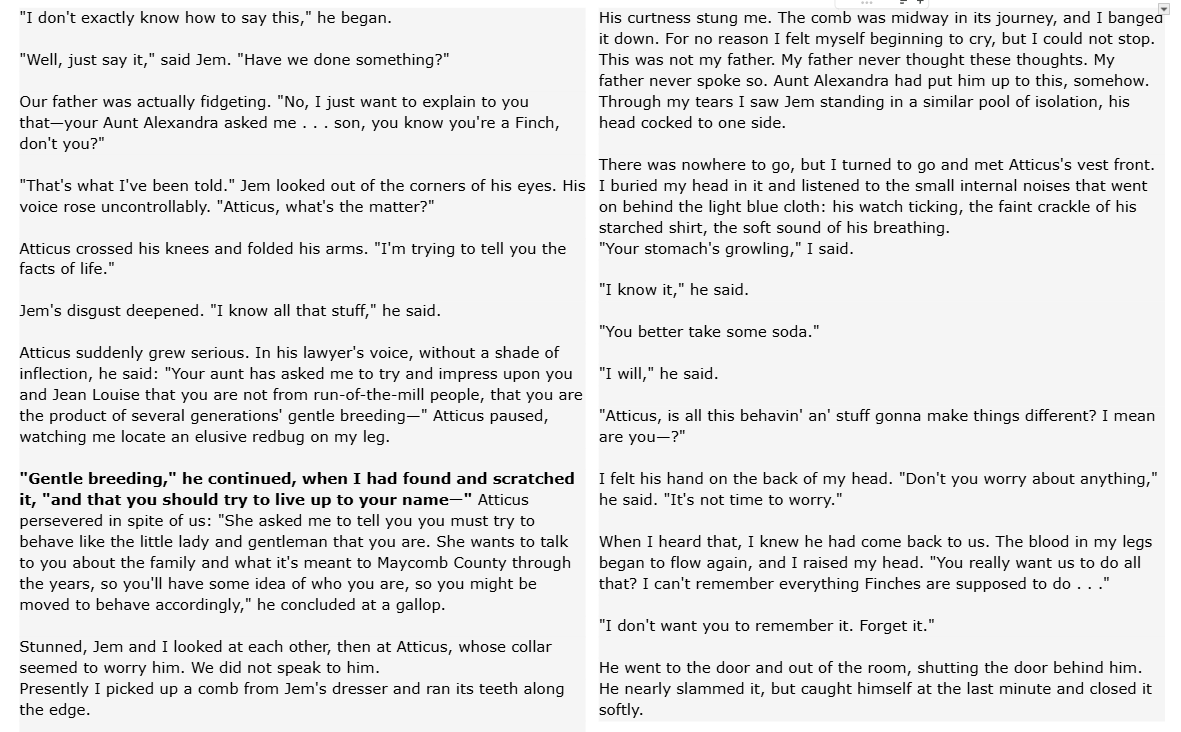
Which of the following opinions would Aunt Alexandra most likely agree with?
Look at the text that is bolded. Why does the author most likely include this detail in the middle of Atticus's attempt to lecture Scout?
Which of the following most likely describes Atticus's usual attitude toward his children's behavior?
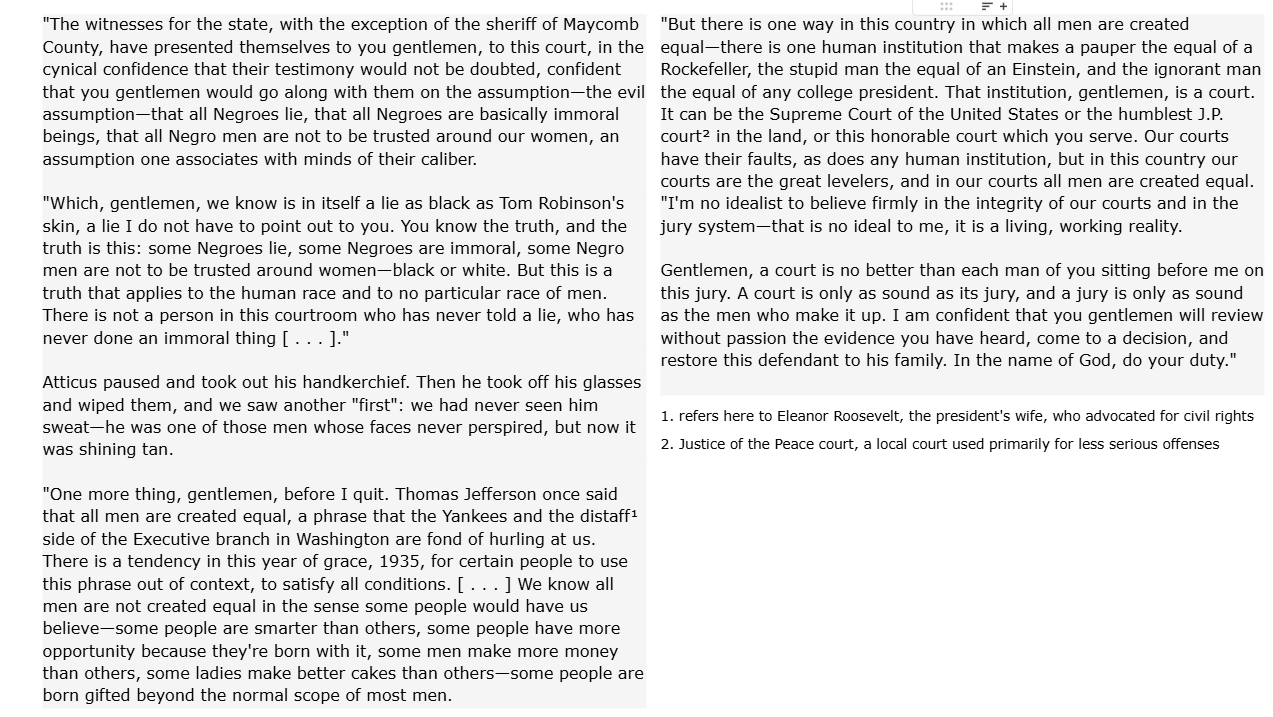
In this excerpt, Scout watches Atticus make his closing statement at the end of Tom Robinson's trial. Atticus had just recapped the lack of evidence against Tom to the jury, which is made up of white men.
According to Atticus, why are the witnesses testifying against his client so confident?
What tactic does Atticus use when he tries to convince the jury that Tom is innocent?
What is the most likely reason why Atticus claims that everyone in the courtroom has told a lie and behaved immorally at some point in their lives?
Which of the following best describes Atticus's characterization of the American justice system?
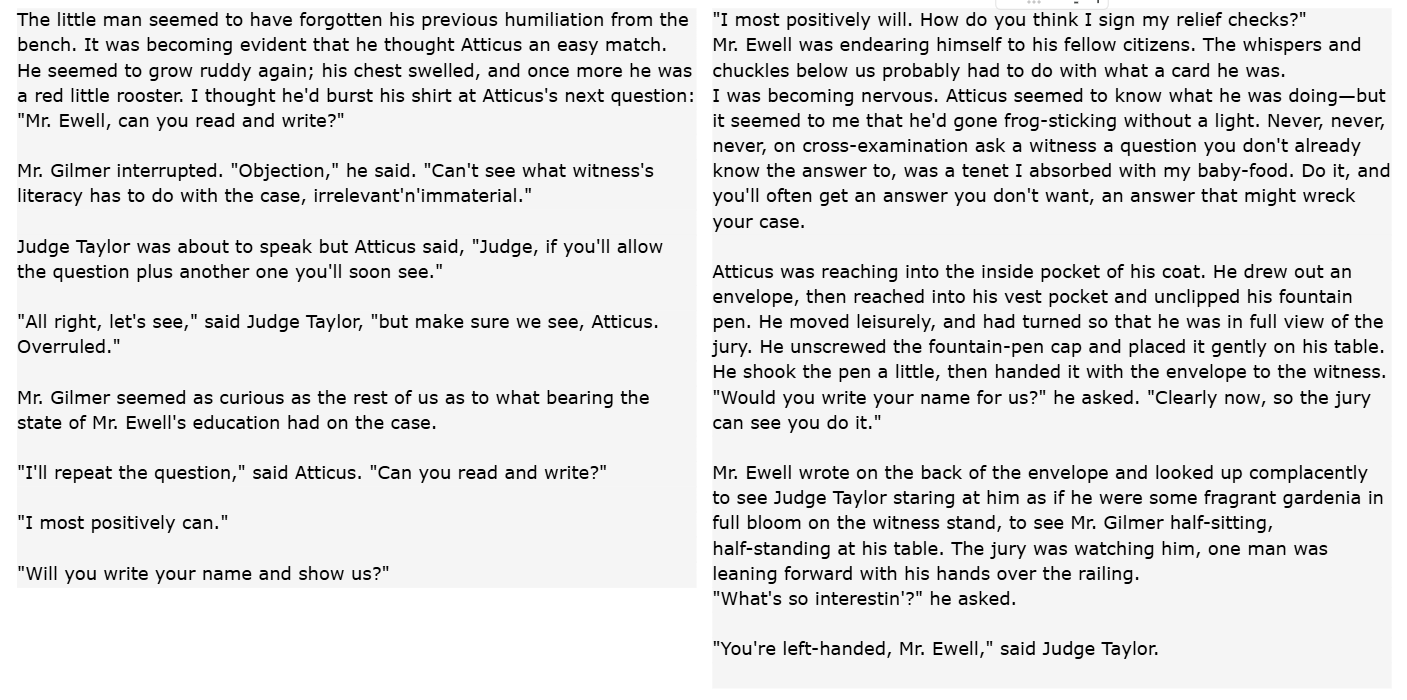
In this excerpt, Scout is watching Atticus interrogate a witness.
How does Scout portray Mr. Ewell in this passage?
Why does Scout feel nervous as she watches the trial?
Based on the passage, which statement would Atticus most likely agree with?
What does the ending of this scene suggest?
There are few legal cases in U.S. history that have received as much media attention as the trials of the nine Scottsboro Boys in 1931. The trials of the African American teenagers went on for decades and began to carve out a path for racial equality in the U.S. justice system.
On the morning of March 25, 1931, nine young black men rode illegally in the back of a freight train chugging across Alabama. Charlie Weems, Ozie Powell, Clarence Norris, Olen Montgomery, Willie Roberson, Haywood Patterson, Eugene Williams, and brothers Andrew and Leroy Wright were all unemployed, travelling to a new destination to look for work. The oldest was 19, and the youngest only 13.
During the journey, a fight broke out between the nine young men and some white men who had also jumped onto the freight car. The train had to stop in Scottsboro, Alabama to end the fight, and the white men went to the local authorities to accuse the black youths of assault. As it turned out, two white women had also been hiding in the train car. They falsely claimed the nine black teenagers had raped them.
The accusation was inflammatory in the Jim-Crow South. News of the alleged crime spread rapidly across the county; later that same day, the Jackson County Sentinel condemned the “revolting crime.” Whites in Scottsboro were so upset that a mob gathered outside the jail where the boys were held, and the Alabama Army National Guard had to step in to control the crowd.
The trial was held in Scottsboro just two weeks after the arrests, and an all-white jury quickly recommended the death penalty for eight of the nine boys, all except 13-year-old Leroy Wright. The judge scheduled the executions for mid-July, the earliest the law would allow.
News of the ruling and severe sentences travelled around the country, and after a demonstration in New York, the Communist Party USA decided to get involved to try to stop the executions. Their legal division convinced the boys’ parents to request new trials and launched detailed investigations into the rape accusations. The stir was enough to delay the boys’ execution date until the case could be appealed to the Alabama Supreme Court.
Meanwhile, the Communist Party USA brought continuous media attention to the details of the case. They hoped to use the baseless accusations and the extreme punishments to shine a light on blatantly unjust legal practices in the South. The Scottsboro Boys became symbols of racial inequality and the need for change.
The Alabama Supreme Court upheld the original convictions, but the boys and their legal counsel brought the case to an even higher court, the U.S. Supreme Court. In the landmark case, Powell v. Alabama, the justices determined that the boys had not received access to competent legal counsel — thus, their Fourteenth Amendment rights had been violated, and they would have the right to start new trials.
Even though they had new hope for freedom now, the retrial process was slow and contentious, despite overwhelming evidence of the boys’ innocence. One of the strongest pieces of evidence came from an accuser herself. In early 1932, a letter surfaced from one of the accusers, Ruby Bates. In it, she admitted that her rape claim was a sham: “[It] is a lie about those negroes jassing me... Those negroes did not touch me or those white boys.” She blamed the Scottsboro police for coercing her into the original accusation. She further admitted, “I know it was wrong to let those Negroes die on account of me.”
Still, the retrial process dragged on. In 1933, one of the boys, Haywood Patterson, stood retrial in the courtroom of one Judge James Horton. His defense attorney called numerous witnesses and built a strong argument that the two girls on the train had lied. Their story did not match medical evidence or the stories of other witnesses, and he even got Ruby Bates to testify that the whole story had been made up. The defense seemed inarguable. And yet, after only a few minutes of deliberation, the jury pronounced Patterson guilty and recommended execution.
Judge James Horton knew he had to step in. In an unprecedented move, he reversed the jury’s decision and mandated that the trial restart yet again. His courage cost him his judgeship in the next election.
Patterson was not the only one of the Scottsboro Boys to experience stubborn juries in the face of convincing evidence. When another all-white jury convicted Clarence Norris in his retrial, he appealed to the Supreme Court. The 1935 Norris v. Alabama case determined that it was unconstitutional to exclude African Americans from serving on juries for African American defendants. Alabama’s jury selection process was inherently racially skewed and violated Norris’ fourteenth amendment right.
The legal proceedings continued for several years. A few of the young men managed to get acquitted. By 1938, five of the Scottsboro Boys remained in Alabama prisons. Their sentences had been reduced from the death penalty to decades in jail, a small but significant victory. Over the next 12 years, the remaining five also made it out of the prison system, usually by receiving parole. Haywood Patterson, however, accomplished an impressive escape in 1948.
Years later, in 2013, the Alabama Board of Pardons and Paroles granted posthumous pardons to three of the Scottsboro Boys who never had their convictions overturned: Charlie Weems, Andrew Wright, and Haywood Patterson.
The Scottsboro incident was one of the earliest signs of the need for racial justice in the U.S. It garnered media attention for several years, and racial equality groups such as the Communist Party USA and the National Association for the Advancement of Colored People (NAACP) capitalized on the cases to win support for their cause.
If the Scottsboro Boys’ story sounds familiar, it might be because the saga partially inspired two famous novels: Richard Wright’s Native Son and Harper Lee’s To Kill a Mockingbird. Lee’s novel in particular has some key similarities: in it, a black man is accused of raping a white woman, and the book’s protagonist is six years old, about the same age as Lee during the first Scottsboro trials. One reason the Scottsboro Boys appear repeatedly in literature and pop culture is because their story clearly demonstrates the importance of racial equality and freedom.
PART A: Which statement best identifies the central idea of the text?
PART B: Which quote from the text best supports the answer to Part A?
PART A: What is the meaning of the word "inflammatory" used in paragraph 4?
PART B: Which detail from the text best supports the answer to Part A?