The Acorn Woodpecker
star
star
star
star
star
Last updated 16 days ago
10 Nsɛmmisa
1 In the hills of the southeastern United States, it is not uncommon to see an unusual sight—trees or telephone poles filled with tiny holes. And it’s not just a few holes, but thousands of them. Inside the holes are . . . acorns! These holes represent the food storage area for an acorn woodpecker. Another name for such a food storage area is granary. A granary is similar to a pantry or cupboard for people. An acorn granary can have up to 50,000 holes! Each hole is filled with an acorn that can be brought back at a later date for a meal.
What Do Acorn Woodpeckers Look Like?
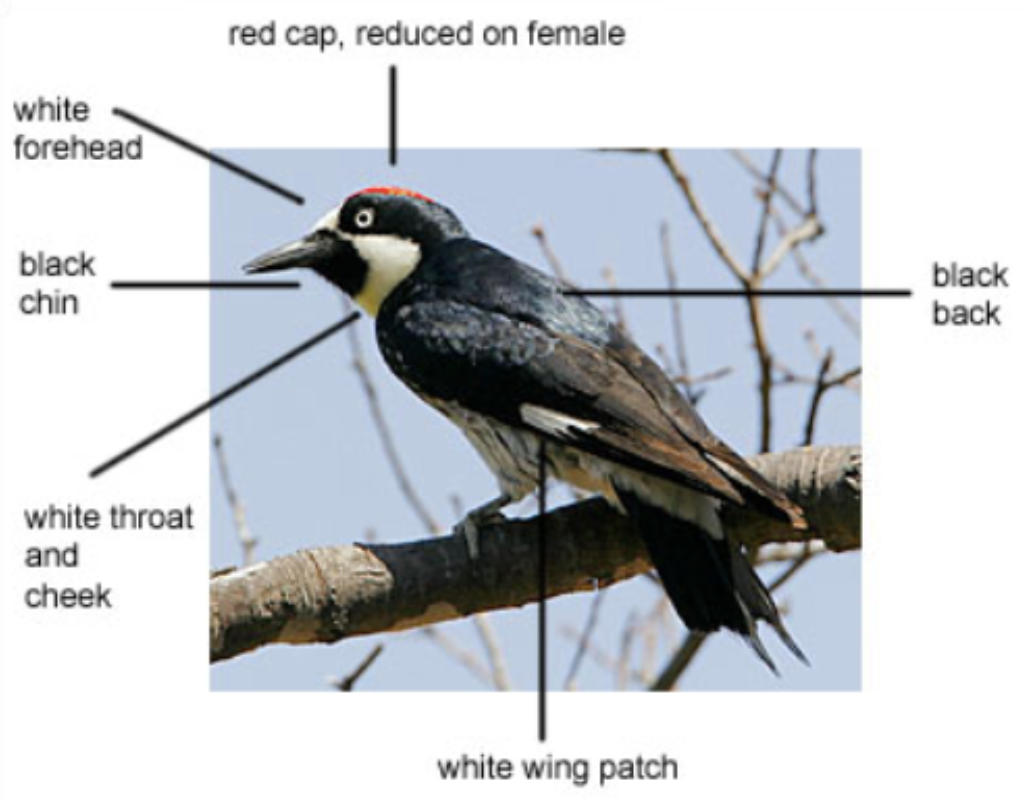
2 A female adult acorn woodpecker has a crown that is black and red. The male is a little different. Its crown is solid red. Both males and females have white eyes and a white forehead, throat, and belly. Their tail feathers are a striking black, and they have white wing patches. When the acorn woodpecker flies, thin white edges of a circle can be seen on the wings. The white and black pattern around its eyes and beak make the bird almost look as if it were wearing clown makeup.
How Do Acorn Woodpeckers Behave in the Wild?
3 One of the most interesting things about this bird is how it gathers acorns and stores them in a granary. Granaries can be built into any wooden structure. Some examples are fence posts, utility poles, and buildings. The bird drills a hole with its beak in one of these structures. Then it places an acorn in that hole. The acorn soon becomes smaller in size as it dries out. Then the bird moves the dried-out acorn to a smaller hole in the granary. An entire family or flock will guard its granary food store against invaders. Other types of birds would see this as an easy and delicious meal.
What Do Acorn Woodpeckers Eat?
4 True to its name, the acorn woodpecker enjoys . . . you guessed it, acorns. An acorn woodpecker can get over fifty percent of its diet from acorns! Though that is a large percentage, they also enjoy insects, sap, seeds, and flower nectar. For a tasty treat, they like to drill holes in fruit. These birds are generous with their food and will share with their family, but not with other birds.
What Are Acorn Woodpecker Families Like?
5 One of the more unusual habits of the acorn woodpecker is that it doesn't "leave the nest," in the way that other birds do. Acorn woodpeckers are social in a family-group way. They stay with their parents for many years. They even help their parents raise more young. Most like to live in extended family groups, and all share the task of storing and making carefully tended holes for their acorns. They build their nests in live or dead trees or tree limbs, and family members can reuse nests for years.
6 The acorn woodpecker’s process of gathering and storing food makes it most unusual. Not many animals are capable of creating such complex food storage systems! The acorn woodpecker is truly a unique member of the animal kingdom.
Part A
Which of these is closest in meaning to the word “invaders” in paragraph 3?
Part B
Which phrase from the passage best supports the answer to part A?
Read these sentences from the passage.
A female adult acorn woodpecker has a crown that is black and red. The male is a little different. Its crown is solid red. Both males and females have white eyes and a white forehead, throat, and belly.
Which of the following describes the text structure of these sentences?
Which two details best support the author’s point that acorn woodpeckers are SOCIAL birds?
Which statement is best supported by details in paragraph 4?
What new information can the reader get from looking at the diagram that follows the passage?
Part A: What point does the author make about acorn woodpeckers in the text?
Part B
Which quotation from paragraphs 4-5 provides support for the answer in Part A?
According to paragraph 1, what region of the United States can the Acorn Woodpecker be found?
According to the text, what is a granary? Give your answer as an ACE response. You will be graded based on the writing rubric.
(If you score a perfect score, you are eligible for 2 bonus points!)