Log in
Sign up for FREE
arrow_back
Library

Hunting for Main Ideas!

star
star
star
star
star
Last updated about 1 year ago
12 questions
Required
1
Required
1
Required
1
Required
1
Required
1
Read closely to determine what the text says explicitly and to make logical inferences from it; cite specific textual evidence when writing or speaking to support conclusions drawn from the text.
Required
1
Required
1
Required
1
Required
1
Required
1
Required
1
Required
1
1. Compared with the fourteen-thousand-foot peaks of the Rockies, Mt. Washington in New Hampshire may seem relatively small at 6, 288 feet high. However, the top of Mt. Washington has unbelievably treacherous weather can change from a sunny to a stormy day-- often with fierce gales. No wonder the building on this mountain top is chained to the ground.
Question 9
9.

3. Trees use and give off a surprising amount of water. The water is taken in by the roots and released by the leaves. It has been estimated that eighty gallons of water a day may evaporate from the average tree. A white oak tree will give off 150 gallons of moisture in a single day during hot weather. A large oak tree will give off 28,000 gallons of water during one growing season.
Question 10
10.

4. The North Pole is not the world’ coldest region. Northeastern Siberia, over one thousand miles south of the North Pole, is the coldest place on earth. Temperatures as low as eighty degrees below zero Fahrenheit (-62.2 Celsius) have often been recorded. Oddly enough, you would seldom catch a cold in the world’s coldest region. Most germs cannot live in such extreme cold!
Question 11
11.

5. The mystery of how salmon can find their way back to their home rivers is solved. A salmon navigates by sun and stars when traveling in the ocean. When the salmon nears the general area of the river in which it was born, it used its nove. The salmon can remember the small of the home river that it left as a baby.
Question 12
12.

Question 1
1.

Name a person this article focuses on.

Question 2
2.

What issue does this article focus on?

Question 3
3.

Question 4
4.

Question 5
5.

Question 6
6.

Question 7
7.

Question 8
8.

The paragraph tells mainly--
A Why people climb to the top of Mt. Washington.
B Why Mt. Washington is smaller than the Rockies.
C Why the weather can change so fast at the top of Mt. Washington.
D Why the top of Mt. Washington is treacherous.
The paragraph tells mainly--
A How much water trees give off.
B How trees give off water.
C What trees give off the least water.
D How trees take in water.
The paragraph tells mainly--
A How cold it gets.
B Why people don’t catch cold.
C What the coldest region is like.
D What the North Pole is like.
The paragraph tells mainly--
A What a mystery is.
B How far salmon travel.
C What salmon remember.
D How salmon find their way home.
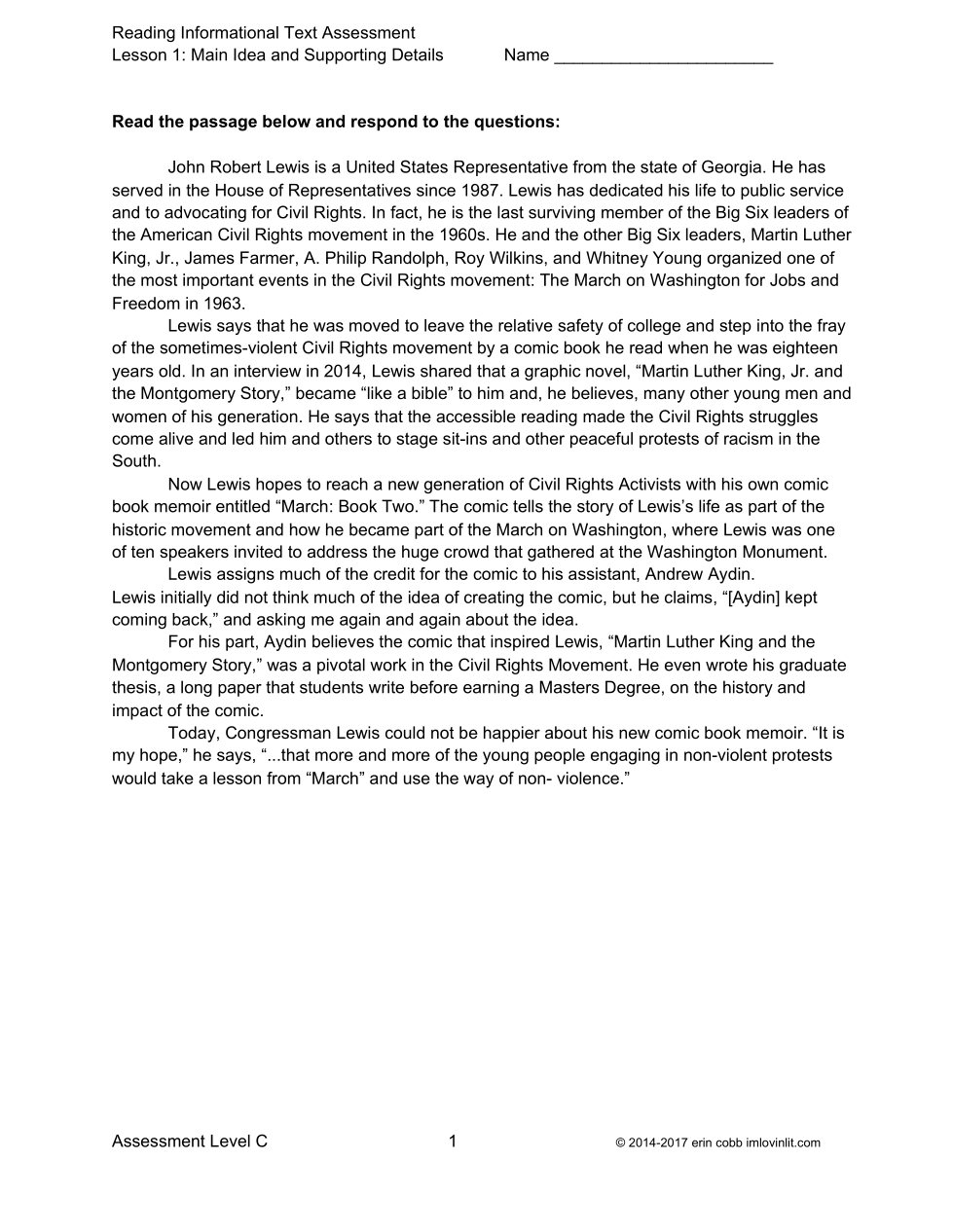
What is the topic of this passage?
A John Robert Lewis's life story
B The Civil Rights Movement
C A new comic book memoir
Sentence 4 is the topic sentence for that paragraph.
True
False
Sentence 5 is the topic sentence of that paragraph.
True
False
Sentence 6 is the topic sentence of that paragraph.
True
False
Which of the details would support the idea that comics can be important literature?
A "Today, Congressman Lewis could not be happier about his new comic book memoir."
B "'Martin Luther King and the Montgomery Story', was a pivotal work in the Civil Rights Movement."
C "The comic tells the story of Lewis's life as part of the historic movement, and how he became part of the March on Washington, where Lewis was one of then speakers invited to address the huge crowd that gathered at the Washington Monument."
Which of these details does not support the main idea of this passage?
A "Lewis says the he was moved to leave the relative safety of college and step into the fray of the sometimes-violent Civil Rights movement by a comic book he read when he was eighteen years old."
B "He even wrote his graduate thesis, which is a long paper that students write before earning a MAsters Degree, on the history and impact of the comic."
C "Lewis has dedicated his life to public service and to advocating for Civil Rights. In fact, he is the last surviving member ofthe Big Siz leaders of the American Civil Rights movement in the 1960s."
D