Do you think being successful means being debt-free? Why or why not?
EDPUZZLE: Is There Such a Thing as Good Debt? đź“·10 min
Debt is personal and people’s opinions on debt range widely. Is debt the pathway to building wealth? Or is it a trap keeping you from wealth? Watch this video and follow your teacher's directions to answer the questions either in your student activity packet or within the EdPuzzle itself.
1 point
1
Question 2
2.
Good debts are incurred for things that are expected to…
1 point
1
Question 3
3.
Summarize: What is the difference between how Robert Kiyosaki and Dave Ramsey approach debt?
1 point
1
Question 4
4.
How does buying something with debt tend to impact people's spending, compared to buying with cash?
2 points
2
Question 5
5.
According to the video, what TWO questions should you ask yourself when making decisions about debt?
INFOGRAPHIC: What’s My Net Worth? 📷7 min
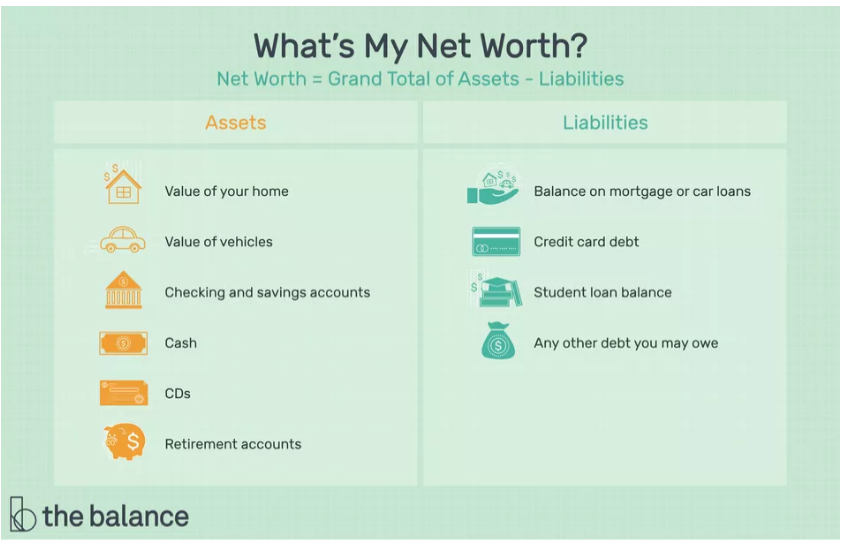
In the previous resource, you learned about how good debts and bad debts impact your wealth. One way to measure wealth is called net worth. Study the infographic to learn how to calculate your net worth. Then, answer the questions.
1 point
1
Question 6
6.
An asset is a resource that someone owns that has value, like furniture or a house that could be sold for money. How could debt help you build your assets?
1 point
1
Question 7
7.
Sakura owns her home, worth $411,000, and car, worth $14,000. She has $10,000 in student loans and owes $115,000 on her mortgage. Using the formula provided, calculate her net worth.
Assetts-Liabilities=Net Worth
_______
7 points
7
Question 8
8.
Complete the table by deciding if each of the following debts will most likely increase the person’s net worth. Yes if it increases net worth, NO if it does not increase net worth, and Depends if other factors impact the increase or decrease of debt.
Elijah takes out a mortgage to buy a house that he expects to re-sell at a higher price in 20 years__________
Liam takes out an auto loan to buy a new luxury car that will decrease in value after he leaves the car dealership__________
Sophia takes out an auto loan with affordable monthly payments to buy a reliable used car for her commute to work__________
Mei takes out a personal loan to pay for a weeklong vacation__________
Ahmed takes out a business loan to start his small business bakery__________
Carlos takes out a personal loan to buy a new television__________
Aisha takes out a student loan to attend a 4-year college__________
VIDEO:Buy, Borrow, Die: How America's Ultrawealthy Stay That Way đź“·5 min
Debt is a key part of wealth building for one particular group of Americans. Watch the video to learn how the wealthy use debt. Then, answer the questions.
3 points
3
Question 9
9.
In your own words, define each step of the “buy, borrow, die” strategy
Buy:_______
Borrow:_______
Die:_______
1 point
1
Question 10
10.
How does the “buy, borrow, die” strategy help the wealthy maintain and accumulate wealth?
1 point
1
Question 11
11.
Why does this strategy primarily work for people who are already wealthy?
Teacher Tip: Please note that the disruption of some agencies, like the CFPB, may impact this worksheet. (Feb 11, 2025)
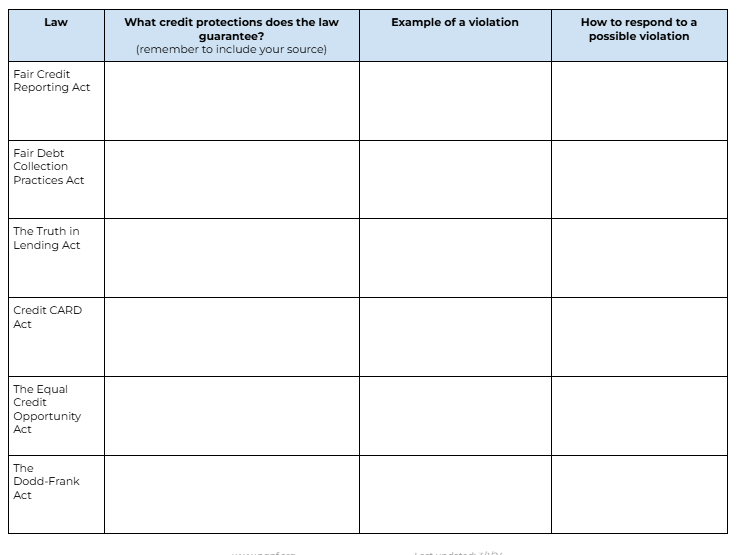
Credit is a part of our lives and the decisions you make with credit have a big financial impact. So what protections do you have as a borrower? In this activity, you’ll become the expert on one specific credit protection law, and then share what you learned with your classmates.
Part I: Research Credit Protections
It’s time to dive in! Use the internet to research your specific credit protection law. Remember to use credible sources and cite them as you complete this section of the activity. To get started, consider searching on sites for government agencies, like the FTC, the CFPB, the OCC, or on reputable finance websites, like Investopedia or Nerdwallet.
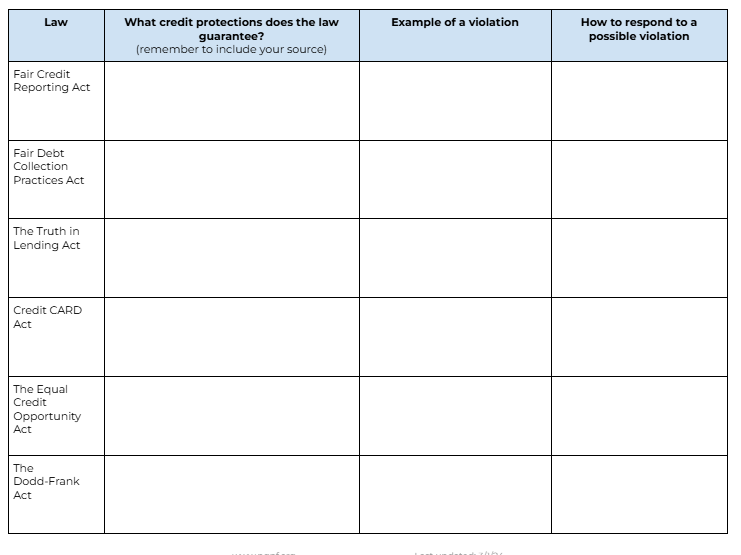
Complete the chart on the following table for your assigned law.
Fair Credit Reporting Act
Fair Debt Collection Practices Act
The Truth in Lending Act
Credit CARD Act
The Equal Credit Opportunity Act
The Dodd-Frank Act
Follow your teachers’ instructions to share what you learned. As your classmates share, complete the remainder of the chart.
1 point
1
Question 12
12.
This is a copy of the chart you will fill out on google docs.
I filled in this chart. If I do not have a copy I will ask Mrs. Pariseau for a copy.
4 points
4
Question 13
13.
Choose one of the credit protections described above. Why is it important?
4 points
4
Question 14
14.
These laws largely work by allowing borrowers to file a report or lawsuit in response to violations. Do you think that is enough to prevent unfair credit practices? Why or why not?
2 points
2
Question 15
15.
Do you think there are any important protections are missing? Why or why not
1 point
1
Question 16
16.
Which of the following is the best definition of a “bad debt”?
A debt with a low interest rate
A debt that decreases your credit score over time
A debt that decreases your net worth over time
A debt that is used to buy something that increases in value over time
1 point
1
Question 17
17.
Which equation best defines net worth?
4 points
4
Question 18
18.
All of the following are true about access to credit in the United States, EXCEPT…
Access to credit can make it easier to build wealth__________
Access to credit is equal across race and income level__________
There are laws against credit discrimination based on characteristics including race, age, and gender__________
There are laws requiring lenders to offer accurate credit information, like the interest rate and total cost of a loan__________