Lesson 10.9 Flat vs Fizzy Soda
star
star
star
star
star
Last updated 4 months ago
40 Nsɛmmisa
Ɛhia
1
Ɛhia
1
Ɛhia
1
Ɛhia
5
Ɛhia
1
Ɛhia
5
Ɛhia
5
Introduction
How far down?
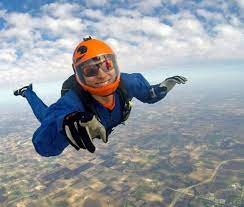
There are people who enjoy going up in an airplane, strapping on a parachute, and diving out the door to free-fall and then open the chute and drop to the ground. This stressful activity (so they say) relieves the stress of everyday life. The release of adrenaline caused by this stressful behavior is said to promote a mood enhancement that helps you deal better with other stresses in your daily life.
Chemical equilibrium was studied by French chemist Henri Le Châtelier (1850-1936) and his description of how a system responds to a stress to equilibrium has become known as Le Châtelier’s principle. Le Châtelier observed that when a chemical system that is at equilibrium is disturbed by a stress, the system will respond in order to relieve the stress and restore the equilibrium. A stress is anything that can change either the rate of the forward reaction or the backward reaction. It could be addition of a chemical or a change in temperature for example.
Stresses to a chemical system involve changes in the concentration of reactants or products, changes in the temperature of the system, or changes in the pressure of the system. We will discuss each of these stresses separately. The change to the equilibrium position in every case is either a favoring of the forward reaction or a favoring of the reverse reaction. When the forward reaction is favored, the concentrations of products increases, while the concentrations of reactants decreases. When the reverse reaction is favored, the concentrations of products decreases, while the concentrations of reactants increases.
Original Equilibrium Favored Reaction Result
A⇄B forward: A→B [A] decreases; [B] increases
A⇄B reverse: A←B [A] increases; [B] decreases
In this activity, we will use a simulation to use LeChatelier's Principle to analyze what happens to chemical reactions in a bottle of soda when the temperature of the bottle changes or the bottle is heated up.
Before you start make these there predictions.
What happens to the amount of gas bubbles in a soda bottle when it is opened?
What happens to the amount of gas bubbles in soda when it warms up?
What happens to the amount of gas bubbles if you squeeze a soda bottle?
Investigate
To see the Le Châtelier's principle in action use the link below to open the Flat vs Fizzy Soda simulation.
https://interactives.ck12.org/simulations/chemistry/le-chateliers-principle/app/index.html
If the link doesn't work google " Flat vs Fizzy Soda CK-12 Simulation"
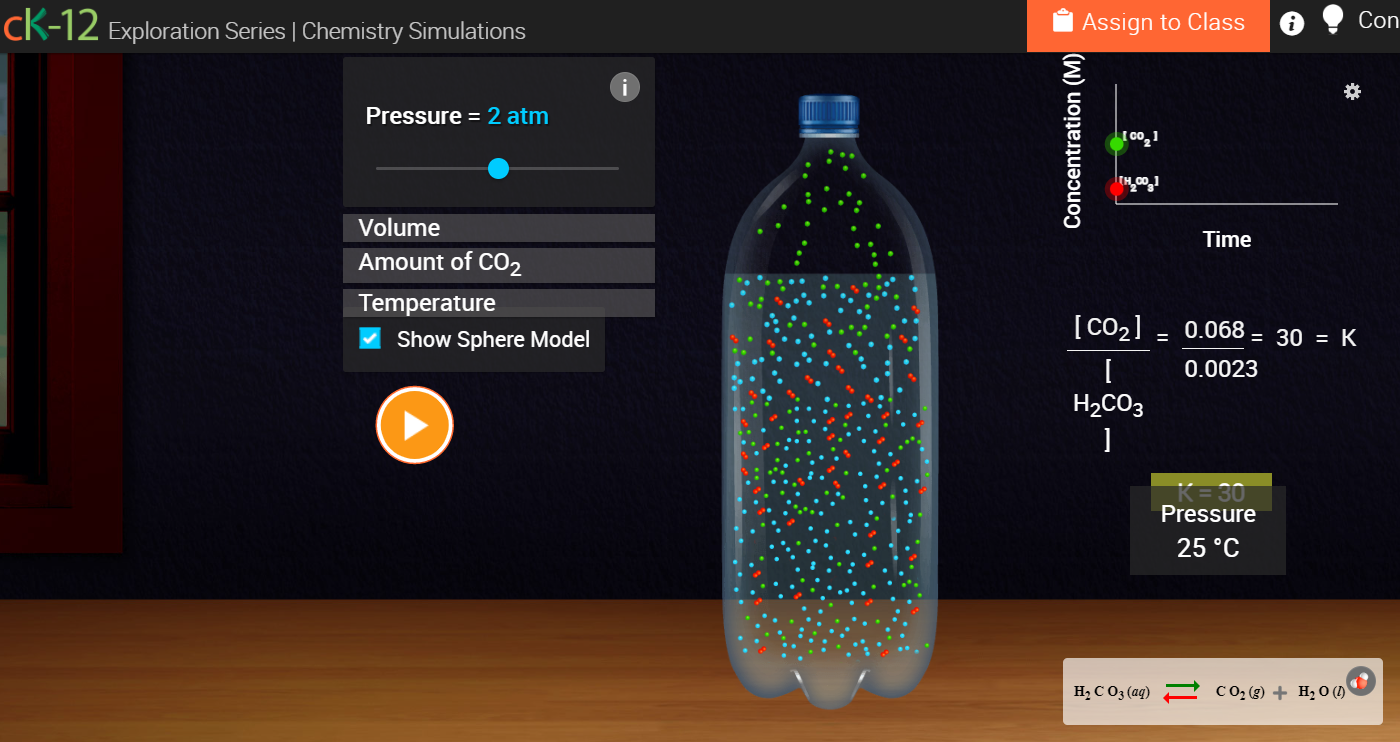
Use the link attached to the TEAMS assignment or the link above to open the simulation. It should look like this. Click on the arrow head in the soda bottle to get started with the introductory video.
What is the chemical reaction that creates the bubbles in soda? Describe the behavior of the reactants. Which one makes the bubbles? Where can they be found inside the bottle?
Where does the chemical reaction take place?
In this chemical system, the concentration of the carbonic acid [H₂CO₃] and the carbon dioxide [CO₂] have a mathematical relationship. For the carbonic acid-carbon dioxide system at each temperature, the ratio of CO₂ to H₂CO₃ is always a constant number. This ratio is called an equilibrium constant. In all reversible reactions, the concentrations of the reactants and the products are related by a mathematical equation that determines a unique number. This number is called the equilibrium constant. The equation for the carbonic acid-carbon dioxide reaction is
Just to be clear this relationship is for the molecules that are dissolved in the water. The CO₂ in the air pocket at the top of the bottle is not part of the equation.
FYI: The forward reaction is carbonic acid making carbon dioxide and water.
The backward reaction is carbon dioxide and water combining to make carbon dioxide.
What happens when you change the pressure?
Your starting pressure should be 2 atm. Don't change any of the settings until instructed in the questions.
In your own words, use the concepts of equilibrium and stress to explain why soda goes flat when you open the bottle. For the most points, you should be using the chemical equation and LeChatelier's principle in your answer.
A possible strategy to temporarily slow the rate at which an open bottle of soda goes flat would be to
What happens when change the amount CO₂ in the liquid?
Soda manufacturers often add phosphoric acid to help the soda maintain a pH at which it is more difficult for carbonic acid to form effectively lowering its concentration. Does adding phosphoric acid make the soda more or less fizzy? Be sure that you are using your observations from the simulation to explain your answer.
What happens when you change the temperature?
How does LeChatelier's Principle explain why soda poured on ice has a different taste than warm soda? Be sure that you are using the vocabulary terms equilibrium, stress and you identify which reaction whose rate changes.
Why can we assume that the amount of water in the bottle doesn't change?
Record the starting concentration of the carbon dioxide and the carbonic acid.
Change the slider to 1 atm and then hit the orange arrow head. Paste in a snip or make a drawing of the graph created by applying the stress.
Record the final concentrations of the carbon dioxide and the carbonic acid
What was the stress in the system? Be specific. Explain what is happening to the numbers of molecules.
How did the system respond to restore the equilibrium? Be specific. Explain what is happening to number of molecules.
Did the rate of the forward or the backward change? Explain how you decided which rate changed?
Change the slider to 2.5 atm and then hit the orange arrow head. Paste in a snip or make a drawing of the graph created by applying the stress.
Record the final concentration of the carbon dioxide and the carbonic acid
What was the stress in the system? Be specific explain what is happening with the molecules.
How did the system respond to restore the equilibrium? Be specific explain what happened to the number of molecules.
Did the rate of the forward or the backward change? Explain how you decided which rate changed?
Before you start:
Set the pressure to 2 atm.
Set the concentration of CO₂ to 0.017M.
Hit the yellow arrow head to start the simulation.
Paste in a snip or make a drawing of the graph created by applying the stress.
Record the final concentration of the carbon dioxide and the carbonic acid after you set the pressure to 2 atm and the CO₂ concentration to 0.017M.
What was the stress in the system? Be specific explain what is happening with the molecules
How did the system respond to restore the equilibrium? Be specific explain what happened to the number of molecules.
Set the pressure back to 2 atm and the amount of CO2 to 0.050M . Hit the yellow arrow head.
Paste in a snip or make a drawing of the graph created by applying the stress.
Record the final concentration of the carbon dioxide and the carbonic acid.
What was the stress in the system? Be specific explain what is happening with the molecules
How did the system respond to restore the equilibrium? Be specific explain what happened to the number of molecules.
Did the rate of the forward or the backward change? Explain how you decided which rate changed?
Change the temperature slider to 2°C and then hit the orange arrow head. Paste in a snip or make a drawing of the graph created by applying the stress.
Record the final concentrations of the carbon dioxide and the carbonic acid
What was the stress in the system? Be specific. Explain what is happening to the numbers of molecules.
How did the system respond to restore the equilibrium? Be specific. Explain what is happening to number of molecules.
Did the rate of the forward or the backward change? Explain how you decided which rate changed?
Change the temperature slider to 38°C and then hit the orange arrow head. Paste in a snip or make a drawing of the graph created by applying the stress.
Record the final concentration of the carbon dioxide and the carbonic acid
What was the stress in the system? Be specific explain what is happening with the molecules.
How did the system respond to restore the equilibrium? Be specific explain what happened to the number of molecules.
Did the rate of the forward or the backward change? Explain how you decided which rate changed?