Click the correct column For compounds 1-5
Click the correct column For compounds 1-5
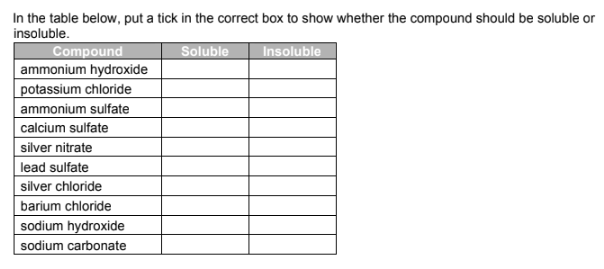
(All common sodium salts are soluble.)
(All nitrates are soluble.)
(All common ammonium salts are soluble.)
(Silver chloride is an exception to the rule that most common chlorides are soluble).
Lead sulfate is an exception to the rule that most common sulfates are soluble.
(Most common carbonates are insoluble.)
(Most common hydroxides are insoluble.)
(Sodium carbonate, potassium carbonate, and ammonium carbonate are soluble).
(Sodium hydroxide, potassium hydroxide, and ammonium hydroxide are soluble).
All common sodium salts are soluble.
Add the state symbols to the following formulae.
( ) indicates aqueous (dissolved in water)
( ) indicates solid (precipitate)
1. Lead Sulfate (PbSO₄)
Reactants: Lead(II) nitrate (Pb(NO₃)₂) and potassium sulfate (K₂SO₄)
Pb(NO₃)₂( ) + K₂SO₄ → PbSO₄( ) + 2KNO₃( )
Add the state symbols to the following formulae.
( ) indicates aqueous (dissolved in water)
( ) indicates solid (precipitate)
2. Barium Sulfate (BaSO₄)
Reactants: Barium nitrate (Ba(NO₃)₂) and potassium sulfate (K₂SO₄)
Ba(NO₃)₂(aq) + K₂SO₄(aq) → BaSO₄( ) + 2KNO₃( )
3. Calcium Sulfate (CaSO₄)
Reactants: Calcium nitrate (Ca(NO₃)₂) and potassium sulfate (K₂SO₄)
Ca(NO₃)₂(aq) + K₂SO₄(aq) → CaSO₄( ) + 2KNO₃( )
Give the steps in order to make a salt by precipitation
https://www.focuselearning.co.uk/s/1q44l3wsl0zo
a) add the solutions of the two soluble salts together
b) filter the mixture
d) wash the salt with a minimum volume of distilled water
c) collect the residue (in the filter paper)
f) scrape the pure dry salt into the sample bottle.
e) dry the salt (leave in a warm dry place or press between dry filter paper)
Click the correct column For compounds 1-5
Click the correct column for compounds 6-10
Procedure for Preparing Insoluble Salts via Precipitation:
https://www.focuselearning.co.uk/s/1q44l3wsl0zo
the soluble reactants: Dissolve each of the chosen soluble salts in separate beakers of distilled water.
: Carefully pour one solution into the other, stirring continuously. The insoluble salt will form as a precipitate.
Separate the precipitate by : Use filtration to separate the solid precipitate from the remaining solution (filtrate).
the precipitate: Wash the precipitate with distilled water to remove any remaining soluble ions.
the precipitate: Dry the precipitate by leaving it to air dry, or pressing between papers.
Now copy this into your books.
Wash
filtration
Dissolve
Mix the solutions
Dry
Procedure for Preparing Insoluble Salts via Precipitation:
https://www.focuselearning.co.uk/s/1q44l3wsl0zo
Separate the precipitate by