Learning ObjectivesStudents will be able to:
| National Standards for Personal Financial Education Managing Credit
|
Learning ObjectivesStudents will be able to:
| National Standards for Personal Financial Education Managing Credit
|
Analyze the image on the worksheet to answer the questions on this Data Crunch.
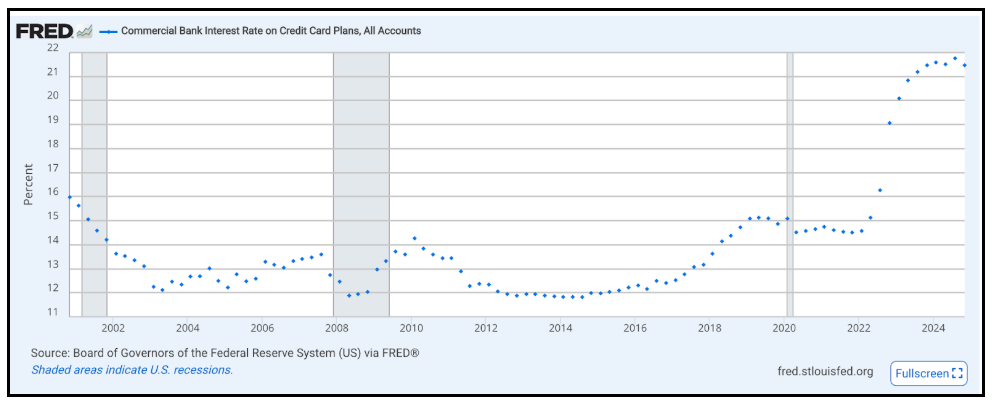
What does the graph suggest about the stability of credit card interest rates over a long period of time?
The gray bars represent periods of economic recession. What pattern, if any, can you see in how recessions affect credit card interest rates? Why do you think this is?
Hypothesize what this chart will look like for the next 10 year period. Explain why.
You can use credit cards for a wide variety of purchases. But, what happens if you spend more on your credit card than you can afford to repay? Watch this video and follow your teacher's directions to answer the questions either in your student activity packet or within the EdPuzzle itself.
Which best describes how a credit card works?
When you get a credit card bill, it might seem like you should only pay the “minimum payment due”. Find out how that could cost you and what to do instead.
Your Credit Card
Interest rate (APR): 19.9%
Minimum payment: 3% of your starting balance OR $25, whichever is higher
Home mortgages, auto loans, and student loans are all typically structured as amortized loans. While the minimum monthly payment on a credit card changes each month, the monthly payment of an installment loan is the same every month until the debt is paid off. Watch this video and follow your teacher's directions to answer the questions either in your student activity packet or within the EdPuzzle itself.
ANALYZE: Understanding Amortization
Janet just graduated college and wants one last big adventure before work starts. A 6-week trip to South America sounds perfect, but she needs to take a loan to pay for it. Her bank offers:
Loan Amount: $3,500
Annual Interest Rate: 24%
Loan Term: 2 years
What would be the benefit of taking a longer time to pay back your loan?
Would you take on debt to finance a vacation? To pay for college? To buy a used car? To buy a new car? As you watch these individuals talk about how much debt they have, think about how life circumstances, values, and decision making all impact attitudes toward debt. Then answer the questions.
On the other hand, some people at the beginning of the video had absolutely no debt whatsoever. What are some possible ways they achieve a debt-free lifestyle while others do not or cannot?
Other than credit card usage, what are some other reasons people say they are in debt? Do their reasons for carrying debt seem valid to you? Why or why not?
Throughout the video, you can tell that individuals’ FEELINGS about their debt are quite different. What might cause one person to worry about the same level of debt that someone else feels quite comfortable having?
If you buy a $1000 bicycle, which credit card payoff strategy will result in your paying the LEAST total amount?
If your credit card limit is $800 and your outstanding balance is $725, what is the largest amount you can charge on that card in the upcoming month?
Each of the following people has $5,000 in debt. Which debt is most worthwhile?
What is the advantage of paying your credit card balance in full each month?
What is an outstanding balance?
Why is it more difficult to get out of debt when only paying the minimum payment?
The video advises you to "be a deadbeat.” What does that mean?
What strategies can consumers use to reduce the interest they’ll pay on credit card debt?
These scenarios assumed a one-time balance with no additional purchases. If you also used your credit for everyday expenses, how might that affect your approach to repayment?