Ɛhia
1
Ɛhia
1
Ɛhia
1
Ɛhia
1
Match each statement with the correct agricultural revolution.
Irrigation was introduced which helped food production.
Genetically modified organisms were introduced.
Caused humans to shift away from being hunter-gatherers and settle down in one place.
Crop rotation was introduced which helped replenish soil nutrients leading to increased crop production.
Allowed farmers to cultivate crops that are more resistant to drought and disease.
Machines started doing the work at the farm instead of manual labor which resulted in a major increase of food.
First Agricultural Revolution
Second Agricultural Revolution
Green Revolution
Match the positive impact, negative impact and alternative/solutions to the correct global trade practice.
Alternative/solution: utilizing bamboo trees and recycling
Alternative/solution: crop rotation and planting a variety of plants
Negative impact: reduces oxygen supply and creates pollution
Positive impact: provides lumber and creates jobs
Negative impact: Increased risk of soil depletion and spread of diseases in crops
Positive impact: mass production of crops
Deforestation
Plantation farming
Which statements are true about water insecurity? (select all that apply)
Match each term to the correct description.
| Draggable item | arrow_right_alt | Corresponding Item |
|---|---|---|
Sustainable development | arrow_right_alt | a resource that can be replaced once it is used |
Specialization | arrow_right_alt | a resource that is hard or can't be replaced once it is used |
Renewable resource | arrow_right_alt | rising global temperatures and changing weather patterns |
Globalization | arrow_right_alt | finding a way to reach one's needs without harming future generations |
Climate change | arrow_right_alt | when a country concentrates on producing a single item and becomes an expert |
Nonrenewable resource | arrow_right_alt | the interconnectedness of the world through trade |
Which of the following best explains the impact of globalization and specialization on the environment?
When countries experience a natural disaster, they often receive assistance from other countries and international organizations. Why would countries and international organizations be interested in helping after a natural disaster?
Match the practice to the correct definition.
| Draggable item | arrow_right_alt | Corresponding Item |
|---|---|---|
Irrigation | arrow_right_alt | the purposeful clearing of forestland |
Strip mining | arrow_right_alt | pumping liquid into cracks in the earth to release oil/natural gas |
Deforestation | arrow_right_alt | removes surface layer of vegetation, soil, rock, etc. to reach minerals beneath |
Fracking | arrow_right_alt | redirecting water for agricultural use |
Which countries were most HELPED by the Green Revolution?
Match each practice with the correct impact.
| Draggable item | arrow_right_alt | Corresponding Item |
|---|---|---|
drought | arrow_right_alt | main cause for the disappearance of the Aral Sea |
burning of fossil fuels | arrow_right_alt | changes amount of water downstream, impacting the ecosystem |
irrigation | arrow_right_alt | climate change |
building of dams | arrow_right_alt | political disputes over water |
Why do many environmental problems lead to political conflict between countries? (select all that apply)
Both Japan and Haiti experienced earthquakes in the early 2000s. Why was recovery in Japan faster than in Haiti?
Which of the following are potential causes of desertification? (select all that apply)
Why has overfishing become a problem in modern times?
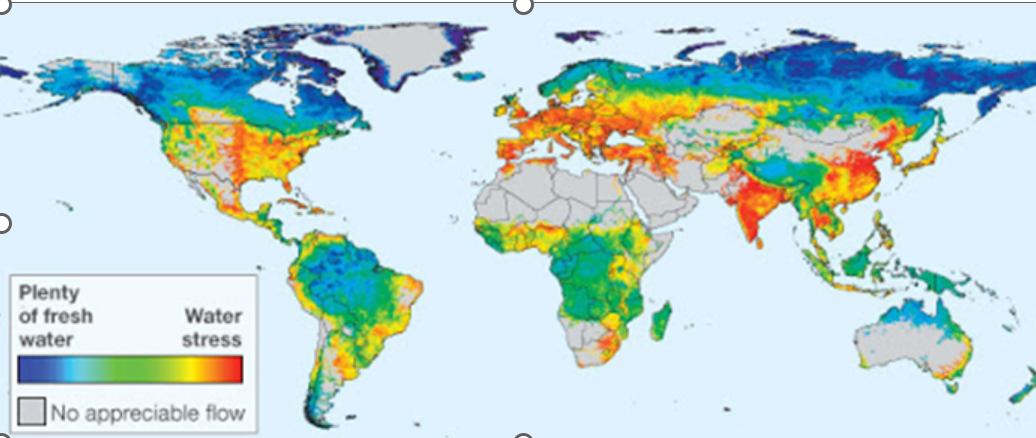
According to the map above, which pattern about water insecurity is true?
Match the advantages and disadvantages to different types of responses to environmental issues.
Disadvantage: Hard to regulate as there are so many countries involved in the process.
Disadvantage: Very costly for the government and can't always enforce regulations put in place.
Advantage: More people are working towards a common goal which can create a better response.
Advantage: Can create incentives for businesses to use alternative resources and can start clean-up processes.
Local responses to issues
International responses to issues
Which practice represents a positive step toward sustainable global trade?
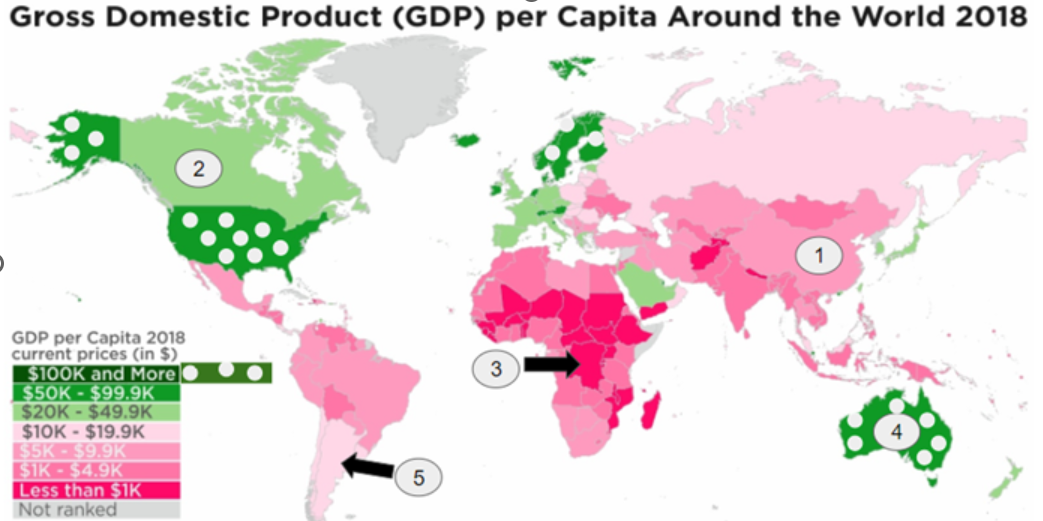
Which country would be BEST able to respond to a natural disaster based on the map above?
Which country would be MOST likely to have environmental problems from primary and secondary industries?
Which country would need the most international support to respond to natural disasters?
Which statement is most likely true about Argentina?