4.08 Handling Significant Debt
star
star
star
star
star
Last updated 2 months ago
28 questions
Note from the author:
2
You have probably heard of celebrities, companies, and everyday people “declaring bankruptcy.”
What do you think “declaring bankruptcy” means?_______
What do you think happens to the person who declares bankruptcy?_______
EDPUZZLE: How to Deal with Debt Collectors 📷13 min
Of course, you don’t want to end up in over your head with debt. But what happens if you do? If you find yourself with overdue bills or big debts, there are still steps you can take. Watch this video and follow your teacher's directions to answer the questions either in your student activity packet or within the EdPuzzle itself.
2
What typically happens when you are 30 days late on a bill? (hint: choose two correct answers)
1
At what point does a lender typically charge off your account and bring in a third-party collections agency?
1
Within 5 days of initially contacting you, debt collectors are required to send a detailed list of what the debt is and how much you owe. What is this called?
1
If you have a debt that goes into collections, your credit score __________.
1
According to the Fair Debt Collection Practices Act, a debt buyer is allowed to...
ARTICLE: Could a Credit Counselor Help Me?
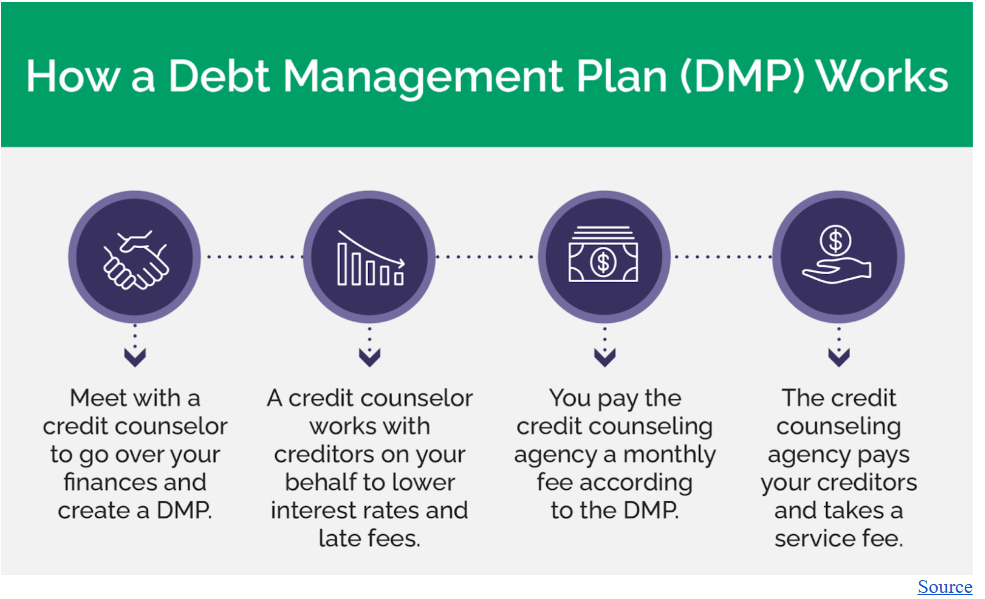
INFOGRAPHIC: How a Debt Management Plan Works 📷7 min
If you’re struggling with debt, one of the first recommendations is often to see a credit counselor. Read the article and study the infographic to learn how a credit counselor could help you manage your debt. Then, answer the questions.
1
In your own words, summarize what a credit counselor does and how they could help if you were in debt.
1
What are red flags that you should watch out for when choosing a credit counselor?
1
A credit counselor can help you set up a debt management plan (DMP). Based on the infographic, what is one advantage and one disadvantage of using a debt management plan?
VIDEO: Debt Consolidation Loans: Understanding How They Help Your Finances 📷6 min
A debt consolidation loan is similar to a debt management plan, but without the involvement of a credit counselor. It allows you to keep some lines of credit open; however, it doesn’t offer the external accountability of a debt management plan. Watch the video and answer the questions.
2
A debt consolidation loan is a type of loan that helps __________ your existing debts into a single loan with __________ monthly payment.
1
What is one potential advantage of using a debt consolidation loan?
6
Complete the blanks with criteria to determine when a debt consolidation loan is a smart move and when it’s not worth it. Debt Consolidation is.....
A smart move if:
_______ _______ _______
Not worth it if:
_______ _______ _______
ARTICLE: Should You File for Bankruptcy? 📷9 min
After trying other debt management strategies, it may be time to consider bankruptcy. Bankruptcy is a legal process that gives individuals or businesses who are overwhelmed with debt the opportunity for a fresh start. Read the article to learn how bankruptcy works and how it may affect you. Then, answer the questions.
5
Under what circumstances should you consider filing for bankruptcy?(list 5 reasons) _______ _______ _______ _______ _______
6
Determine if each of the following statements is TRUE or FALSE.
- Filing for bankruptcy stays on your credit report for at least 7 years: __________
- Filing for bankruptcy will significantly decrease your credit score: __________
- Filing for bankruptcy is free: __________
- Chapter 7 bankruptcy allows you to keep more of your personal assets than Chapter 13 bankruptcy: __________
- Filing for bankruptcy makes it easier for you to get a credit card in the short term: __________
- Filing for bankruptcy could impact your ability to get a job: __________
INFOGRAPHIC: Understanding Bankruptcy 📷4 min
The term “bankruptcy” can actually refer to a few different processes. For individuals, the two main types of bankruptcy are Chapter 7 and Chapter 13 bankruptcy. Study the infographic and answer the questions.
6
Question: Which Type of Bankruptcy…
Requires you to make debt payments over 3-5 years?__________
Is restricted to people with lower incomes?__________
Results in your assets being repossessed or sold to pay the debt?__________
Is more common?__________
Leaves your credit report sooner?__________
If you are interested in keeping your home or car but need to file for bankruptcy, which type is a better option? __________
ARTICLE: What is a Debt Relief Program and How Do I Know if I Should Use One? 📷5 min
If you’re overwhelmed by debt, you might be tempted by the promises that debt settlement companies make to solve all your debt problems. However, those claims are often too good to be true. Read the article, stopping at “Warning: There could be tax consequences for debt forgiveness.” Then, answer the questions.
What is a debt relief program and how do I know if I should use one?
Debt relief or settlement companies are companies that say they can renegotiate, settle, or in some way change the terms of a person's debt to a creditor or debt collector. Dealing with these companies can be risky.
Debt settlement companies, also sometimes called "debt relief" or "debt adjusting" companies, often claim they can negotiate with your creditors to reduce the amount you owe. Consider all of your options, including working with a nonprofit credit counselor and negotiating directly with the creditor or debt collector yourself. Before agreeing to work with a debt settlement company, there are risks that you should consider:
- Debt settlement companies often charge expensive fees.
- Debt settlement companies typically encourage you to stop paying your credit card bills. If you stop paying your bills, you will usually incur late fees, penalty interest and other charges, and creditors will likely step up their collection efforts against you.
- Some of your creditors may refuse to work with the company you choose.
- In many cases, the debt settlement company will be unable to settle all of your debts.
- If you do business with a debt settlement company, the company may tell you to put money in a dedicated bank account, which will be managed by a third party. You might be charged fees for using this account.
- Working with a debt settlement company may lead to a creditor filing a debt collection lawsuit against you.
- Unless the debt settlement company settles all or most of your debts, the built-up penalties and fees on the unsettled debts may wipe out any savings the debt settlement company achieves on the debts it settles.
- Using debt settlement services can have a negative impact on your credit scores and your ability to get credit in the future.
Warning: Debt settlement may well leave you deeper in debt than you were when you started. Most debt settlement companies will ask you to stop paying your debts in order to get creditors to negotiate and in order to collect the funds required for a settlement. This can have a negative effect on your credit score and may result in the creditor or debt collector filing a lawsuit while you are collecting funds required for a settlement. And if you stop making payments on a credit card, late fees and interest will be added to the debt each month. If you exceed your credit limit, additional fees and charges may apply. This can cause your original debt to increase.
Avoid doing business with any company that promises to settle your debt if the company:
- Charges any fees before it settles your debts;
- Represents that it can settle all of your debt for a promised percentage reduction;
- Touts a "new government program" to bail out personal credit card debt;
- Guarantees it can make your debt go away;
- Tells you to stop communicating with your creditors;
- Tells you it can stop all debt collection calls and lawsuits; or
- Guarantees that your unsecured debts can be paid off for pennies on the dollar.
An alternative to a debt settlement company is a non-profit consumer credit counseling service. These non-profits can attempt to work with you and your creditors to develop a debt management plan that you can afford, and that can help get you out of debt. They usually will also help you develop a budget and provide other financial counseling.
Also, you may want to consider consulting a bankruptcy attorney, who may be able to provide you with your options under the law. Some bankruptcy attorneys will speak to you initially free of charge.
Warning: There could be tax consequences for debt forgiveness. If a portion of your debt is forgiven by the creditor, it could be counted as taxable income on your federal income taxes. You may want to consult a tax advisor or tax attorney to learn how forgiven debt affects your federal income tax.
For servicemembers with loans taken out before entering active duty military service, the Servicemembers Civil Relief Act (SCRA) provides a variety of protections, including an interest rate reduction down to 6 percent and foreclosure protections. Download our fact sheet to learn more.
If you are on active duty when you refinance or consolidate your loans, the new loan will not be covered under the protections of the SCRA since it is no longer considered a pre-service loan. For example, if you took out a student loan before you entered active duty, but then consolidate that student loan after entering active duty, you would not then be able to request an interest rate reduction down to 6 percent on that new consolidation loan. Or, if you took out a mortgage before you entered active duty, and refinance during active duty, you would lose the foreclosure protections provided under the SCRA.
If you still have questions about your rights under the SCRA, contact your closest legal assistance (JAG) office for more information. You also may be able to get assistance from your state attorney general .
5
Why can working with debt settlement companies be risky?
CASE STUDY: Get Me Out of My Debt Dungeon! 📷60 min
With your new knowledge of debt management, it’s time to take on the role of a credit counselor. In this activity, you will help a borrower who is overwhelmed by debt find a path forward. Follow the directions on the worksheet to complete this activity.
Juanita, a credit counselor, stared outside her office and saw the darkening sky, as a winter storm approached. Her next client, Bill, faced his own financial storm with debts mounting and no clear solution in sight. Juanita hunkered down to review his thick file, knowing that Bill would soon arrive looking for answers to his financial predicament.
Juanita reviewed her notes summarizing Bill’s current situation:
- Recent college graduate earning $36,000 as a salesperson at a local technology company. Base salary of $24,000 and $12,000 earned in commissions in the past year. His company has been struggling recently, and he is worried about potential layoffs.
- His three largest monthly expenses:
- Rent: He rents a one-bedroom apartment in a “hip” part of the city for $1,200 per month. His lease is up next month, and he needs to let the landlord know if he wants to stay there. He pays his rent on-time every month. His parents, who live in the same city, have always offered him his old bedroom if he wants to move back in but would expect him to pay “some” rent.
- Food: He loves dining out 2-3 times per week at nice restaurants with friends and spends about $500 per month on food using his debit card.
- Entertainment: Concerts, sporting events, movies; Bill vowed that he would enjoy the city life and clearly has by spending about $500/month to entertain himself and friends.
When Bill arrived for their meeting, Juanita thought a great starting point for their discussion would be to discuss his spending habits. Juanita’s experience as a credit counselor had taught her that you couldn’t treat the symptom (high debt levels) without addressing the cause (spending more than you take in) first. While Bill was anxious to talk about solutions first, Juanita pulled out a worksheet they worked through together.
14
Answer this:
- Complete the worksheet below to analyze Bill’s current budget situation:
Annual Salary + Commission =?
_______ +_______=_______
Monthly Salary + Commission =?
_______+_______=_______
Monthly Take-home Pay (assume 75% of Monthly Salary + Commission)_______
Monthly Expenses
- Rent _______
- Food _______
- Entertainment_______
Total Expenses: _______
Take-home pay-Expences=_______
What ideas might Juanita have on how Bill can improve his monthly budget so he can start to pay off his debts?_______ Be sure to identify how much she thinks that Bill can save in his monthly expenses with your proposal._______
13
After developing some workable ideas on how Bill might improve his monthly budget, Juanita had renewed energy and optimism as she and Bill discussed his three largest debts:
1. Left college with debt on four credit cards totaling $7,000 and now has $15,000 in debt at an interest rate of 21.9%. Making minimum payment of $300/month. Bill said he was prioritizing this bill since it would have the largest impact on his credit score. He would like to pay off his credit card within 5 years so he can start saving for other things.
Complete the table below, listing each of Bill’s debts and use this loan calculator to calculate his monthly payments.
Credit Card:
Amount:$_______
Term:_______ years
Interest Rate:_______ %
Monthly Pmt:$_______
2. Incurred student debt of $35,000 (which is about average for recent college graduates), with a 4.45% interest rate for the 10 year term. He has missed his last three payments. Bill had heard that there was a government plan to forgive student loans after 10 years so he wasn’t too concerned about missing those payments. Besides, since these were federal loans they wouldn’t affect his credit score.
Complete the table below, listing each of Bill’s debts and use this loan calculator to calculate his monthly payments.
Student Loans:
Amount:$_______
Term:_______ Years
Interest Rate: _______ %
Monthly Payments: $_______
3. Purchased a new mini-Cooper as a present to himself after graduating from college and has a $20,000 loan outstanding at 7.99% interest over a 5 year term. He hasn’t made a payment in three months. Bill had resigned himself to the fact that he could always just sell the car and all would be good.
Complete the table below, listing each of Bill’s debts and use this loan calculator to calculate his monthly payments.
Mini-Cooper:
Amount:$_______
Term: _______ Years
Interest Rate:_______ %
Monthly Payments: $_______
Add up all three Monthly Payments to get your total Monthly Payments: $_______
5
What misconceptions should Juanita correct during her meeting with Bill?
Credit Card:_______
Student Loans:_______ _______
Car Loan: _______ _______
2
Based on Juanita’s recommendations, will Bill be able to cover his TOTAL monthly debt payments?_______
What other next steps/actions does Bill need to take to address these three items?_______
Once they had finished looking at his budget situation and his outstanding debts, Bill pulled out his notes and let Juanita know what he had been up to since their last meeting:
“I did my homework after we last met and have narrowed it down to three options to get me out of my debt dungeon:
- First, I can do this debt settlement thing that I saw an ad for that will help me lower my debts.
- Second, I read about these consumer credit counselors who sit down with distressed debtors like me and help sort out these issues. That’s what we are doing now, right?
- Third, a friend told me they had filed for bankruptcy, wiped their debts clean and were able to borrow money again the next month. This seems like a really good option to me. I mean that certainly sounds attractive, doesn’t it?”
Before Juanita could interject or respond, Bill pulled out his phone and showed her an ad that he had saved that covered the first option he was considering. He continued:
“I contacted the debt settlement company in the ad and it sounds like exactly what I need. No upfront payment, they contact the credit card companies and the auto loan company and they get me a lower payment and help repair my credit score too. It sounds like it is guaranteed and all the finance companies work with them. Besides, once I sign up for one of these plans, I will be able to start charging on my cards again. This will save me both time and money...what’s not to like?”
1
What inaccuracies should Juanita correct in Bill’s comments about debt settlement companies?
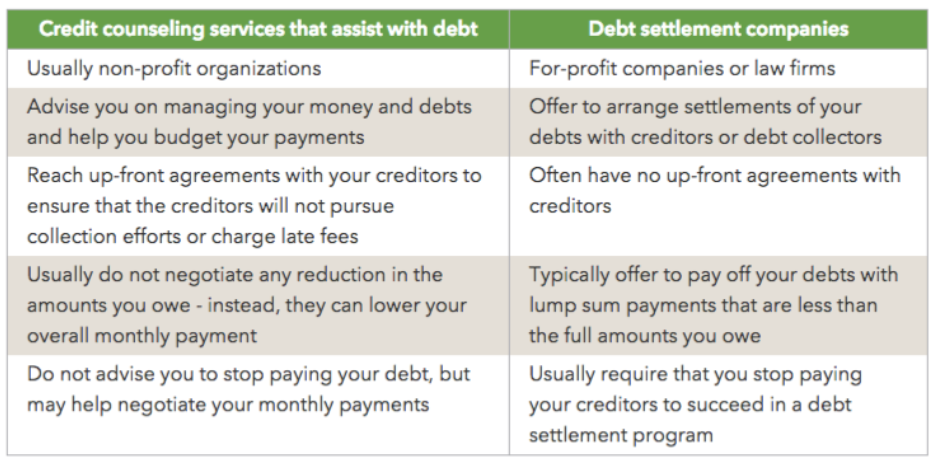
Juanita realized that she needed to explain to Bill how her credit counseling services differed from the debt settlement companies whose commercials he loved. She shared this Youtube video and article with him to deepen his understanding of credit counseling services and help him draw distinctions between the two. Bill went on:
“Juanita, I have to admit that I am even more confused now. I know that you are a credit counselor and that you offer a bunch of services to help me. I am not sure how you differ from that debt settlement firm we saw in the video. You both seem to provide the same set of services. Well, one pretty obvious difference is that they seem to have much better commercials and make claims that have a stronger appeal to me. Also, I don’t understand why they charge me for their service and you’re free. I always thought you got what you pay for so worried that your service isn’t as good. “
1
Help Bill by identifying, in your own words, at least three differences between credit counselors and debt settlement firms.
1
Which service do you think he should choose? Why?
Finally, Bill got very animated discussing how his friend’s recent bankruptcy filing enabled her to walk away from her debts:
“It was hard for me to believe what she was telling me. She had similar debts to me, including credit card, federal student loans and a car loan, and they all got wiped out. Just like that! She gets to keep driving her car and doesn’t have to make any more payments. The crazy thing is that a week later, she got a credit card offer in the mail too, so she will be able to start borrowing again. Oh, and it didn’t cost her anything to accomplish all this. Amazing! This seems like a great route to go, too. Am I missing something?
1
What should Juanita tell Bill that he is missing?
With only ten minutes left in their session, Bill wondered aloud about his best option to get out of his debt dungeon:
“Well, Juanita, we have talked about a lot of different options in the last fifty minutes: debt settlement, consumer credit counseling and bankruptcy. I appreciate you helping me sort out my budget as well as the debt payments that I need to make on a monthly basis too. All very helpful stuff but I am still having trouble sorting all this out. It seems that I could go in a lot of different directions, and all the options seem like good ones. What would you recommend?”
8
Using all of the information provided in this case, as well as your previous knowledge, develop a plan for Bill to tackle his debt demons. Be sure that your plan is very specific and includes the following:
- Recommended changes to his budget and how they will impact his ability to pay down his debt (i.e. how much more money will you free up to make his monthly payments)_______
- Total monthly payments currently required to service his debt_______
- Discussion of pros/cons of the three alternatives (a chart would be useful)_______
- Reason that a particular course of action was selected_______
1
Quinn started receiving notices that they have overdue payments and they are feeling overwhelmed by their debt. They ask you for advice. Of the following strategies, which would be the best strategy for Quinn to try first?- Ignore the notices to avoid overpaying, as the debt will be discharged after 180 days
- Meet with a credit counselor to set up a debt management plan
- File for bankruptcy to eliminate their debts
- Pay a debt settlement company to solve the problem for them
Quinn started receiving notices that they have overdue payments and they are feeling overwhelmed by their debt. They ask you for advice. Of the following strategies, which would be the best strategy for Quinn to try first?
- Ignore the notices to avoid overpaying, as the debt will be discharged after 180 days
- Meet with a credit counselor to set up a debt management plan
- File for bankruptcy to eliminate their debts
- Pay a debt settlement company to solve the problem for them
1
What does a debt consolidation loan do?- Negotiate with your creditors to lower your debt amount
- Combine your existing debts into one loan with one payment
- Create a loan repayment schedule as part of Chapter 13 bankruptcy
- Charge a high one-time fee to forgive all your existing debts
What does a debt consolidation loan do?
- Negotiate with your creditors to lower your debt amount
- Combine your existing debts into one loan with one payment
- Create a loan repayment schedule as part of Chapter 13 bankruptcy
- Charge a high one-time fee to forgive all your existing debts
4
Which of the following statements is TRUE/FALSE about Chapter 7 bankruptcy?
- Chapter 7 bankruptcy requires you to complete a 3-5 year repayment plan on your debts__________
- Chapter 7 bankruptcy is restricted to higher income levels than Chapter 13 bankruptcy__________
- Chapter 7 bankruptcy leaves your credit report after 3 years__________
- Chapter 7 bankruptcy results in you losing assets, like your home or car__________