1
Some economists criticize the New Deal as the beginning of
“Europe’s requirements for the next three or four years of foreign food and other essential products—principally from America—are so much greater than her present ability to pay that she must have substantial additional help or face economic, social, and political [decline] of a very grave character.”
—Secretary of State George Marshall, 1947
What was the main goal of the “help” mentioned by Secretary Marshall?
What is the purpose of the 15th Amendment?
“I am tired of fighting. Our chiefs are killed. Looking Glass is dead. Toohulhulsote is dead. The old men are all dead. It is the young men who say yes or no. He who led the young men is dead.
It is cold and we have no blankets. The little children are freezing to death. My people, some of them, have run away to the hills and have no blankets, no food . . . I want to have time to look for my children and see how many I can find. Maybe I shall find them among the dead.
Hear me, my chiefs. I am tired. My heart is sick and sad. From where the sun now stands, I will fight no more forever.”
—Surrender of Chief Joseph of the Nez Perce, 1877
Chief Joseph was tired of fighting against:
"It is not true that the United States feels any land hunger or entertains any projects as regards the other nations of the Western Hemisphere save such as are for their welfare. All that this country desires is to see the neighboring countries stable, orderly, and prosperous. Any country whose people conduct themselves well can count upon our hearty friendship. If a nation shows that it knows how to act with reasonable efficiency and decency in social and political matters, if it keeps order and pays its obligations, it need fear no interference from the United States. Chronic wrongdoing . . . which results in a general loosening of the ties of civilized society, may in America, as elsewhere, ultimately require intervention by some civilized nation, and in the Western Hemisphere the adherence of the United States to the Monroe Doctrine may lead the United States, however reluctantly, in [obvious] cases of such wrongdoing . . . , to the exercise of an international police power."
—Theodore Roosevelt’s Corollary to the Monroe Doctrine, 1904
Which early twentieth-century leader is best known for supporting women's suffrage?
Equal pay for equal work
Equal opportunities in the job market
Elimination of gender-based discrimination
Which social movement is most aligned with the ideas in this list?
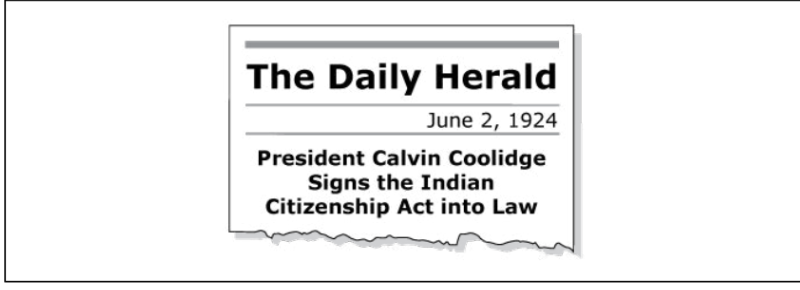
Which statement best describes one effect of the action described in this headline?
Source A
President Roosevelt has cleverly camouflaged a most amazing and startling proposal for packing the Supreme Court. . . . Increasing the number of judges from nine to fifteen would not make this high tribunal act any more promptly than it does now, but it would give the President control of the Judiciary Department.. . . The President is mistaken, if he thinks he can conceal his real purpose of packing, influencing and controlling the Supreme Court . . . The Supreme Court has been the anchor that has held America safe through many storms. Its absolute independence and integrity must never be in doubt.Our Government is composed of three departments, Legislative, Executive and Judiciary. These are the foundations of our Democracy. As a result of the election and the transfer of powers by so-called emergency measures, the Executive now dominates the Legislative Department. The President now proposes also to dominate the Judiciary. Do we want to give to this man or any one man complete control of these three departments of our Government which, from the beginning of the Republic, have been kept entirely separate and independent? This proposal should give every American grave concern for it is a step towards absolutism and complete dictatorial power.
—Frank Gannett, Gannett Publishing, Rochester, New York, February 23, 1937
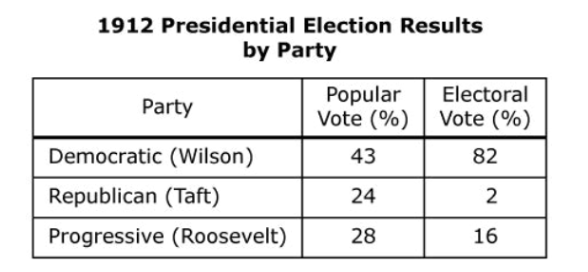
Former Republican President Theodore Roosevelt ran for president on a third-party ticket in 1912. This table best supports which claim about third parties?
“You have a row of dominoes set up, you knock over the first one, and what will happen to the last one is the certainty that it will go over very quickly.”
—President Dwight D. Eisenhower, referring to the spread of communism in Southeast Asia, 1954
Which U.S. action was a direct result of President Eisenhower’s theory about communism in Vietnam?
Executive Order 11,246 (1965) required federal contractors to take affirmative action to recruit and employ minorities.
President Lyndon B. Johnson issued this executive order primarily to
In East Germany and Czechoslovakia, the fall of communism was
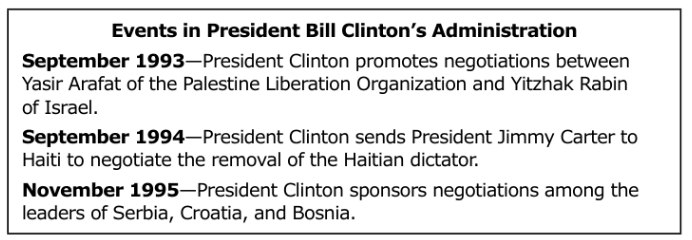
These events best demonstrate President Clinton’s
Which remark made by President George W. Bush during the signing of the Homeland Security Act summarizes the intent of the new department?
During the early 1900s, a group of American writers called muckrakers wrote extensively about corruption, economic inequalities, and social hardships in urban areas in the United States.
How did the work of these writers most affect the United States?
In late 1919 and early 1920, U.S. Attorney General A. Mitchell Palmer authorized a series of government raids to arrest suspected radicals in the United States. The raids became known as the "Palmer Raids" and were considered highly unsuccessful and resulted in the Department of Justice receiving a lot of criticism. In addition, the overall constitutionality of the raids was brought into question.
Based on this information, the government was criticized for failing to
At the height of the 1920s, average Americans spent more and more of their disposable income on major durable consumer goods . . . The advertising industry grew to match. By the end of the 1920s, an increasingly sophisticated advertising industry had integrated new techniques . . . into the marketing process. Marketing efforts accelerated to match businesses’ rapid introduction of new products and services to satisfy consumer markets.
— Library of Congress
Which factor most contributed to the trend described in this excerpt?
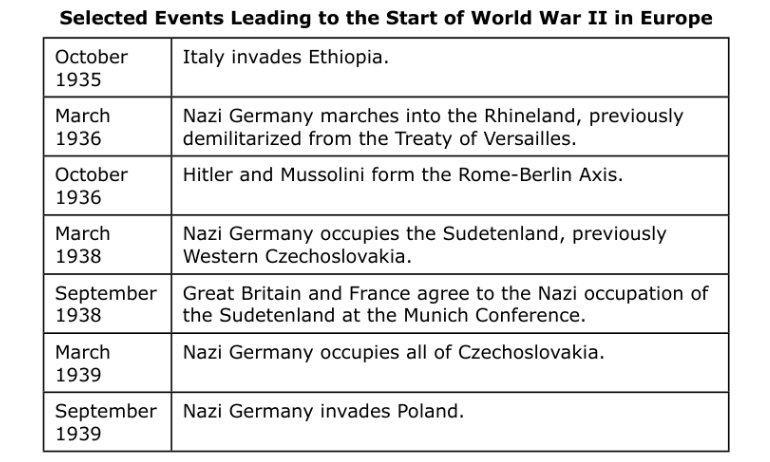
How did the British policy of appeasement and U.S. isolationist policies contribute to these events?
The concept of mutually assured destruction (MAD) developed during the Cold War between the two superpowers, the United States and the Soviet Union. Mutually assured destruction was based on the belief that an attack by one superpower would be met with an overwhelming counterattack by the other. The end result would be that both the attacker and defender would be completely destroyed.
How did this doctrine affect the United States and the Soviet Union?
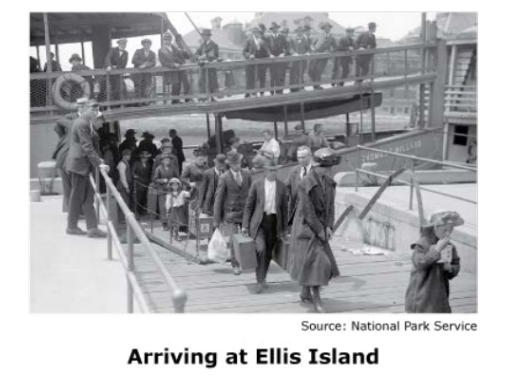
How did this island most contribute to the development of the United States during the early 1900s?
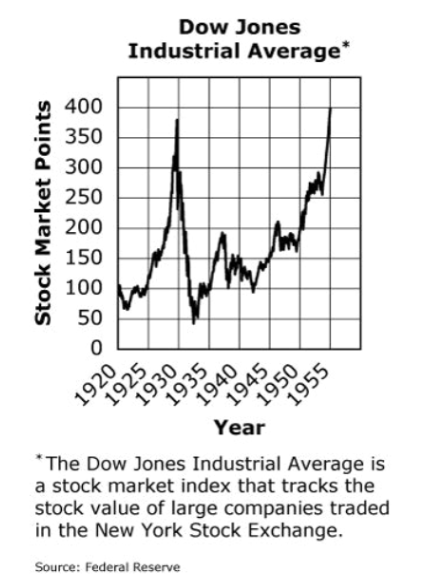
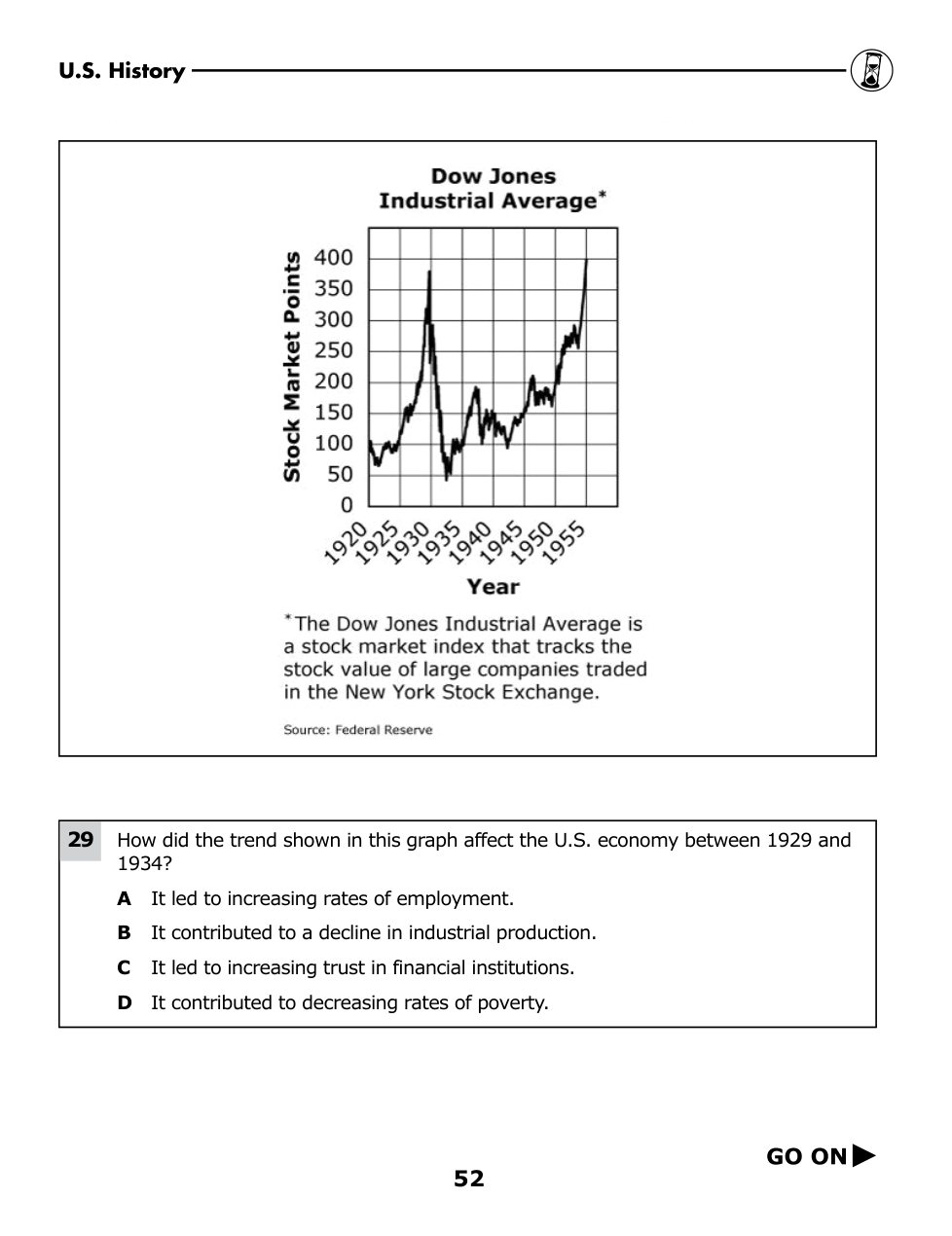
How did the trend shown in this graph affect the U.S. economy between 1929 and 1934?
In the middle of the 20th century, a nationwide movement for equal rights for African Americans and for an end to racial segregation and exclusion arose across the United States. This movement took many forms, and its participants used a wide range of means to make their demands felt. . . . By the end of the 1960s, the civil rights movement had brought about dramatic changes in the law and in public practice, and had secured legal protection of rights and freedoms for African Americans that would shape American life for decades to come.
—Library of Congress
| Draggable item | arrow_right_alt | Corresponding Item |
|---|---|---|
Thurgood Marshall | arrow_right_alt | believed that peaceful protest could help bring about social equality |
Dr. Martin Luther King Jr. | arrow_right_alt | believed that violence was acceptable for achieving social change when it was used in self defense |
Malcolm X | arrow_right_alt | argued the Brown v. Board of Education case and later became a Supreme Court Justice |
The policy described in Source A was used as a justification for American
intervention in:
The creator of Source B would most likely agree with which statement?
The speaker in Source C would most likely agree with which position?
Which conclusion is best supported by Sources A, B, and C?
The plan described in Source A and Source B was intended
Source C supports the idea that many New Deal programs were
The creators of Source A and Source B would most likely agree with which statement?
Which conclusion is best supported by Sources A, B, and C?