Log in
Sign up for FREE
arrow_back
Library

Biology Spring EOC 2025

star
star
star
star
star
Last updated about 2 hours ago
35 questions
Required
1
Required
1
Required
1
Required
1
Required
1
Required
1
Required
1
Required
1
Required
1
Required
1
Required
1
Required
1
Required
1
Required
1
Required
1
Required
1
Required
1
Required
1
Required
1
Required
1
Required
1
Required
1
Required
1
Required
1
Required
1
Required
1
Required
1
Required
1
Question 4
4.

Required
1
Question 6
6.

Required
1
Required
1
Question 9
9.

Question 10
10.

Question 11
11.

Question 12
12.

Question 13
13.

Question 14
14.

Question 15
15.

Question 16
16.

Question 17
17.

Required
1
Question 19
19.

Required
1
Question 21
21.

Question 22
22.

Question 23
23.

Question 24
24.

Required
1
Question 26
26.

Question 27
27.

Question 28
28.

Question 29
29.

Question 30
30.

Question 31
31.

Question 32
32.

Required
1
Question 34
34.

Question 35
35.

Question 1
1.

Question 2
2.

Question 3
3.

DNA replication results in two DNA molecules,
a. each with two new strands.
b. one with two new strands and the other with two original strands.
c. each with one new strand and one original strand.
d. each with two original strands.
Question 5
5.

Which of the following is not part of protein synthesis?
a. replication
b. translation
c. transcription
Question 7
7.

Question 8
8.

Which is an example of an RNA nucleotide?
a. deoxyribose + phosphate + thymine
b. ribose + phosphate + thymine
c. deoxyribose + phosphate + uracil
d. ribose + phosphate + uracil
One similarity between DNA and messenger RNA molecules is that they both contain ________.
a. the same sugar.
b. genetic codes based on sequences of bases.
c. a nitrogenous base known as uracil.
d. double-stranded polymers.
The cell cycle is the
a. period of time between the birth and the death of a cell.
b. time from prophase until cytokinesis.
c. series of events that cells go through as they grow and divide.
d. time it takes for one cell to undergo mitosis.
Right after a bone breaks, cells at the edge of the injury
a. stop dividing.
b. begin to divide rapidly.
c. form a thin layer over the edge of the injury.
d. develop a defect in a gene called p53.
Which event occurs during interphase?
a. DNA replication.
b. Centrioles appear
c. Spindle fibers begin to form
d. Centromeres divide
Jack bought a small turtle. Three months later, the turtle had grown twice its original size. Which of the following statements BEST describes why Jack’s turtle got bigger?
a. Parts of the turtle stretched out as it grew larger.
b. The number of cells in the turtle’s body increased.
c. The turtle’s body absorbed the food it ate and water it drank.
d. The size of each cell in the turtle’s body got bigger as it got older.
The genome of a goldfish contains 96 chromosomes. How many chromosomes will each daughter cell have after meiosis of a goldfish cell is complete?
a. 24
b. 48
c. 96
d. 192
What process is necessary for the inherited traits of an organism to be passed along by sexual reproduction?
a. Mitosis
b. Meiosis
c. Mutation
d. Fission
Which of the following statements correctly describes meiosis?
a. Cells divide only once during meiosis.
b. Meiosis does not occur in reproductive cells.
c. The cells produced at the end of meiosis are genetically identical to the parent cell.
d. The cells produced at the end of meiosis contain half the number of chromosomes as the parent cell.
Question 18
18.

If a body cell in a butterfly contains 24 chromosomes, a butterfly sex cell would contain ______________chromosomes.
a.3
b. 6
c. 12
d. 24
Question 20
20.

Using the property of codominance, cross a red jellyfish with a white jellyfish. What would the color of the offspring be?
a. red
b. white
c. red and white
d. pink
What is the probability that a human offspring will be female?
a. 50% because there are only two alleles for sex chromosomes.
b. 50% because males and females take turns choosing their sex.
c. 50% because male genes are dominant to female genes.
d. 50% because female genes are dominant to male genes.
In Mendelian genetics, round seed pea plants are dominant to wrinkled seed pea plants. What would be the genotypes of the parents in a cross between a homozygous dominant round plant with a homozygous recessive wrinkled plant?
a. Rr and rr
b. Rr and Rr
c. RR and RR
d. RR and rr
Use the property of incomplete dominance. If a red flower is crossed with a white flower, specify the color of the offspring.
a. red
b. white
c. red and white
d. pink
Question 25
25.

Colorblindness is more common in males than females. Why are males more likely to become colorblind?
a. Males have a Y chromosome, which causes colorblindness.
b. Males have one X chromosome while females have two X chromosomes which helps mask colorblindness in females.
c. Males have recessive traits while females have dominant traits.
d. Males are affected by colorblindness through independent assortment.
Charles Darwin made many _____ from around the world that led him to propose how organisms have _____.
a. drawings, stayed the same over generations
b. friends, increased in population size
c. observations, changed over time
d. predictions, changed over time
According to natural selection, individuals that tend to survive are those that have __.
a. characteristics their parents acquired in their lifetime
b. characteristics that plant and animal breeders value
c. the greatest number of offspring
d. variations best suited to the environment
If an organism has high fitness, it is also _____.
a. able to struggle and adapt in every environment.
b. able to struggle and adapt in its environment.
c. able to survive and reproduce in every environment.
d. able to survive and reproduce in its environment.
The theory of evolution is based on change over time because _____.
a. modern organisms have ascended from ancient organisms
b. modern organisms have descended from ancient organisms
c. ancient organisms have ascended from modern organisms
d. ancient organisms have descended from modern organisms
Charles Darwin’s observation that finches of different species on the Galápagos Islands have many similar physical characteristics supports the hypothesis that these finches ____.
a. have the ability to interbreed.
b. acquired traits through use and disuse.
c. all eat the same type of food.
d. descended from a common ancestor.
Speciation can be a result of _____.
a. reproductive isolation of genetic material
b. cloning
c. chance events that maintain relative frequencies
d. natural selection on genotype
Question 33
33.

A volcanic eruption covers an area of brown dirt with black rock. The black mice in the area are able to camouflage and may _____.
a. reproduce more often and increase the relative frequency of black fur genes
b. reproduce less often and decrease the relative frequency of black fur genes
c. genetic drift
d. struggle for existence
Which of these best illustrates natural selection?
a. A population monopolizes all of the resources in its habitat, forcing other species to migrate.
b. The largest organisms in a species receive the only breeding opportunities.
c. An organism with favorable genetic variations will tend to survive and breed successfully.
d. A community whose members work together utilizes all existing resources.
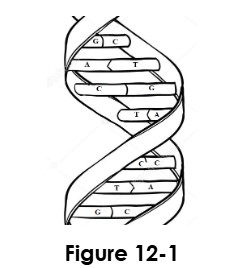
Figure 12–1 shows the structure of a(an)
a. DNA molecule
b. Amino acid
c. RNA molecule
d. Protein
Which statement correctly describes the function of the molecule in Figure 12-1?
a. The molecules speed up replication.
b. The molecule determines the characteristics that will be inherited.
c. The molecule mutates with every cell division.
d. The molecule is inherited from child to parent
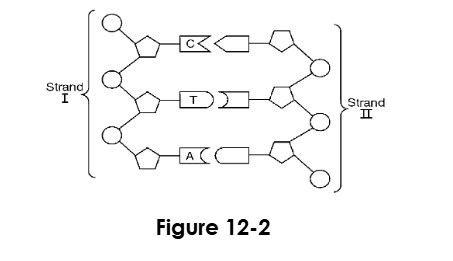
In Figure 12-2, strands I and II represent portions of a DNA molecule. What is the correct sequence of bases for strand II after replication?
a, AGC
b. TCG
c. TAC
d. GAT
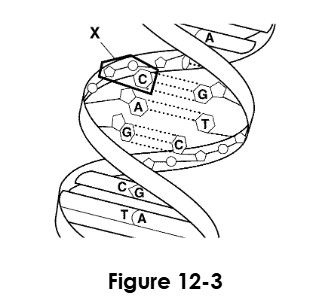
The structure labeled X in Figure 12–3 is a(an)
a. Nucleotide
b. Backbone
c. Base
d. RNA
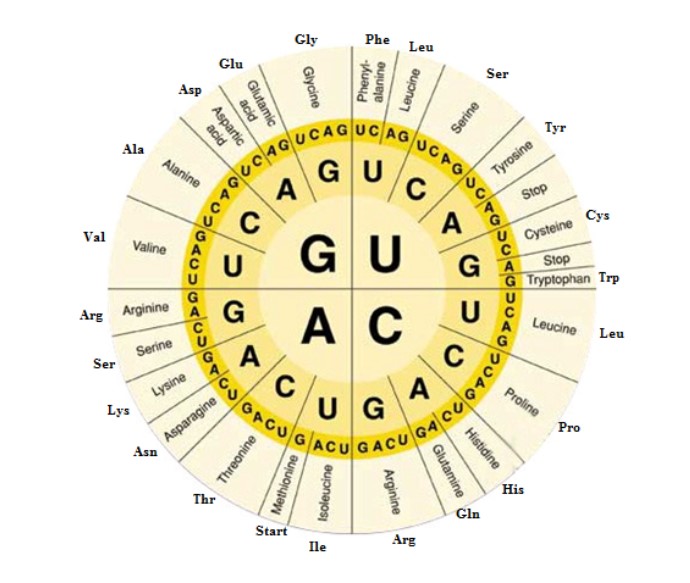
What is the amino acid sequence for the following DNA strand: CCCCGTATG?
a. Pro-Arg-Ile
b. Gly-Ala-Tyr
c. Ile-Leu-Gly
d. Asp-Ser-Val
Which of the following is a possible codon sequence for the following amino acid sequence: His-Val-Ser?
a. ACU-GGU-GCA
b. UAA-CUC-UUG
c. CAU-GUC-UCG
d. CAC-AGG-GAA
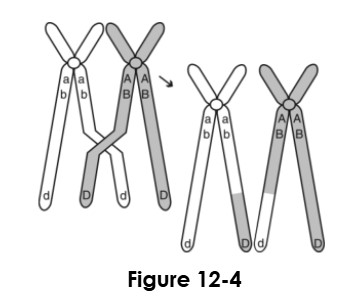
Figure 12-4 shows homologous chromosomes during prophase 1 of meiosis. Which of the following correctly describes the process being illustrated?
a. Mutation in which the DNA content of the gene is altered
b. Segregation of sister chromatids
c. Condensation and segregation of alleles
d. Crossing-over in which alleles are exchanged
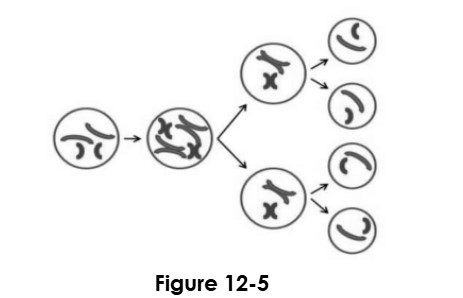
The distribution of chromosomes in one type of cell division is shown in Figure 12-5. Which process and type of resulting cells are represented in Figure 12-5?
a. Mitosis, which produces gametes
b. Mitosis, which produces body cells
c. Meiosis, which produces gametes
d. Meiosis, which produces body cells
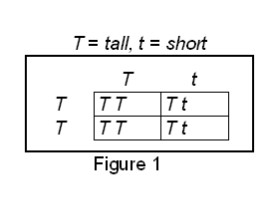
In the Punnett square shown in Figure 1, which of the following is true about the offspring resulting from the cross?
a. About half are expected to be short.
b. All are expected to be short.
c. About half are expected to be tall.
d. All are expected to be tall.
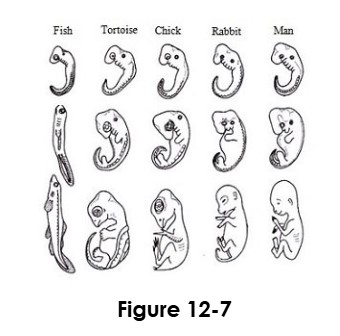
The fact that many vertebrate embryos (Figure 12-7) pass through similar stages of development is evidence for ____.
a. Acquired characteristics.
b. Common ancestor.
c. Use and disuse.
d. Homologous structures.