Log in
Sign up for FREE
arrow_back
Library

Enzymes and digestion

star
star
star
star
star
Last updated 3 months ago
31 questions
2
1
1
1
1
3
1
1
1
10
10
10
4
4
4
4
4
4
4
1
describe biological and chemical processes that maintain homeostasis;
1
describe biological and chemical processes that maintain homeostasis;
1
1
1
1
1
1
1
1
1
1
Question 10
10.

Question 11
11.

Question 12
12.

Question 13
13.

Question 14
14.

Question 15
15.

Label the parts of this diagram showing the catalyzed reaction breaking down hydrogen peroxide into water and oxygen using the terms (A) enzyme, (B) substrate, and (C) products.

Question 16
16.

Question 17
17.

Question 18
18.

Question 19
19.

Question 20
20.

Question 21
21.

Question 22
22.

Question 23
23.

Question 24
24.

Question 25
25.

Question 26
26.

Question 27
27.

Question 28
28.

Question 29
29.

Question 30
30.

The alimentary canal can also be referred to as the .......

Question 31
31.

Question 1
1.

Question 2
2.

Question 3
3.

Question 4
4.
Question 5
5.

Question 6
6.
Question 7
7.

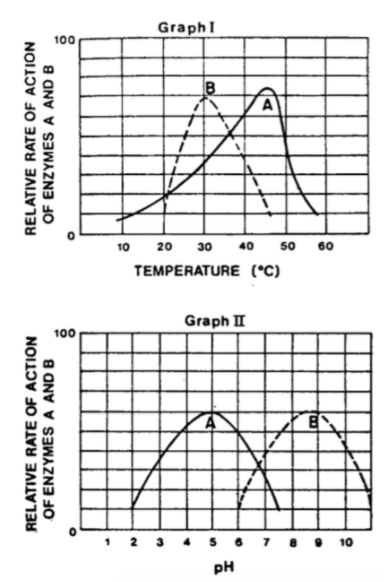
Which enzyme works best in an acidic environment (pH less than 7)

Question 8
8.

Question 9
9.

What happens to the enzyme when the pH increases to high?

Under which conditions is enzyme A most productive?
at 50' C and a pH of 9
at 40'C and a pH of 5
at 45' C and a pH of 5
at 45' C and a pH of 9
Various enzymes in our bodies are:
Lipids
Carbohydrates
Nucleotides
Proteins
Enzymes only work with specific substrates because each enzyme:
Has an active site which only fits substrates with a particular shape.
Can only make ionic bonds.
Cannot change shape.
Becomes denatured when it is heated.
Structural changes in an enzyme can affect its ability to function correctly. This denaturation can occur as a result of _______________.
Extreme temperature change
Change in pH
Addition of substrates
Both A and B are correct
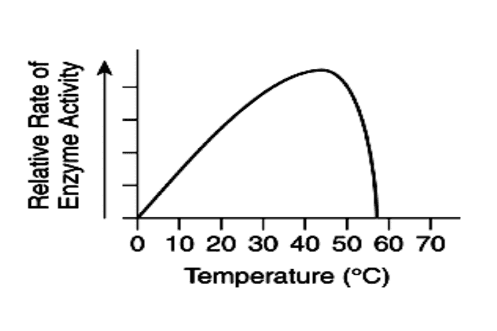
What is the optimal temperature for this enzyme?
20℃
32℃
45℃
60℃
In the lock and key model of of enzyme function shown above, what is happening in step 2?
The enzyme is causing new bonds to form between the substrate
The substrates are beginning to bind to the enzyme
The active sites are restructuring the enzyme.
The catalyzed reaction is releasing a product.
Some bacteria live in hot springs. Their cells contain enzymes that function best at temperatures of 70 °C or higher. At the temperature of 50 °C, how will the enzymes in these bacterial cells most likely be affected?
The enzymes will be destroyed by lysosomes.
The enzymes will lose their bond structure and fall apart.
The enzymes will require less energy to function than at 70 °C.
The enzymes will not increase the rate of reactions as much as they would at 70 °C.
As food travels through the digestive system, it is exposed to a variety of pH levels. The stomach has a pH of 2 due to the presence of hydrochloric acid (HCl), and the small intestine has a pH ranging from 7 to 9. HCl converts pepsinogen into pepsin, an enzyme that digests proteins in the stomach. Which of the following most likely happens to pepsin as it enters the small intestine?
It begins to replicate
It becomes inactive
Its shape changes to engulf large proteins
Its activity increases to digest more proteins.
You are analyzing a compound in the laboratory. You find that it is made up of carbon, hydrogen, and oxygen in a ratio of two hydrogen atoms for each carbon atom. How will you classify the compound?
Lipid
Carbohydrate
Nucleic Acid
Protein
Fats, oils and cholesterol are all types of what?
Lipids
Nucleic Acid
Carbohydrates
Proteins
The enzyme lactase will break down the sugar lactose into which of the following components? (hint: look at the -ose ending of lactose)
Lipids
Nucleic Acids
Carbohydrates
Proteins
Which sequence shows the pathway that food takes in the digestive system?
stomach, esophagus, large intestine, small intestine
esophagus, stomach, large intestine, small intestine
stomach, esophagus, small intestine, large intestine
esophagus, stomach, small intestine, large intestine
Which of the following system breaks food into nutrients that can be used by the body?
circulatory
digestive
respiratory
reproductive
The digestion process begins in which of the following?
large intestine
mouth
small intestine
stomach
Which best describes the role of the esophagus in digestion?
It releases acid and mixes the food.
It aids in absorption of nutrients from food.
It carried food from the mouth to the stomach.
It carries food from the stomach to the intestines.
What does the stomach do for the body?
It chews food.
It breaks food down.
It swallows food.
None of the above
What is the primary function of the large intestine?
to digest proteins
to absorb nutrients
to beak down complex carbohydrates
to remove water from undigested waste
Look at the diagram above and answer the question below.
1 and 2
2 and 3
3 and 4
1 and 4
The digestive deconstructs food both mechanically and chemicaly.
True
False
The process of digestion starts where?
the small intestines
the large intestines
the mouth, by chewing food.
This is the
substrate
enzyme
active site
This is the
substrate
enzyme
active site
This is the
substrate
enzyme
active site
D
A
B
C
D
At what temperature does this enzyme work the fastest?
0
20
40
60
A
B
C
D
Which enzyme works best in a neutral environment?
chymrotrypsin
pepsin
both enzymes