Log in
Sign up for FREE
arrow_back
Library

Sci- C3 Ecology Performance Task

star
star
star
star
star
Last updated about 3 hours ago
10 questions
Why is This Rhino Picking Up Hitchhikers?
Required
2
Required
2
Required
2
Required
2
Required
4
How Is Temperature a Hurdle for Turtles?
Required
2
Required
2
Required
2
Required
2
Required
5
Question 1
1.

Question 2
2.

Question 3
3.

Question 4
4.

Question 5
5.

Question 6
6.

Question 7
7.

Question 8
8.

Question 9
9.

Question 10
10.

Oxpeckers are __________ of parasites meaning that they hunt and eat them.
predators
relatives
competitors
prey
Which relationship is most similar to the rhino and oxpecker?

Relationship A:
Ticks suck the blood of a deer. The tick gets nutrients and the deer loses them.

Relationship B:
Dotted humming frogs live in black tarantula burrows.
The frog protects the tarantula’s eggs and gets a place to live.

Relationship C:
Lions hunt gazelles on the plains and feast as a family.
Relationship C
Relationship B
All of these relationships are like the relationship between the rhino and the oxpecker.
Relationship A
What might happen to the rhino population if oxpeckers were removed from their ecosystem?
Rhinos would have more parasites on their skin, leading to potential health problems.
Rhinos would start eating the parasites instead of grass and plants.
Rhinos would become more aggressive toward other animals.
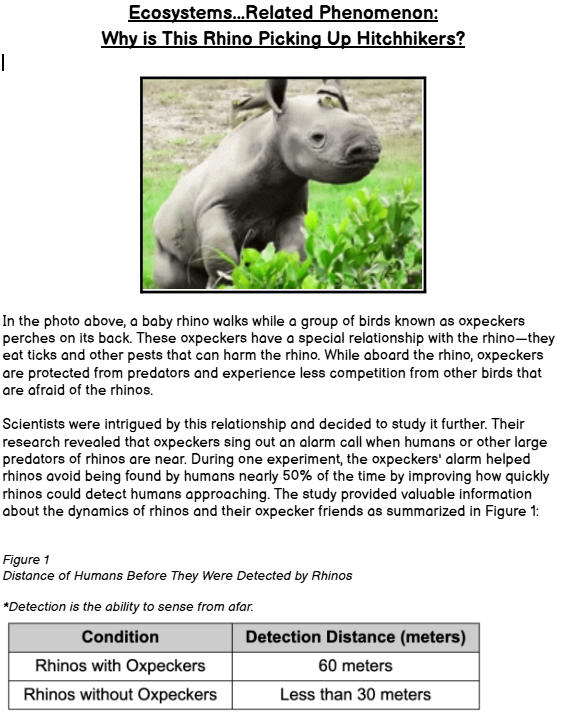
Based on Figure 1 and and the second paragraph in the document, predict the rhino’s reaction time to a predator if there were no oxpeckers:
Rhinos would detect the predator at the same distance as with an oxpecker and have the same time to react and the same risk of being caught.
Rhinos might detect the predator when they are at a further distance and have more time to react, decreasing their risk of being caught.
Rhinos might detect the predator when they are at a closer distance and have less time to react, increasing their risk of being caught.
There is not enough information to determine what would happen to the rhino's reaction time if there were no oxpeckers.
Read each paragraph carefully.
Determine which one best explains why rhinos allow oxpeckers to ride on their backs using supporting details and evidence from the documents.

Rhinos allow oxpeckers to ride on their backs because they benefit from it. Oxpeckers help the rhino in many ways. The oxpecker benefits from this relationship too.
Rhinos allow oxpeckers to ride on their backs because the oxpeckers clean dirt off of the skin of the rhinos. Without the oxpeckers, the rhinos skin can become infected and cause disease. Rhinos also want to protect the oxpeckers from the predators that hunt oxpeckers.
Oxpeckers ride on the backs of rhinos because they like the protection that they get from the large animal. The rhinos do not mind having the birds on their backs because the birds are so light that the rhino barely feels them. Humans have been able to observe this relationship between oxpeckers and rhinos from distances of less than 30 meters.
Rhinos allow the oxpeckers to ride on their backs because they help the Rhino. The oxpecker benefits too. Oxpeckers helps the rhino by eating harmful pests that are on it. Oxpeckers also signal when predators of the rhino are nearby.
Which is the most likely reason sea turtles migrate south every fall?
To avoid rapid changes in the temperature of their environment
To find a different food source so they can add variety to their diet
To escape from predators
To avoid periods of increased precipitation
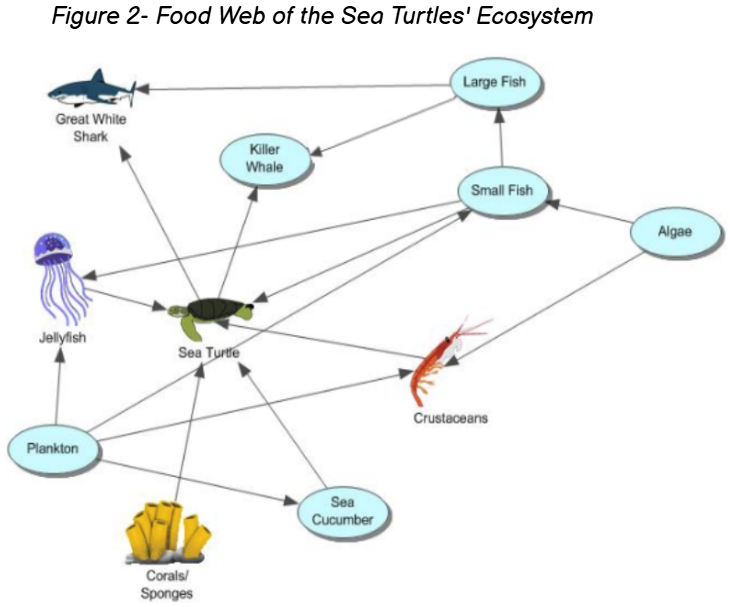
How might the cold-stunning of turtles affect the population of algae?
The population of algae will decrease because there will be more crustaceans to eat them
There would be no change to the population of the algae.
The killer whales and great white sharks will eat the algae because they won't have any sea turtles to eat.
The population of algae will increase because turtles eat algae and the population of turtles will decrease.
Using the data in Figure 2, is it possible for cold snaps to ultimately affect the population of Great White Sharks?
No; cold snaps only affect the population of sea turtles.
Yes; the sharks are likely to become cold-stunned and die.
Yes; decreased populations of sea turtles could leave the sharks without enough food to eat.
No; air temperature has no effect on water temperature so the water habitat will not be affected.
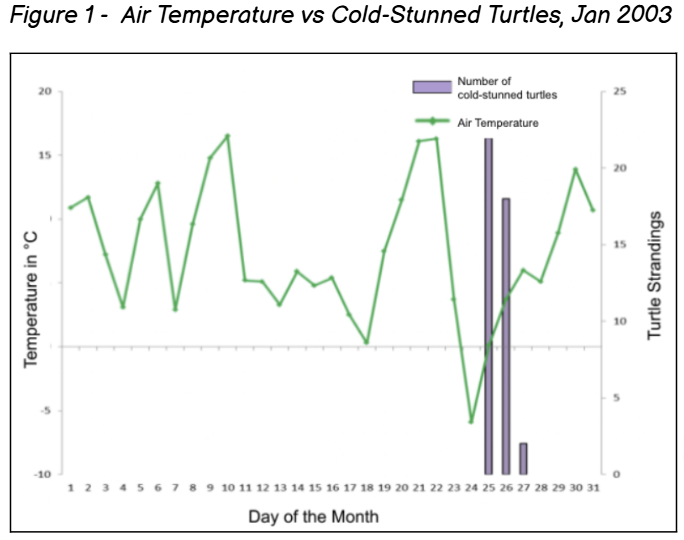
Which of these statements accurately describes a pattern seen in the data in Figure 1?
As temperature decreases, the number of cold-stunned turtles decreases
No trend can be identified in this data
Turtles were only stranded in periods when the temperature dropped below 0℃
As temperature decreases, the number of cold-stunned turtles increases
Off the coast of Florida, there is a place called Mosquito Lagoon. It is predicted that Mosquito Lagoon is going to have a cold winter this year, causing at least two cold snaps.

Select from the choices below some of the things that may happen if these cold snaps occur.
(Choose 5)
The number of jellyfish will increase
The population of sea turtles will increase
The population of sea cucumbers will increase
The population of small fish will decrease
The number of sea turtles will decrease
The population of crustaceans will decrease
The population of corals and sponges will increase
Great white sharks and killer whales will need to find another food source