1
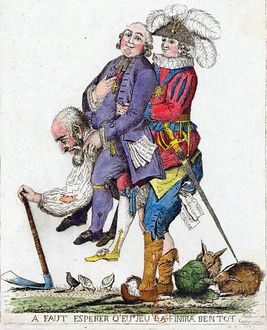
This drawing illustrates conditions that contributed primarily to the beginning of the
This drawing illustrates conditions that contributed primarily to the beginning of the
1
This is a ruler with complete authority over the government and lives of the people.
Match Each Ruler to their corresponding country
| Draggable item | arrow_right_alt | Corresponding Item |
|---|---|---|
King of England | arrow_right_alt | King Phillip II |
King of Spain | arrow_right_alt | King Louis XIV |
King of France | arrow_right_alt | Peter the Great |
Czar of Russia | arrow_right_alt | King Henry VIII |
Who was the last of Henry VIII's children to rule England?
Phillip II of Spain believed it was his duty to defend this branch of Christianity.
What were some of Phillip II's accomplishments as king of Spain?
Louis XIV built this palace as a symbol of Frances wealth and power.
King Louis XIV was also know as what?
What is Divine Right?
Who modernized Russia bringing better shipbuilding, gov't, manufacturing, city planning, music, and fashion
Who was the monarch of England when Phillip II went to war with his Spanish Armada and lost?
Peter the Great moved the capital city of Russia from Moscow to St. Petersburg to:
Peter the Great implemented this to make Russia stronger
This absolute monarch weakened his nobles by forcing them to live with him and occupied them with ridiculous tasks.
Who responded to Elizabeth I's support of protestant uprisings (Balance of Power) by sending his armada to invade England?
Extreme spending on his estate and wars led to debt for this monarch's country and they lost power in Europe.
What did Peter the Great place a tax on after his tour through Europe.
Which country provided financial support and recognition for the United States during the American Revolution?
What was a major reason for the growing estrangement between the British crown and its North American colonies?
What event on December 16, 1773, escalated tensions between American colonies and Britain?
Identify the Intolerable Acts under which the colonists were required to house British soldiers.
What was the famous phrase to come out of the Battle of Lexington
How many British colonies formed the USA?
What was the name given to American colonists who supported Great Britain during the American Revolution?
According to the Theory of Mercantilism the
The American Revolution and French Revolution were similar in that both
This philosopher separated the government into three branches of government and argued for separation of powers.
Enlightenment thinkers contributed to changes in relationships between citizens and governments through their belief that
The Declaration of the Rights of Man and of the Citizen includes several Enlightenment ideas. Which of the following is not one of the Enlightenment ideas incorporated into the document?
Who makes up the Third Estate?
Why did members of the Third Estate take revolutionary action?
John Locke believed that the government had an obligation to the people it governed to protect their natural rights. If the government failed to do this, then the people had the right to
Which of the following is not an idea from the Enlightenment?
The philosopher who believed that all people are born free and equal, with the rights to life, liberty, and property was
This was the period under Maximilian Robespierre when revolutionary courts were set up to prosecute enemies of the French Revolution.
Enlightenment philosophes such as John Locke and Jean Jacques Rousseau challenged the idea of the divine right of kings. They wrote about a government’s obligations to uphold people’s rights and how the government should be based on the consent of the governed. These new ideas encouraged people to:
Intellectual movement that stressed reason and the power of individuals. It challenged modern forms of government and asked what the ultimate purpose of a government should be.
Who made up the Second Estate?
What is the significance of the Tennis Court Oath?
This man was the leader of The Committee of Public Safety who believed in active citizenship and turning in “enemies of the Revolution.” He led during the infamous Reign of Terror, finally losing his own head to the guillotine.
This individual become a national hero for his role in the defeat of Austria. He constructed a coup d ’tat to take over the French government.
Who made up the First Estate?
This drawing illustrates conditions that contributed primarily to the beginning of the
Declaration of the Rights of Man and the Citizen—1789
Approved by the National Assembly of France, August 26, 1789
Articles:
1. Men are born and remain free and equal in rights. Social distinctions may be founded only upon the general good.
2. The aim of all political association is the preservation of the natural and imprescriptible [inalienable] rights of man. These rights are liberty, property, security, and resistance to oppression. . . .
Which of the following individuals most strongly influenced the ideas in the excerpt of the Declaration of the Rights of Man and the Citizen above?
| Draggable item | arrow_right_alt | Corresponding Item |
|---|---|---|
Native Americans/Slaves | arrow_right_alt | People born in Spain who could hold the highest offices in the New World. |
Mulattos | arrow_right_alt | Spanish people who were born in the New World. Along with the Peninsulares, they controlled most of the wealth. |
Peninsulares | arrow_right_alt | People born of European and Native American Ancestry |
Mestizos | arrow_right_alt | People of African and European ancestry. |
Creoles | arrow_right_alt | Most numerous, and contained the least amount of rights. |
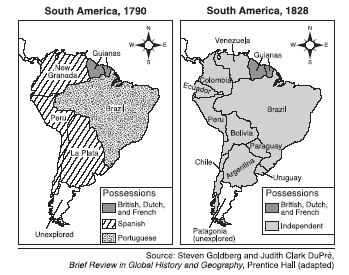
Based on a comparison of these maps of South America, which conclusion is accurate?
August 29, 1793
Brothers and friends.
I am Toussaint L’Ouverture, my name is perhaps known to you. I have undertaken vengeance. I want Liberty and Equality to reign in San Domingo. I work to bring them into existence. Unite yourselves to us, brothers, and fight with us for the same cause, etc. . . .
Which statement describes the author’s purpose for writing this letter?
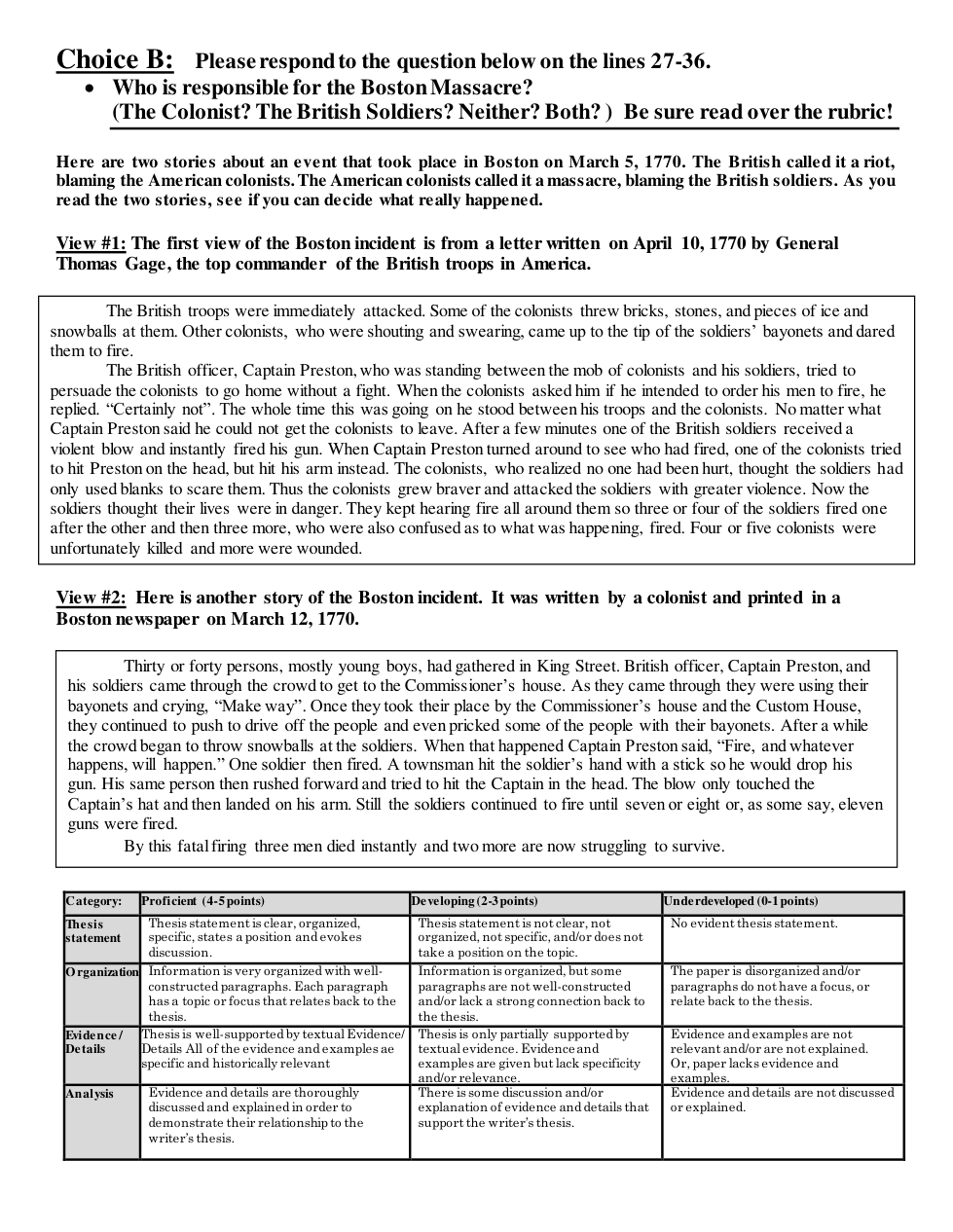
Who is responsible for the Boston Massacre? (The Colonist? The British Soldiers? Neither? Both?) Be sure to read over the rubric!
What the point of view of the author of this drawing?
Which of the following states the point of view of the authors of the Declaration of the Rights of Man and the Citizen?
Identify the best use of this document for a historian.
Which individual is most closely associated with the changes indicated on these maps?
Identify one effect of Toussaint L’Ouverture’s letter.
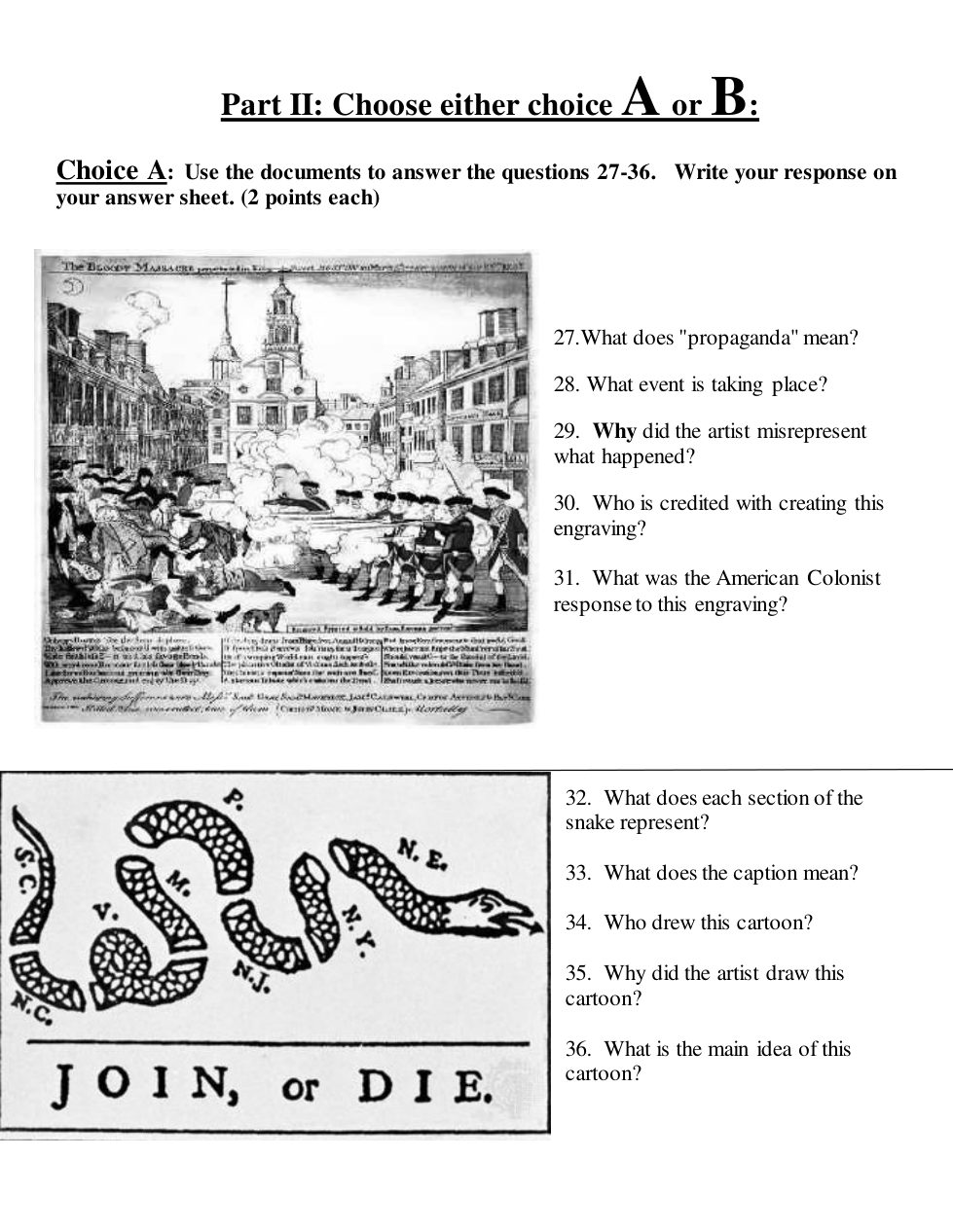
Use the documents to answer the questions 27-36. Write your response on your answer sheet. (2 points each)
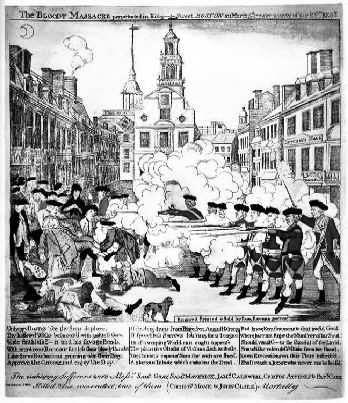
What does "propaganda" mean?
What event is taking place?
Why did the artist misrepresent what happened?
Who is credited with creating this engraving?
What was the American Colonist response to this engraving?
What does "propaganda" mean?
What event is taking place?
Why did the artist misrepresent what happened?
Who is credited with creating this engraving?
What was the American Colonist response to this engraving?
What does each section of the snake represent?
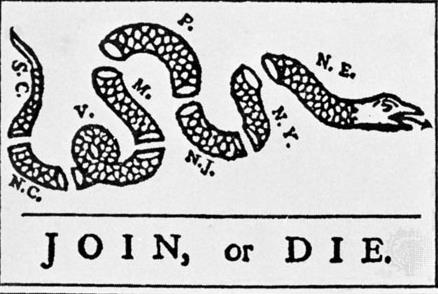
What does the caption mean?
Who drew this cartoon?
Why did the artist draw this cartoon?
What is the main idea of this cartoon?