Log in
Sign up for FREE
arrow_back
Library

UNIT 2 DIRECT STUDY GUIDE - EXPLORATION & COLONIZATION

star
star
star
star
star
Last updated 11 months ago
50 questions
Required
2
Required
2
Required
2
Required
2
Required
2
Required
2
Required
2
Required
2
Required
2
Required
2
Required
2
Required
2
Required
2
Required
2
Required
2
Required
2
Required
2
Required
2
Required
2
Required
2
Required
2
Required
2
Required
2
Required
2
Required
2
Required
2
Required
2
Required
2
Required
2
Required
2
Required
2
Required
2
Required
2
Required
2
Required
2
Required
2
Required
2
Required
2
Required
2
Required
2
Required
2
Required
2
Required
2
Required
2
Required
2
Required
2
Required
2
Required
2
Required
2
Required
2
Question 1
1.

Question 2
2.

Question 3
3.

Question 4
4.

Question 5
5.

Question 6
6.

Question 7
7.

Question 8
8.

Question 9
9.

Question 10
10.

Question 11
11.

DIRECTIONS: Multiple Choice Indicate the answer choice that best completes the statement or best answers the question.
Question 12
12.

Question 13
13.

Question 14
14.

Question 15
15.

Question 16
16.

Question 17
17.

Question 18
18.

Question 19
19.

Question 20
20.

Question 21
21.

Question 22
22.

Question 23
23.

Question 24
24.

Question 25
25.

Question 26
26.

Question 27
27.

Question 28
28.

Question 29
29.

UNIT 2 VOCAB - Select the answer choice that matches the definition listed
Question 30
30.

Question 31
31.

Question 32
32.

Question 33
33.

Question 34
34.

Question 35
35.

Question 36
36.

Question 37
37.

Question 38
38.

Question 39
39.

Question 40
40.

Question 41
41.

Question 42
42.

Question 43
43.

Question 44
44.

Question 45
45.

Question 46
46.

Question 47
47.

Question 48
48.

Question 49
49.

Question 50
50.

1. How did the Crusades contribute to the Age of Exploration?
by proving to Europeans that the world was round
by increasing the power of the Protestant churches
by forcing Protestants to flee Europe
by stimulating European trade with Asia
2. By the 1300s, Italian city-states had become economic and cultural centers because of their
rejection of Roman Catholicism
central location along the Mediterranean Sea
extensive overland trade routes to China
sea trade with the Middle East and India
3. Which of the following had the greatest impact on the increasing accuracy of maps during the Renaissance?
the rediscovery of classical works
reports from traders and travelers
the consolidation of royal power
scientific advances in astronomy
4. Which two European powers were the first to explore the world extensively by sea?
England
France
Portugal
Spain
5. Which of the following was most responsible for the terrible epidemics suffered by the Aztec?
Ferdinand Magellan’s crew’s circumnavigation of the world
Hernán Cortés’s conquests in Mexico
Hernando de Soto’s exploration of modern-day Florida
Christopher Columbus’s exploration of Hispaniola and Cuba
6. Which conquistador was most successful in making Spain wealthy with gold from the Americas?
Francisco Vázquez de Coronado
Álvar Núñez Cabeza de Vaca
Francisco Pizarro
Juan Ponce de León
7. Why are colonies important for countries that practice mercantilism?
They provide raw materials for the home country to manufacture goods.
They make it unnecessary for businesses in the home country to become monopolies.
They create a market for products made by the home country.
They make it easier for the home country to trade bullion for raw materials.
8. In addition to finding gold and other sources of wealth, the first Spanish settlers in the Americas
wanted to found new nations apart from Spain
fled Europe to escape religious persecution
hoped to learn much about Native American religions
hoped to convert Native Americans to Christianity
9. Which of the following show the results of the Columbian Exchange?
Corn became an important part of the Native American diet
Tobacco smoking became popular in Europe and Asia
Farming began to take hold in parts of the Middle East.
Horses allowed Native Americans to travel more quickly.
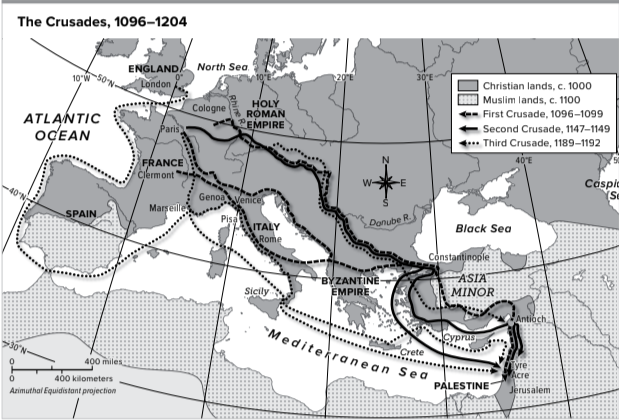
10. Based on your knowledge and the map, which of the following most directly resulted from the events shown?
spread of Islam into parts of Europe
Growth & prosperity of Italian city-states
increased trade between Africa & Asia
rebirth of intellectual curiosity in Europe
11. Because of events shown on the map,
new goods were introduced to Europeans
poverty spread throughout the Mediterranean region
European interest in faraway places increased greatly
European Christians became more tolerant of different religious beliefs
12. Which of the following first caused Europeans to become more interested in Asia?
the rise of Italian city-states as economic centers in the 1300s C.E.
military expeditions made by Europeans to the Holy Land beginning in the 1000s C.E.
the spread of Islam throughout the Middle East and Africa beginning in the 600s C.E.
the fall of the Roman Empire in 476 C.E.
13. Why did Portugal search for new trade routes to Asia along the African coast?
Portugal did not have a port on the Mediterranean Sea.
The journey from Portugal to Asia was shorter along the African coast.
Portugal wanted to gain control of the African slave trade.
The Portuguese hoped to learn about trade routes from African merchants.
14. What was an effect of mercantilism on the colonies in the 1600s?
It discouraged the private ownership of property in the Americas.
It led to fierce rivalry between European nations over territory in the Americas.
It caused Christianity to spread quickly among the native peoples of the Americas.
It forged an alliance between Spain and Portugal against the other colonial powers.
15. A desire to spread Christianity was one reason for European exploration. Which two forms of Christianity were rivals in the exploration of the Americas?
Roman Catholicism and Lutheranism
Protestantism and Judaism
Roman Catholicism and Protestantism
Lutheranism and Protestantism
16. Most English and Dutch colonies in North America were situated
along the Mid-Atlantic coast
in the southwest
along the Great Lakes
in the southeast
17. In the 1500s and early 1600s, explorers from England, France, and the Netherlands hoped to find
a way to reach Asia by sailing around Africa.
the “fountain of youth” mentioned in Native American legend.
a sea route between the Atlantic and Pacific Oceans.
the elusive “Silk Road” that linked Europe to China.
18. After Europeans began colonizing the Americas, chickens changed the diet of many Native American peoples. This is an effect of
the Columbian Exchange
merchantillism
the Reformation
peninsulares
19. In contrast to other European colonizers, French colonists in North America
did not try to convert Native Americans to Christianity.
had no interest in finding a Northwest Passage
arrived more quickly and in much greater numbers
had generally good relations with Native Americans
20. Which explorer was most responsible for making Portugal the “marketplace of Europe”?
Bartolomeu Dias
Vasco da Gama
Marco Polo
Christopher Columbus
21. What is one way in which Columbus’s explorations impacted the Americas?
Native peoples of the Americas quickly adopted European lifestyles.
Native peoples of the Americas began losing control of their lands.
Native peoples of the Americas largely abandoned their territory to live in Europe.
Native peoples of the Americas formed military alliances with European nations.
22. What is one reason Spain’s monarchs supported Christopher Columbus’s explorations?
They hoped to launch a new crusade against Islam.
They wanted to find new markets for Spanish goods.
They wanted a new source of labor for Spanish plantations.
They wanted to spread Protestantism to Asia.
23. How did Amerigo Vespucci’s voyages impact European knowledge of the world?
Europeans accepted that there was no direct western route to Asia.
Europeans recognized that South America was a continent, not part of Asia.
Europeans learned that it was possible to sail completely around the world.
Europeans learned that many wealthy civilizations lived in the Americas.
24. What was the purpose of the Treaty of Tordesillas?
It gave Portugal complete control of the African slave trade.
It ended a war between Portugal and England over control of North America.
It limited exploration of North America to the east coast.
It divided claims in the Americas between Spain and Portugal.
25. Which explorer’s stories of China’s fabulous wealth inspired other Europeans to search for sea routes to Asia?
Prince Henry
Bartolomeu Dias
Kublai Khan
Marco Polo
26. What was a major characteristic of the Renaissance?
a sharp decline of trade between Europe and Asia
a “turning inward” and a loss of interest in exploration
a renewed reliance on religious belief rather than reason
a renewed interest in culture and learning
27. During the Renaissance, which of the following contributed to Europe’s desire to explore?
Strong monarchs sought ways to increase trade to make their countries wealthier.
Scientists wanted to establish once and for all that the Earth was round.
Small, weak city-states needed additional income to compete with larger nations.
A system of national laws increasingly replaced local rule.
28. By the 1400s, which nations began to rival Italy as leaders in trade and exploration?
France and England
Greece and Spain
England and Portugal
Portugal and Spain
29. Which technological innovation allowed sailors to use the position of stars to plan a course?
Telescope
Compass
caravel
astrolabe
30. A reawakening of culture and intellectual curiosity in Europe from the 1300s to the 1600s.
armada
astrolabe
caravel
tenant farmer
Renaissance
Columbian Exchange
Reformation
Mercantilism
Northwest Passage
31. An instrument that uses positions of the stars to plan a course
astrolabe
armada
caravel
Renaissance
Mercantilism
Northwest Passage
Reformation
tenant farmer
Columbian Exchange
32. A small, fast Portuguese ship used during the age of exploration and usually having 3 sails.
astrolabe
Columbian Exchange
caravel
armada
Reformation
Mercantilism
Northwest Passage
Renaissance
tenant farmer
33. An economic theory that a nation's power depends on its ability to increase wealth by accumulating precious metals.
armada
Renaissance
astrolabe
Columbian Exchange
tenant farmer
Reformation
caravel
Mercantilism
Northwest Passage
34. A religious movement in the 1500s that rejected or changed some Roman Catholic teachings and practices and established the Protestant Church
Reformation
Northwest Passage
tenant farmer
caravel
Mercantilism
astrolabe
Columbian Exchange
Renaissance
armada
35. A fleet of warships
armada
Columbian Exchange
astrolabe
Renaissance
Reformation
tenant farmer
Mercantilism
caravel
Northwest Passage
36. A global trade of people, goods, technology, ideas, and diseases that occurred during the 1500s & 1600s.
Renaissance
caravel
Northwest Passage
armada
Columbian Exchange
Reformation
tenant farmer
astrolabe
Mercantilism
37. A much-sought sea route between the Atlantic and Pacific oceans, located along the north coast of North America.
astrolabe
tenant farmer
caravel
Columbian Exchange
Renaissance
Northwest Passage
Mercantilism
Reformation
armada
38. An instrument that uses positions of the stars to plan a course
Northwest Passage
caravel
Mercantilism
Reformation
Columbian Exchange
tenant farmer
armada
astrolabe
Renaissance
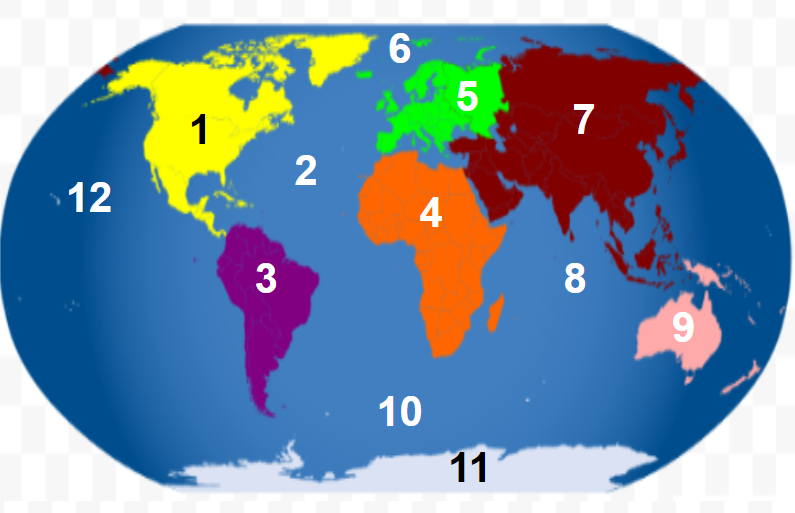
39. What is #1?
West America
America
North America
South America
40. What is #2?
Indian Ocean
Arctic Ocean
Atlantic Ocean
Pacific Ocean
41. What is #3?
Atlantic Ocean
South America
Indian Ocean
Brazil
42. What is #4?
Africa
Europe
Brazil
Australia
43. What is #5?
England
Africa
Asia
Europe
44. What is #6?
Atlantic Ocean
North Sea
Arctic Ocean
Southern Ocean
45. What is #7?
China
Europe
Africa
Asia
46. What is #8?
Southern Ocean
Atlantic Ocean
Arctic Ocean
Indian Ocean
47. What is #9?
Brazil
Europe
Australia
Africa
48. What is #10?
Atlantic Ocean
Indian Ocean
Southern Ocean
Arctic Ocean
49. What is #11?
Tundra
North Pole
South Pole
Antarctica
50. What is #12?
Southern Ocean
Specific Ocean
Pacific Ocean
Atlantic Ocean